Third-Party Risk Management (TPRM) for SaaS Vendors: A 2026 Guide
Hemant Wadhwani · August 2, 2026
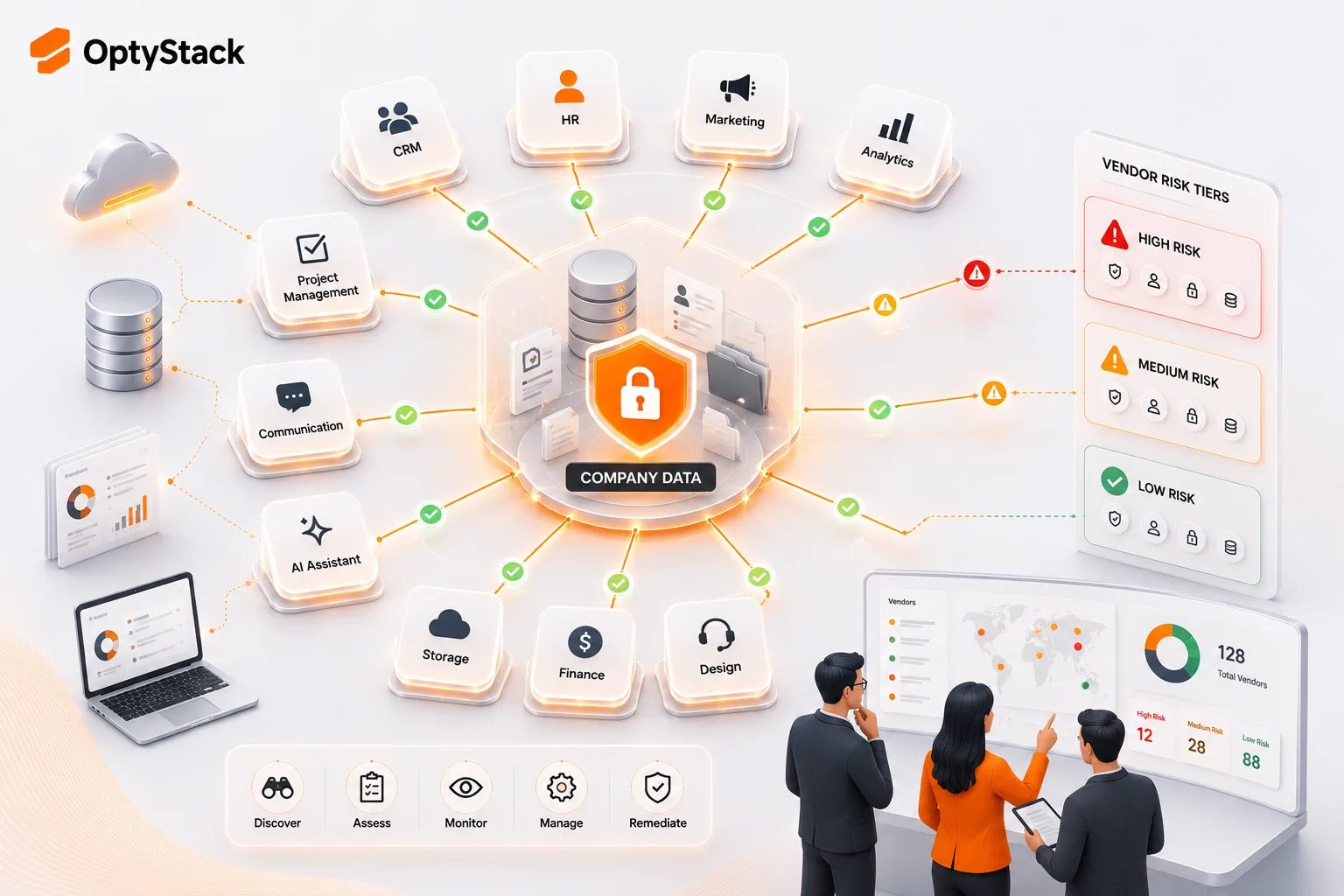
Every SaaS vendor you use is a door into your data — and a majority of breaches now involve a third party. This is the 2026 guide to third-party risk management for SaaS: the lifecycle, how to tier vendors by risk, and why annual SOC 2 collection isn't enough.
Third-Party Risk Management (TPRM) for SaaS Vendors: A 2026 Guide
Quick answer: Third-party risk management (TPRM) for SaaS is the practice of identifying, assessing, and continuously monitoring the security and compliance risk that every SaaS vendor introduces to your data and systems. It matters because a majority of breaches now involve a third party — and every SaaS tool you adopt is, by definition, a third party with access to some slice of your company. Effective TPRM starts with a complete inventory of every vendor, tiers each by how much data and criticality it carries, runs due diligence proportional to that risk, and re-checks posture over time rather than once at signing.
Here's a question most companies can't answer confidently: how many third-party vendors currently have access to your company's data? Not the ones procurement formally vetted — all of them, including the design tool marketing signed up for, the AI assistant an analyst connected to your Google Workspace, and the analytics platform an engineer wired in last quarter. Each of those is a third party. Each is a potential path to your data. And in most organizations, nobody has the full list.
That gap is what third-party risk management exists to close. This guide explains what TPRM means in a SaaS-first world, why the risk has exploded, and how to build a program that's proportionate, continuous, and actually maintainable — instead of a compliance checkbox that gives you a false sense of safety.
What is third-party risk management (in a SaaS context)?
Third-party risk management is the discipline of understanding and controlling the risk that outside parties introduce when you trust them with your data, your systems, or your operations. Classic TPRM grew up around suppliers, contractors, and outsourced services. In 2026, the dominant category of third party is your SaaS stack.
Here's why that reframing matters. When you adopt a SaaS tool, you're not just buying software — you're handing an external company some level of access to your information. A CRM holds your customer data. A support tool holds your users' messages. An AI assistant reads whatever you paste into it. A tool connected via OAuth can often read, and sometimes write, across systems it was never obviously granted. Every one of these vendors sits inside your trust boundary, whether or not anyone formally decided to put them there.
So TPRM for SaaS isn't a niche security exercise. It's the practice of governing that trust boundary: knowing who's inside it, how much they can touch, whether they're trustworthy enough to be there, and what happens when they should no longer be. In the broader SaaS governance framework, this is the engine of the Security & Risk pillar — the part that decides which vendors are safe enough to keep and which need scrutiny, replacement, or removal.
Why third-party risk exploded in the SaaS era
TPRM got harder for structural reasons, not because security teams got worse at their jobs. Several forces compounded at once.
Every SaaS tool is a third party — and there are hundreds of them. The typical mid-to-large company runs well over a hundred SaaS applications. That's well over a hundred external parties with some access to company data, up from a handful a decade ago. The attack surface didn't grow linearly; it exploded.
Buying decentralized, so vetting collapsed. When any employee can adopt a tool with a company card in ninety seconds, tools enter the company without ever passing a security review. The vendor that marketing onboarded was never risk-assessed, because marketing isn't a security team and there was no gate to stop them. Shadow IT and shadow AI — tools adopted entirely outside official channels — are, almost by definition, un-vetted third parties.
Integrations multiplied the surface. Modern SaaS tools connect to each other. A single "Sign in with Google" or OAuth grant can give a third-party app deep, standing access to your email, files, or calendar — often with permissions nobody reviewed. Your third-party risk isn't just the vendors you pay; it's every app anyone connected to a system that matters.
Breaches increasingly come through the side door. The data backs the concern up: by widely-cited estimates, more than 60% of breaches now involve a third party in some way. Attackers have learned that the easiest route into a well-defended company is often through a less-defended vendor it trusts. Your security is now only as strong as the weakest vendor with access to your data.
Compliance made it mandatory. Frameworks stopped treating vendor oversight as optional. SOC 2 explicitly requires vendor risk assessment and ongoing monitoring. ISO 27001's 2022 revision strengthened supplier-relationship controls. Regulations like GDPR hold you accountable for how your processors handle personal data. Auditors now routinely ask how you identify vendors, assess their controls, and monitor them over time — and "we collect their SOC 2 report once a year" is increasingly not a passing answer.
Put those together and TPRM went from a periodic procurement task to a continuous, security-critical discipline that most companies' processes were never built to handle.
The hidden layer: fourth-party and subprocessor risk
Here's a wrinkle that catches teams off guard: your vendors have vendors. The SaaS tool you trust with customer data probably relies on its own set of subprocessors — cloud hosting, analytics, sub-vendors of its own. Those are your fourth parties, and their risk flows through to you.
If your CRM vendor's data-hosting subprocessor is breached, your customer data can be exposed even though your direct vendor did nothing obviously wrong. This is why serious due diligence looks past the vendor's own controls to how they manage their supply chain — and why a vendor's SOC 2 report matters not just for what it covers, but for how it treats subcontractors (a "carve-out" report that excludes subprocessor controls leaves a gap you may be inheriting). You don't need to audit the entire chain yourself, but you do need to know it exists and confirm your direct vendors govern it.
The SaaS TPRM lifecycle
A good TPRM program isn't a one-time gate at purchase. It's a lifecycle that runs from the moment a vendor is considered to the moment they're fully offboarded. Six stages do the work.
1. Discover every vendor
You cannot manage risk you can't see, so the program starts with a complete inventory of every SaaS vendor touching your company — including the ones bought outside procurement. This means cross-referencing finance data (vendors on cards and invoices), identity and SSO logs (what people log into), and integration and OAuth grants (what's connected to your core systems). A TPRM program built only on the vendors procurement remembers is governing a fraction of the real surface.
2. Tier vendors by risk
Not every vendor deserves equal scrutiny — a note-taking app one person uses is a different animal from a platform holding all your customer records. Tier each vendor by the risk it carries: how sensitive the data it accesses is, how critical it is to operations, how deep its access runs, and whether it's subject to compliance obligations. This tiering is what makes the program proportionate — you spend your due-diligence effort where the real risk is, instead of drowning every tool in the same heavy questionnaire.
3. Run proportionate due diligence
For each vendor, gather evidence appropriate to its tier. For high-risk vendors that means the full picture: SOC 2 Type II or ISO 27001 certification, a signed data processing agreement, penetration-test summaries, encryption and data-residency details, incident-response commitments, and a security questionnaire. For low-risk tools, a lighter check is fine. The principle is depth proportional to risk — demand real evidence from the vendors that could actually hurt you, and don't bury the trivial ones in process.
4. Lock controls into the contract
Diligence tells you a vendor is trustworthy today; contracts hold them to it tomorrow. The agreement is where you set security requirements, data-handling obligations, breach-notification timelines, a right to audit, and data-return-or-deletion terms for when the relationship ends. Contractual controls turn a vendor's verbal assurances into enforceable commitments — and they're exactly the evidence auditors look for.
5. Monitor continuously — not once a year
This is the stage most programs get wrong. Vendor risk is not static: a vendor that was secure at onboarding can suffer a breach, let a certification lapse, or change subprocessors next quarter. Modern frameworks — from ISO 27001's continuous-monitoring expectations to NIST's guidance — increasingly require treating vendor security as a living data point, not a checkbox completed at signing. That means re-checking certifications before they expire, watching for vendor security incidents, and reassessing high-risk vendors on a schedule. Point-in-time assessment gives you a snapshot; risk needs a video.
6. Offboard cleanly
When a vendor relationship ends, the risk doesn't end with it — not until access is revoked and data is returned or destroyed. Offboarding means killing every account and integration tied to the vendor, confirming your data is deleted per the contract, and closing the OAuth grants that would otherwise persist as quiet backdoors. A vendor you stopped paying but never disconnected is still part of your attack surface.
How to tier SaaS vendors (a practical model)
Tiering sounds abstract until you make it concrete. A simple three-tier model covers most companies:
Tier 1 — Critical / high-risk. Vendors that hold sensitive or regulated data (customer PII, financial data, source code), are business-critical, or have deep system access. These get the full due-diligence treatment, contractual controls, and scheduled reassessment. Think CRM, HR systems, code hosting, anything touching customer data.
Tier 2 — Moderate. Vendors with some access to internal (non-regulated) data or moderate operational importance. These get standard diligence — certification check, basic questionnaire — and lighter ongoing monitoring.
Tier 3 — Low. Tools with minimal data access and low criticality. These get a basic check and are mostly monitored through your discovery process for changes in usage or scope.
The point of tiering isn't bureaucracy — it's focus. Most of your real risk concentrates in a small number of Tier 1 vendors. Getting those genuinely well-governed matters far more than running a heavy process across every trivial tool.
Common TPRM mistakes to avoid
Even well-intentioned programs stumble in predictable ways.
Collecting SOC 2 reports and calling it done. Gathering an annual certification from your major vendors is necessary but nowhere near sufficient. It's a point-in-time snapshot of the vendor's own controls, it may carve out subprocessors, and it says nothing about the dozens of smaller vendors you never assessed. Real TPRM is systematic oversight across the whole vendor base, continuously — not a folder of once-a-year PDFs.
Assessing at onboarding and never again. A vendor vetted two years ago is not a vendor you understand today. Without continuous monitoring, your risk picture is permanently out of date.
Having no inventory. If you don't know which vendors have access to your data, every other step is built on sand. Discovery isn't the boring prerequisite — it's the foundation, and the place shadow IT and shadow AI hide.
Treating TPRM as pure compliance theater. A program that exists only to pass audits, without actually reducing risk, produces paperwork instead of protection. The goal is fewer and better-governed vendor risks, not a thicker binder.
Ignoring the tools nobody bought on purpose. The riskiest vendor is often the AI tool or browser plug-in someone connected without telling anyone — ungoverned, unassessed, and quietly reading sensitive data. If your TPRM program only covers procurement-approved vendors, it's missing exactly the ones most likely to hurt you.
Where OptyStack fits
The hardest parts of TPRM for SaaS are the first and fifth stages — seeing every vendor (including the ones nobody registered) and monitoring them continuously instead of once a year. Both are nearly impossible to do by hand across a hundred-plus vendors that change every week.
OptyStack is built for exactly that. It discovers every SaaS vendor touching your company by unifying billing, identity, and usage signals — surfacing the shadow IT and shadow AI that a procurement-only list will always miss. It ranks each vendor by data sensitivity, adoption, and access footprint, so your team can tier and prioritize the genuinely risky ones instead of drowning in a flat list. And because it monitors your estate continuously, new vendors and risky integrations surface as they appear, keeping your risk picture current rather than frozen at the last audit.
That turns TPRM from a periodic scramble into a living part of your SaaS governance — the Security & Risk pillar, running on real data. It's free to start, with no credit card, and you can see every vendor in your estate in under ten minutes.
Frequently asked questions
What is third-party risk management (TPRM)?
TPRM is the practice of identifying, assessing, and continuously monitoring the risk that outside parties — in a modern company, primarily SaaS vendors — introduce when you trust them with your data, systems, or operations. For SaaS, it means governing every vendor with access to your company, proportional to the risk each one carries.
Why is TPRM important for SaaS companies?
Because every SaaS tool is a third party with access to some of your data, companies now run hundreds of them, and a majority of breaches involve a third party. Your security is only as strong as the weakest vendor with access to your systems, so managing that vendor risk is now a core security and compliance requirement, not an optional procurement task.
What is the difference between third-party and fourth-party risk?
Third-party risk comes from the vendors you directly contract with. Fourth-party risk comes from their vendors — the subprocessors your vendors rely on, like their cloud host or analytics provider. Fourth-party risk flows through to you: if your vendor's subprocessor is breached, your data can be exposed, which is why due diligence should confirm how vendors govern their own supply chain.
How do you assess SaaS vendor risk?
Start by discovering every vendor, then tier each by data sensitivity, criticality, and access depth. Run due diligence proportional to that tier — certifications (SOC 2, ISO 27001), a data processing agreement, security questionnaires, and pen-test evidence for high-risk vendors. Lock controls into contracts, and reassess on a schedule rather than only at onboarding.
Is collecting a vendor's SOC 2 report enough for TPRM?
No. A SOC 2 report is a useful point-in-time snapshot of a vendor's own controls, but it may exclude their subprocessors, it goes stale, and it covers only the vendors you thought to ask. Effective TPRM adds a complete vendor inventory, risk-based tiering, contractual controls, and continuous monitoring on top of certification collection.
How often should you review SaaS vendor risk?
Continuously for discovery (new vendors appear constantly), and on a risk-based schedule for reassessment — high-risk (Tier 1) vendors more frequently than low-risk ones. The key shift is away from once-a-year point-in-time checks toward ongoing monitoring, since a vendor's security posture can change at any time.
Want to see every SaaS vendor with access to your data? Start free with OptyStack and discover your full vendor estate — including shadow IT and shadow AI — in under 10 minutes.
Related reading: [The Complete SaaS Governance Framework for 2026](https://optystack.ai/blogs/complete-saas-governance-framework-2026)