Browser Discovery vs SSO Discovery: Which Is Better?
Aryan Malik · September 15, 2026
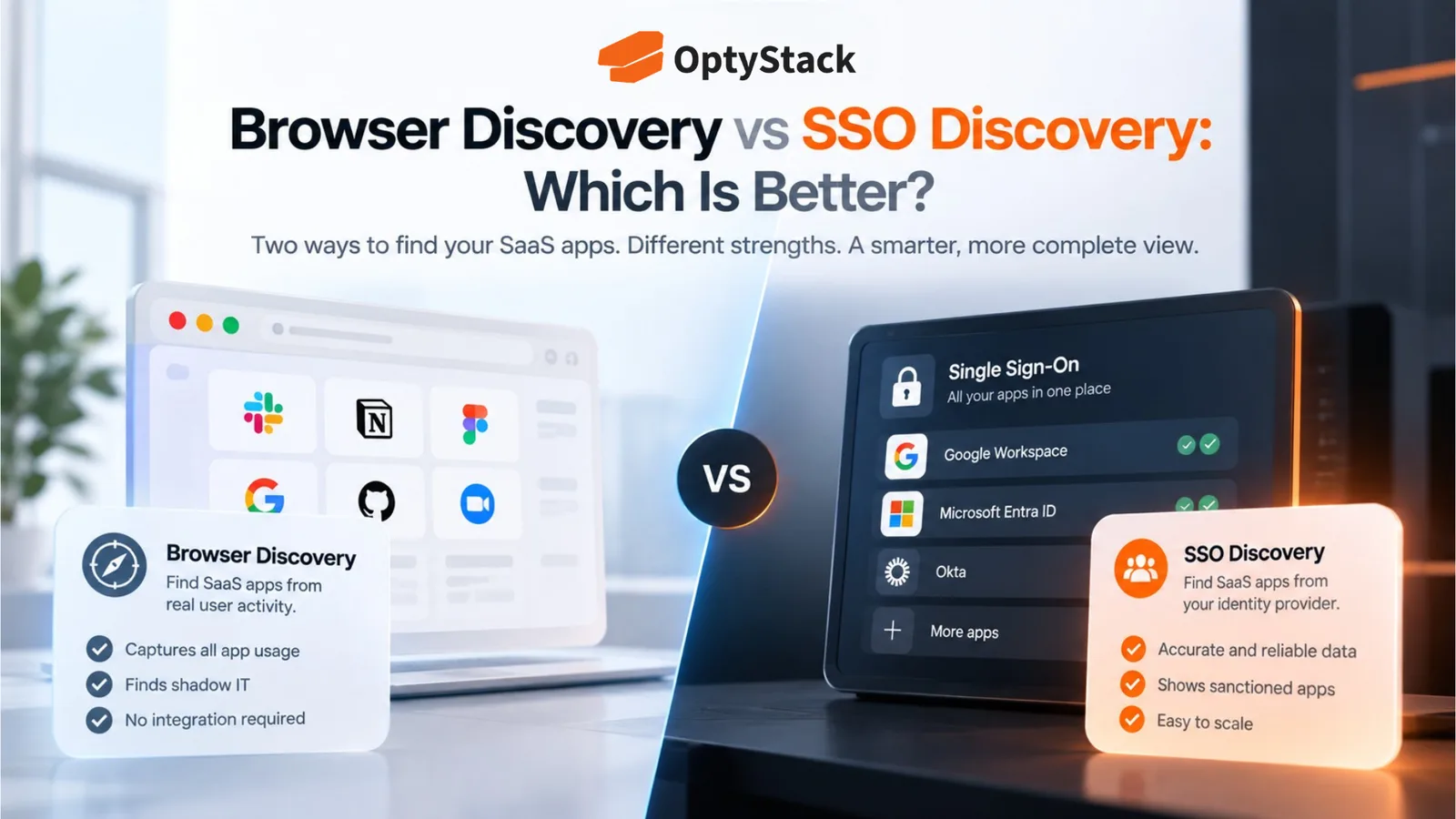
SSO discovery and browser-based discovery each catch a different slice of your SaaS stack. Here's how the two methods compare, where each wins, and why relying on one alone leaves gaps.
Neither method sees the whole picture, and the specific tools each one misses are different in kind, not just degree. SSO discovery is built around the assumption that meaningful software gets accessed through corporate credentials. Browser discovery is built around observing application access through browser activity, regardless of how someone logged in. Both approaches have blind spots, so relying on either one alone can leave gaps.
What SSO discovery actually shows you
SSO discovery works by tracking authentication events through your identity provider—Okta, Microsoft Entra ID, Google Workspace, or similar—and identifying which applications employees are accessing with corporate credentials. For tools that require SSO to log in, this method provides a reliable record of who accessed what and when.
The gap is everything that doesn't require SSO to begin with. An employee who signs up for a free tool with a personal email and password doesn't generate an SSO event. A tool that offers its own username-and-password login, bypassing single sign-on entirely, may be invisible to this method even if it's actively used every day. AI tools can be especially difficult to capture through SSO when users access them through personal accounts or services without enterprise identity integration.
What browser discovery actually shows you
Browser-based discovery can use browser activity to identify SaaS applications employees access, including tools that don't authenticate through the corporate identity provider.
This can catch a category SSO discovery may miss: direct-login tools, free-tier applications, and other services that employees access without going through the company's identity provider.
The gap here is coverage and consistency. A browser-based discovery tool only sees activity from devices and browsers where its monitoring capability is deployed. Personal devices, unmanaged endpoints, and mobile access can therefore fall outside its view. Coverage can also vary depending on whether the required browser extension or endpoint component is installed, active, and supported across the organization's device fleet.
Where each method genuinely wins
SSO discovery is stronger for sanctioned, enterprise-grade tools. For core platforms that require SSO as a matter of policy, identity-provider data gives a reliable record of authentication and access without requiring separate browser deployment.
Browser discovery can be stronger for shadow AI and consumer-style tools. Direct-login AI products and other applications that don't use corporate SSO can be visible through browser activity even when the identity provider has no record of them.
SSO discovery scales more easily across a large organization. Once the identity provider is configured, coverage can extend to employees using SSO-gated tools without requiring a separate browser deployment for each device. Browser-based discovery requires the relevant monitoring capability to be deployed and maintained across the devices or browsers it needs to cover.
Browser discovery raises privacy and trust questions that SSO discovery generally doesn't. Monitoring browser activity, even when limited to work-related applications or domains, can feel more invasive to employees than authentication logging. Organizations need to consider privacy requirements, employee expectations, and how the data will actually be used before deploying it.
Why relying on either one alone leaves gaps
A company using only SSO discovery can have strong visibility into applications accessed through corporate identity credentials while missing free tools, personal-account signups, and direct-login applications that never interact with the identity provider.
A company using only browser discovery can identify many of those applications but lose visibility when employees use personal devices, mobile apps, or browsers without the required monitoring capability.
Neither gap is insignificant. Shadow AI and other unsanctioned applications can exist outside corporate SSO, while parts of an organization's device fleet can remain outside browser-based monitoring. The result is that each method provides useful evidence but leaves areas that another discovery source can help identify.
How to think about which to prioritize
If your primary concern is enforcing access policy on sanctioned, business-critical tools, SSO discovery is the stronger foundation because it is tied directly to the identity and access controls your organization already uses.
If your primary concern is catching shadow AI and unsanctioned tool adoption early, browser discovery can provide visibility into applications that SSO discovery may not capture.
If you're trying to build a more complete picture, neither method alone is enough. Financial data, expense reports, and corporate card statements can identify spend that never touches either SSO or browser monitoring. A broader discovery approach can combine identity data, browser or endpoint signals, and financial records so that one source helps expose the blind spots of another.
Where OptyStack fits
Building a complete picture from SSO logs, browser activity, and financial records separately, then reconciling all three by hand, is a significant ongoing effort. The applications most likely to be missed are often the ones that require this kind of cross-referencing to identify.
OptyStack brings identity, usage, and spend signals together across your SaaS estate, helping reduce the blind spots that remain when discovery relies on a single source.
It's free to start and doesn't require a credit card.
See your SaaS estate across multiple discovery signals. Start free with OptyStack.