Redefining ROI: A CIO’s Guide to Holistic SaaS Procurement
Amit Dangi · March 14, 2026

In a SaaS-driven enterprise, procurement is no longer a discrete purchasing event; it is a continuous, strategic IT lever. CIOs must shift from simply approving the vendor invoice to leading a holistic procurement framework that calculates actual Total Cost of Ownership by weighing subscription fees against security liabilities and operational friction.
For decades, enterprise software procurement was a highly structured, siloed, and infrequent event. A department identified a need, submitted a formal request, and Procurement negotiated the contract. IT then spent six months implementing the software on local servers.
The SaaS model, fueled by Product-Led Growth (PLG), has entirely dismantled this process. Today, software procurement happens daily, democratized across the organization. Anyone with a corporate credit card can acquire enterprise-grade capabilities in minutes.
While this decentralized buying drives incredible business agility, it fundamentally breaks the traditional Return on Investment (ROI) calculation. If a CIO or Finance Director only reviews the SaaS purchase after the fact and only looks at the subscription invoice—they are abdicating their responsibility for enterprise risk and operational efficiency.
To thrive in this environment, CIOs must redefine ROI and champion a Holistic SaaS Procurement Framework.
The Broken Equation of Decentralized Buying
When department heads buy their own software, they calculate ROI through a very narrow lens: Will this $30/month tool save my team $50/month in time? If yes, they buy it.
However, they are completely blind to the macro-level "heavy weights" that this purchase drops onto the broader organization's balance scale:
The InfoSec Blind Spot: The marketing manager does not read the vendor's SOC 2 report or check if the app supports Enterprise SSO. They are focused on features, not the fact that the tool might expose customer PII to an unvetted third party (Security Risk).
The IT Labor Tax: The sales director does not consider that the new forecasting app lacks automated provisioning APIs. They expect IT to manually create accounts, manage permissions, and field password reset tickets for the next three years (Admin Time).
The Duplication Drain: The HR team doesn't know that Engineering already owns a massive enterprise license for a project management tool that does the exact same thing as the shiny new app they just purchased (Wasted Cost $$$).
The 360-Degree SaaS Evaluation
To achieve true value, procurement must evaluate new applications and upcoming renewals across four critical, equally weighted axes.
1. Direct Cost vs. Business Value This is the baseline. Is the application delivering its intended business value? More importantly, can that value be quantified against the license cost and projected user growth? If an application's cost scales linearly with headcounts but its value diminishes, the ROI equation will eventually invert.
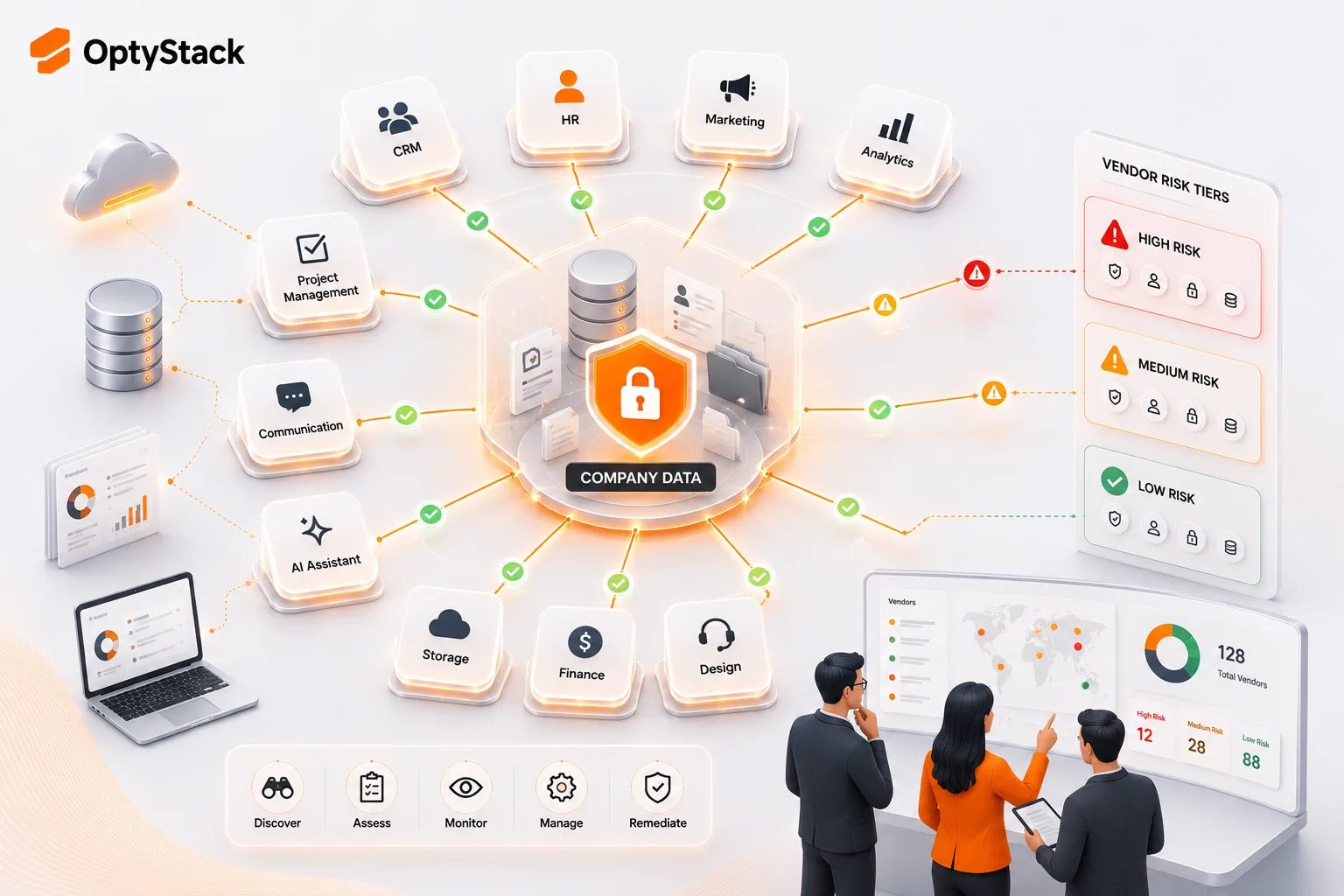
2. The Risk Premium (Security & Compliance) What is the application's security posture? Does it handle highly sensitive data or internal IP? A CIO must ensure that a vendor risk assessment happens before the contract is signed. An inexpensive, highly productive app is a massive liability if its infrastructure is insecure. The potential cost of a regulatory fine or a data breach can instantly dwarf years of perceived ROI.
3. The Operational Tax (Admin & Integration Friction) Does this application support your Identity Provider (Okta, Azure AD) for SSO? Does it have open APIs for automated user lifecycle management (Joiner/Mover/Leaver processes)? If an application requires 15 hours a month of manual IT overhead to maintain, that labor cost must be aggressively factored into the purchasing decision.
4. Strategic Alignment & Consolidation Before buying something new, the primary question must be: Do we already own a tool that does this? Holistic procurement relies on mapping functional overlap. If a department requests Asana, but you already have a 500-seat enterprise agreement with Jira, the strategic move is to leverage existing investments to drive maximum volume discounts, rather than fragmenting the stack.
Implementing a CIO-Led Procurement Mandate
Shifting to holistic procurement does not mean reverting to the slow, hated "gatekeeper" days. It means building intelligent, automated guardrails.
Modern procurement requires a SaaS Management Platform that acts as a central nervous system. You need automated vendor intake workflows that allow employees to easily request tools via Slack or Teams. Those requests should automatically trigger parallel, asynchronous reviews from Legal (checking DPAs), InfoSec (reviewing SOC 2s), and IT (checking for SSO and functional overlap).
By bringing Cost, Risk, and Time to the forefront of the buying process, CIOs ensure that IT is no longer just a payer of software invoices, but a strategic governor of digital value.