Building a 12-Month SaaS Renewal Calendar
Aryan Malik · September 10, 2026
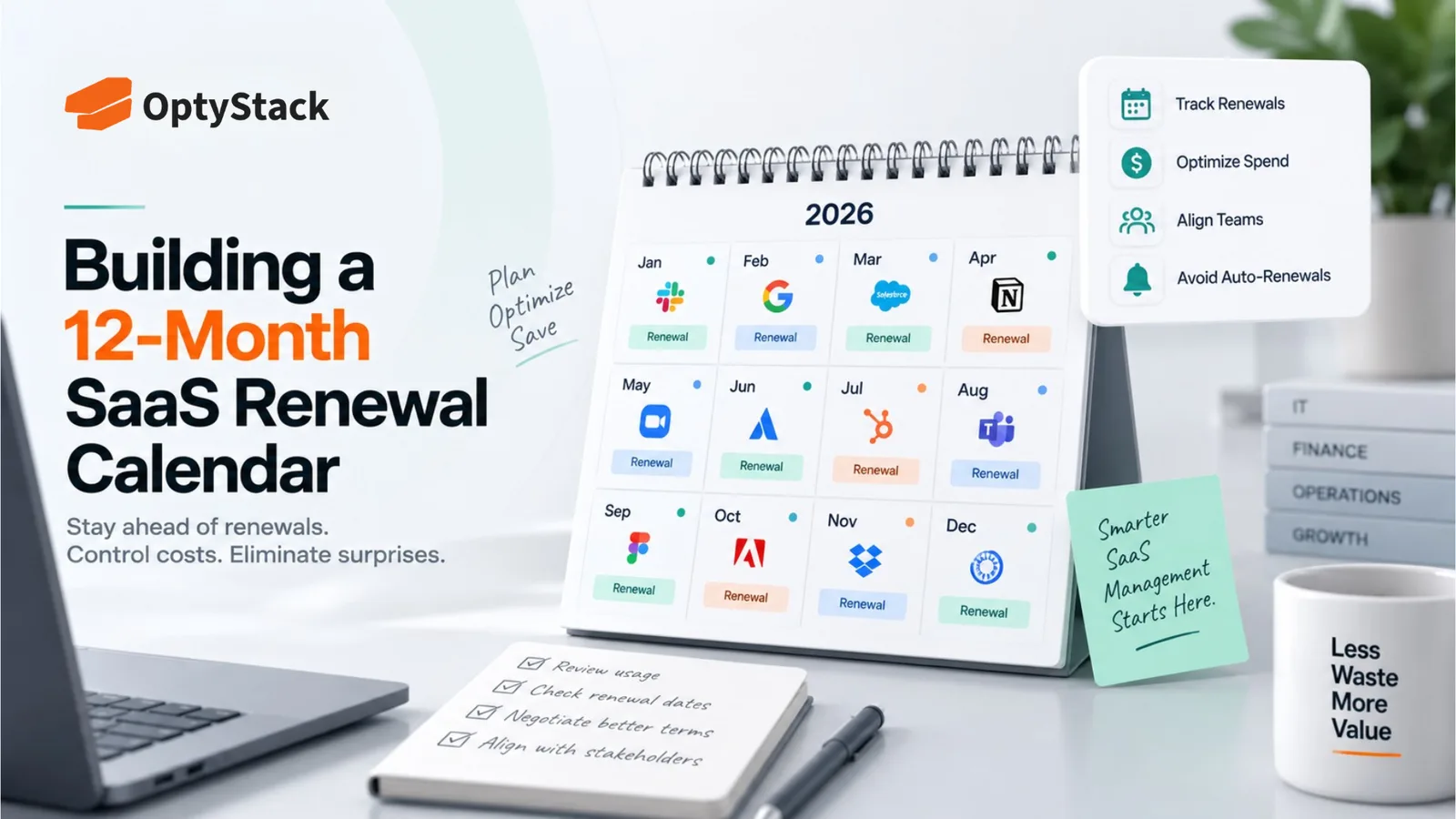
About 69% of software contracts carry a 30-to-90-day notice period, and missing that window means losing your ability to negotiate. Here's how to build a 12-month renewal calendar with the right fields, cadence, and ownership to actually keep it current.
Roughly 69% of software contracts carry a notice period of 30 to 90 days before they auto-renew, according to a May 2026 dataset from contract management platform ContractSafe. That window is where most renewal problems actually happen. The contract's end date isn't the deadline that matters. The date by which you have to act, weeks or months earlier, is the one that decides whether you get to negotiate or just accept whatever the vendor sets.
A renewal calendar is the tool that turns that deadline from something you discover after the fact into something you can actually plan around. Building one that survives past the first quarter takes a specific structure, not just a spreadsheet with dates in it.
What a working renewal calendar actually needs to track
A calendar with too few fields misses the details that matter. One with too many becomes something nobody keeps updated. A workable structure sits at five to eight fields per contract:
Vendor and contract value. The basic identifying information, plus the annual or total contract cost, so the calendar doubles as a rough spend forecast as renewals approach.
Contract end date, pulled from the actual signed agreement. Not the date in your billing portal, which sometimes reflects the current billing cycle rather than the underlying contract term.
Notice period length, in the exact units the contract states. A clause that says "three months" is not the same as 90 days, and calculating it as though it were can put your deadline off by a few days, which is sometimes exactly enough to miss it.
Calculated notice deadline, meaning the contract end date minus the notice period. This is the single most important field on the entire calendar, and it's the one most manual tracking systems skip because it requires a calculation rather than a value copied straight from the contract.
Owner. One named person, not a department or a team. When responsibility is shared across a group, it's effectively unowned, and unowned renewals are the ones that get missed.
Status. A simple field tracking where each contract stands: upcoming, under review, decided, or completed, so a monthly scan of the calendar shows exactly where attention is needed without reopening every individual record.
Structuring the calendar across a full year
Stagger your review cadence around each notice deadline, not the calendar month. A common structure uses three checkpoints: 90 days before the notice deadline to start the review, 60 days out to gather usage data and pricing benchmarks, and 30 days out as the final decision point before the window closes. Building alerts around the deadline itself, rather than a fixed monthly date, keeps the timing accurate even as new contracts get added throughout the year.
Group your annual review load by quarter, since renewals rarely distribute evenly. Many companies find a disproportionate share of contracts cluster around specific months, often tied to when the company was founded or when a major vendor push happened. Mapping this out for the year ahead shows you which quarters will require heavier renewal attention, so you can plan the workload rather than being surprised by it.
Build in a monthly standing review, separate from the individual contract-specific alerts. A short, recurring block of time each month to scan the full calendar catches contracts that might otherwise slip between individual deadline alerts, particularly ones added mid-year that weren't part of the original build-out.
Plan renewal-heavy months around your broader budget cycle where possible. If your company runs an annual budgeting process, having visibility into which major renewals fall in the months just before or after it lets finance factor those decisions into the budget rather than treating them as a separate, disconnected process.
Building it from scratch
Start by pulling every active contract, not just the ones you remember. Corporate card statements, expense records, and procurement files often surface renewals that never made it onto anyone's radar as an ongoing obligation.
Extract the five core fields for every contract before worrying about anything more sophisticated. A complete, accurate list with just vendor, end date, notice period, calculated deadline, and owner is more useful than an elaborate system with missing or wrong data in half the entries.
Push the calculated deadlines into whatever calendar your team actually checks, not a separate spreadsheet nobody opens outside of renewal season. A notice deadline that only lives in a spreadsheet, with no active reminder, provides very little practical protection.
Where this tends to fall apart
The calendar gets built once and stops being updated. A renewal calendar is only as good as its most recent update. New contracts signed after the initial build-out need to be added the same day, not whenever someone remembers to do it.
Notice periods get approximated instead of read from the actual clause. Assuming every contract uses a standard 30-day window, when the actual language specifies 90, is a common and completely avoidable way to miss a deadline that looked comfortably far away.
Ownership gets assigned to a team instead of a person. A contract marked "IT" or "Procurement" as its owner has no one specifically accountable when the deadline approaches, which is exactly the condition under which renewals get missed.
Shadow IT subscriptions never make it onto the calendar at all. A tool purchased outside a formal procurement process typically has no one tracking its notice period, which means it's likely to auto-renew simply because nobody knew to include it.
Where OptyStack fits
Building and maintaining an accurate renewal calendar by hand means pulling contract data from multiple sources, calculating notice deadlines correctly for each one, and keeping the whole thing updated as new tools get added throughout the year, which is exactly the kind of ongoing maintenance that tends to lapse once the initial build-out is done.
OptyStack keeps renewal dates and application data connected in one place across your SaaS estate, including tools discovered outside a formal procurement process, so notice deadlines stay current without depending on someone manually updating a spreadsheet every time a new contract gets signed.
It's free to start and doesn't require a credit card.
Build a renewal calendar that actually stays current. Start free with OptyStack.