The Complete SaaS Governance Framework for 2026
Hemant Wadhwani · July 28, 2026
SaaS governance decides how software gets bought, accessed, secured, paid for, and retired across your company. This is the complete 2026 framework — the six pillars, a step-by-step rollout, the ownership model, and the metrics that prove it's working.
The Complete SaaS Governance Framework for 2026
Quick answer: SaaS governance is the system of policies, ownership, and controls that decides how software gets bought, accessed, secured, paid for, and retired across a company. A working framework rests on six pillars — discovery and visibility, ownership and accountability, access and identity, security and risk, cost and value, and lifecycle and compliance — run as a continuous rhythm rather than an annual scramble. Done well, it turns SaaS from an ungoverned sprawl of cost and risk into a managed, measurable asset.
Most companies have spent the last few years learning to optimize SaaS cost — reclaiming licenses, catching renewals, cutting waste. That work matters. But there's a trap hiding inside it: optimization without governance is a diet with no lifestyle change. You cut the waste, feel good for a quarter, and then it quietly grows back, because the conditions that created it never changed. New tools keep arriving through the side door. Access keeps outliving the people it was granted to. Vendors keep renewing on autopilot. The savings erode, and you're back where you started.
Governance is the fix. It's the operating system that sits underneath cost management, security, and procurement and makes all three durable. This guide lays out the complete SaaS governance framework for 2026: what it actually is, why it broke, the six pillars that hold it together, how to roll it out without boiling the ocean, who owns it, how to tell if it's working, and the mistakes that quietly undo it. It's long because governance is genuinely broad, but it's built so you can jump to the part you need.
What SaaS governance actually is (and isn't)
Let's start by clearing up what governance is not, because the word gets stretched in every direction.
It is not the same as spend management. Spend management asks "are we paying too much?" Governance asks the bigger question: "how do we decide what we buy, who gets access, how it's secured, and when it leaves?" Spend is one output of governance, not the whole thing.
It is not the same as security. Security asks "is this tool safe?" Governance asks "how do we consistently decide which tools enter, what data they touch, and who reviews them?" Security is a pillar of governance, not a synonym for it.
And it is not the same as procurement. Procurement is the moment of purchase. Governance is the entire lifecycle around that moment — the intake that precedes it, the access that follows it, the reviews that keep it honest, and the offboarding that ends it.
So here's a working definition: SaaS governance is the framework of policies, ownership, and controls that governs the full lifecycle of every piece of software in your company — from how it's requested and approved, to how access is granted and reviewed, to how it's secured, paid for, and eventually retired. It's not a document that sits in a drawer. It's a living operating model that connects IT, security, finance, and the business around a shared set of rules and a shared source of truth.
The reason it matters more in 2026 than it did five years ago is that software stopped being something IT hands out and became something everyone buys. That single shift broke the old model — and a new framework is what replaces it.
Why SaaS governance broke
Before building a framework, it helps to understand why the old way stopped working. The causes are structural, not a sign anyone did something wrong.
Buying got democratized. A decade ago, software came through one door: IT. Now any employee can sign up for an enterprise-grade tool in ninety seconds with a company card. Marketing buys its own stack, sales buys its own, engineering expenses APIs. Speed is a feature — but the buying spread across the whole company while the governing of it stayed stuck in one team's spreadsheet.
Sprawl became the default. The typical mid-to-large company now runs well over a hundred SaaS applications, and the number keeps climbing through decentralized purchasing. Each tool is a rational choice in isolation. Collectively they're an ungoverned surface area that no single person can see.
Ownership fragmented. When buying decentralizes, accountability scatters with it. Finance sees a charge but not its purpose. IT knows the sanctioned tools but not the rogue ones. The person who championed a tool moves teams, and it becomes an orphan. Ask most companies "who owns SaaS governance?" and the honest answer is nobody — and unowned software is ungoverned software.
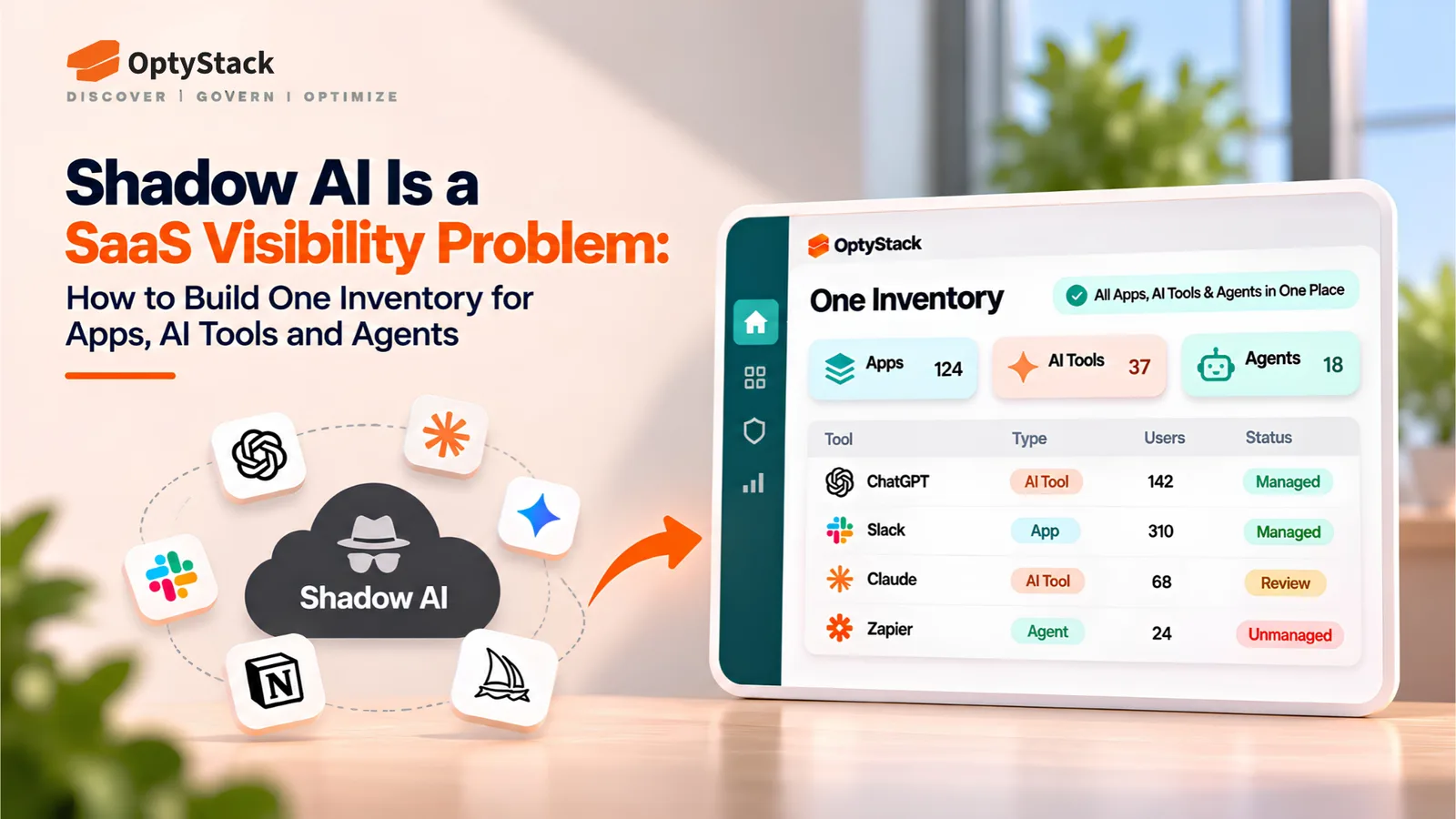
Shadow IT and shadow AI exploded. Tools adopted outside official channels now account for a large share of software spend in many organizations — and the fastest-growing slice is AI. Spending on AI-native software has been growing at roughly triple-digit rates year over year, and almost none of it passes through a review. Gartner has projected that by 2027, the vast majority of employees will acquire, build, or modify technology outside IT's visibility, up sharply from a few years earlier. That's not a fringe problem. That's the mainstream.
Compliance pressure intensified. At the same time, the bar for proving control went up. SOC 2, ISO 27001, and GDPR all expect you to know what software touches your data, who has access, and how that access is reviewed. Auditors increasingly ask questions that an ungoverned SaaS estate simply can't answer.
Put those five forces together and you get the modern condition: more software, bought by more people, touching more data, with less central visibility, under more scrutiny. No spreadsheet survives that. What survives is a framework.
The six pillars of a SaaS governance framework
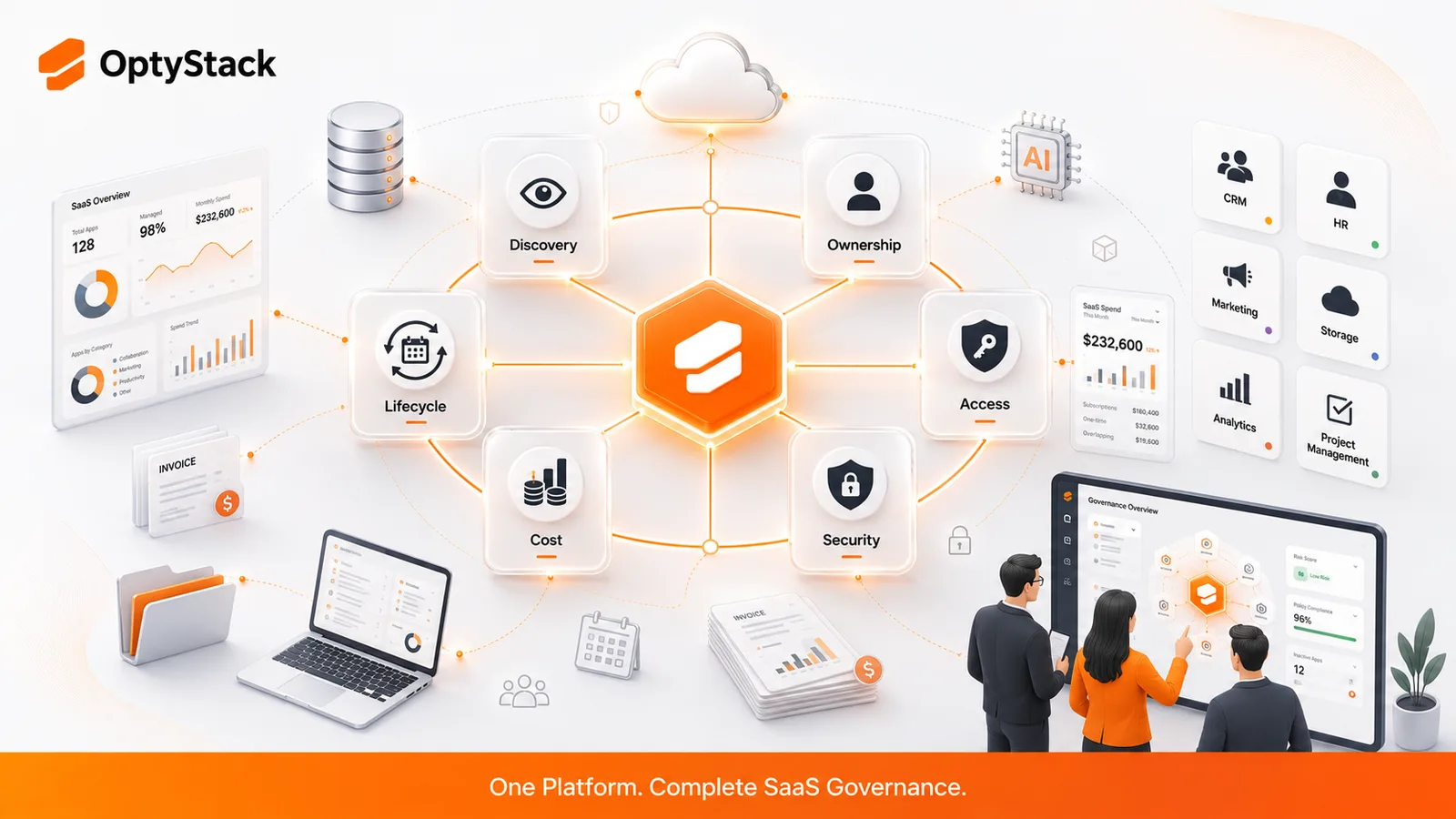
A complete SaaS governance framework rests on six pillars. Think of them less as a checklist and more as six angles on the same object — each one governs a different dimension of the software lifecycle, and they reinforce each other. Weaken one and the others start to leak.
Pillar 1 — Discovery and visibility
Everything starts here, and it's non-negotiable: you cannot govern what you cannot see. Before any policy means anything, you need a complete, living inventory of every application the company pays for or uses — including the tools bought outside official channels.
Good discovery cross-references multiple signals, because no single source sees everything. Finance and expense data catch tools bought on cards. Identity and single sign-on logs show what people actually log into. Browser and endpoint signals surface the AI plug-ins and free tools that never touch a central system. Direct integrations with major vendors give exact seat counts and last-login data. The output is a single source of truth: one place where every tool, owner, cost, renewal date, access footprint, and risk signal lives together. That single source is the foundation every other pillar builds on.
Pillar 2 — Ownership and accountability
The cornerstone of governance is almost embarrassingly simple, which is exactly why it works: every tool needs an owner, a purpose, and a renewal date on record.
An owner is a specific, named person accountable for the tool — not a department, a person. A purpose is the documented reason it exists and who depends on it, which is what lets you judge whether a cost is justified or whether two tools overlap. A renewal date (with its notice window) turns renewals from ambushes into planned decisions. Most SaaS waste and risk trace back to one of these three being missing: unowned tools nobody questions, tools whose purpose everyone forgot, renewals nobody tracked. Record all three across your estate and problems start resolving on their own, because now there's always someone to ask "do we still need this?"
Pillar 3 — Access and identity
Once tools are visible and owned, the next question is who can get into them — and the answer changes constantly as people join, move roles, and leave. This pillar governs the joiner-mover-leaver lifecycle: granting the right access on day one, adjusting it when someone changes roles, and revoking it the moment they leave. It's where least-privilege lives (people should have the access they need and no more), where periodic access reviews live (confirming, on a schedule, that the right people still have the right access), and where third-party app connections and OAuth grants live — the "Sign in with Google" permissions that quietly give tools deep access to your data and almost never get reviewed. Weak access governance is where cost leaks (paying for seats nobody uses) and security risk (accounts that outlive employees) meet — they're often the very same accounts.
Pillar 4 — Security and risk
This pillar governs the danger a tool represents, not just its convenience. It covers vendor risk — assessing whether a supplier's security posture is good enough before you trust it with your data, and re-checking that posture over time rather than once at signing. It covers data sensitivity — knowing which tools touch regulated or confidential information, so the riskiest ones get the most scrutiny. And it covers the overall posture of your SaaS estate: misconfigurations, over-permissioned integrations, and the sprawl of AI tools ingesting company data. In a world where a large share of breaches now involve a third party, your vendors are part of your attack surface — and governing that surface is a core job of the framework, not an afterthought for the security team alone.
Pillar 5 — Cost and value
This is the pillar most companies start with, and it belongs in the framework — just not as the whole of it. Cost governance asks whether every rupee or dollar of software spend maps to real value: tracking total spend, measuring utilization against what you pay for, reclaiming unused and duplicate licenses, and timing renewals to keep leverage. The shift governance brings is that cost stops being a periodic panic and becomes a continuous discipline, informed by the same source of truth as everything else. When you can see usage alongside spend, "this looks expensive" becomes a decision — keep it because it's fully used, or right-size it because it isn't — instead of a guess.
Pillar 6 — Lifecycle and compliance
The final pillar ties the timeline together, governing a tool from cradle to grave: a clear intake process for how software gets requested and approved (so new tools come through the front door, not the side one), contract management so every agreement, term, and obligation lives in one place instead of scattered inboxes, renewal management so decisions happen before notice windows close, and offboarding so tools and their access are cleanly retired when they're no longer needed. Running through all of it is compliance: the ability to prove, on demand, what software you have, who can access it, and how you govern it — the exact evidence auditors ask for under SOC 2, ISO 27001, and GDPR. A governed lifecycle is what turns audit season from a fire drill into a report you can already produce.
Six pillars, one object. Discovery makes the estate visible; ownership makes it accountable; access controls who gets in; security controls the risk; cost controls the value; lifecycle controls the timeline. Get all six working from one source of truth and SaaS stops being something that happens to you and becomes something you actually run.
How to implement the framework (without boiling the ocean)
Six pillars can sound like a lot. The good news: you don't build them all at once, and you don't need a perfect estate to start. Governance matures in stages. Here's a phased rollout you can begin this quarter.
Phase 1 — See everything (weeks 1–3). Start with discovery, because nothing else works without it. Pull every software charge from the last twelve months, layer in identity and usage signals, and build the single source of truth. Don't aim for perfection; aim for a complete-enough picture that better decisions become possible. If a full sweep feels daunting, start with your top 25 tools by spend — that's usually where most of the cost and risk concentrate.
Phase 2 — Assign ownership (weeks 3–5). For every tool that matters, record the three facts: owner, purpose, renewal date. This single step does more to reduce waste and risk than any policy, because it creates accountability where there was none. Begin with the tools that are expensive, widely used, or touch sensitive data.
Phase 3 — Set the policies (weeks 5–8). Now write the light rules that govern the lifecycle: how software gets requested and approved (intake), who reviews access and how often, how vendors get risk-assessed, and what happens at offboarding. Keep policies simple and enforceable — a short rule people follow beats a thick document they ignore. The goal is a clear front door for new tools and a clear exit for old ones.
Phase 4 — Establish the rhythm (ongoing). Governance is a cadence, not a project. Run a short monthly review for the fast-changing things — new tools that appeared, access that went stale, spend anomalies, risky new integrations. Run a deeper quarterly review for the structural things — contract strategy, major renewals, consolidation opportunities, and access recertification. The rhythm is what makes governance continuous instead of a once-a-year cleanup that decays by month three.
Phase 5 — Automate (as you mature). As the practice settles, automate the parts that break when done by hand: continuous discovery, access provisioning and deprovisioning, renewal alerts, and risk scoring. Automation is what lets governance scale past a couple dozen tools without a growing army of analysts.
The throughline: crawl before you run. A company that can see its estate and has assigned ownership is already governing better than most. Everything after that is refinement.
Who owns SaaS governance?
A framework with no owner is a framework that drifts, so this question deserves a clear answer. The honest one: SaaS governance is a team sport, but someone has to captain it.
IT typically owns discovery, access, and the technical side of the lifecycle — provisioning, integrations, and offboarding. Security owns vendor risk, data sensitivity, and posture. Finance owns cost, budget, and value, and cares about ROI. Procurement owns intake and contracts. And department leaders own the ground truth of what their teams actually need. Each brings a piece; none has the whole picture alone.
What ties them together is a single accountable owner — a governance lead, an IT asset or SaaS manager, or a small cross-functional committee — whose job is to run the rhythm, maintain the source of truth, and make sure decisions actually get made rather than endlessly discussed. In smaller companies this might be one person wearing several hats; in larger ones, a defined role or council. Either way, the principle holds: governance that belongs to everyone belongs to no one unless someone is explicitly accountable for the whole.
The SaaS governance maturity model
Governance isn't binary — you're not either governed or ungoverned. It's a spectrum, and knowing where you sit tells you what to fix next. Here's a simple five-level model.
Level 1 — Ad hoc. No inventory, no owners, no rules. Software is bought and forgotten. Most companies start here and don't realize it.
Level 2 — Reactive. You respond to problems after they surface — a surprise renewal, a failed audit question, a security scare. There's some tracking, usually a spreadsheet, usually out of date.
Level 3 — Defined. You have a real inventory, ownership is assigned, and basic policies exist. You know what you have and who's responsible. This is the level that stops the bleeding.
Level 4 — Managed. Governance runs on a rhythm. Reviews happen on schedule, access is recertified, renewals are planned, risk is scored. The source of truth is trusted and current. Problems get caught before they cost you.
Level 5 — Optimized. Governance is largely automated and continuous. Discovery, provisioning, and alerts run on their own; humans focus on decisions, not data collection. Governance is a competitive advantage — you move faster and safer than peers because your estate is fully under control.
The goal isn't to leap to Level 5 overnight. It's to know your level honestly and climb one rung at a time. Most of the value comes from getting to Level 3–4: visible, owned, and run on a rhythm.
The metrics that prove governance is working
"We have better governance now" is a feeling. To manage it — and to defend it in a leadership meeting — you need numbers. A handful do most of the work:
Coverage: the percentage of your software estate that's discovered and in the source of truth. If you can't see it, you can't govern it, so this is the foundational metric.
Ownership: the share of tools with a named owner, documented purpose, and tracked renewal date. The closer to 100%, the less drift.
Access hygiene: how quickly access is revoked after someone leaves, and what share of access has been reviewed on schedule. This is where cost and security both live.
Utilization: the percentage of purchased licenses actually in active use — the single most revealing cost-and-value number.
Renewals reviewed before notice windows: the discipline metric that measures whether you're deciding renewals or just letting them happen.
Risk posture: the share of vendors risk-assessed and the number of high-risk findings open versus resolved.
Audit readiness: how long it takes to produce a complete, accurate list of software, access, and controls when an auditor asks. Governed estates measure this in minutes; ungoverned ones in weeks.
Track these over time and governance stops being a vague intention and becomes a visible operating discipline — the kind you can put in a board deck and defend.
The mistakes that quietly undo governance
Plenty of companies launch a governance effort. Fewer sustain one. The difference usually comes down to a few avoidable mistakes.
Treating it as a one-time project. A governance push driven by a scare — an audit, a breach, a budget crunch — that ends once the crisis passes will decay within months. Governance is a rhythm, not a cleanup. The rhythm is the point.
Leading with restriction. Locking everything down feels decisive and mostly backfires. Block the tools people need and they route around you onto personal accounts and devices, where you have no visibility at all. Governance is about seeing and guiding, not banning. Give people a fast, sanctioned path and they'll use it.
Governing cost but not access or risk. Many programs start and stop at spend. But an estate that's cost-optimized and access-ungoverned is still one departed employee away from a breach. All six pillars matter; a framework that's really just cost management in disguise leaves the biggest risks untouched.
Leaving it unowned. Without a single accountable owner, governance becomes everyone's job and therefore no one's. Name the owner.
Relying on a spreadsheet. A manual inventory captures only what someone remembers to enter and goes stale the moment updates lapse — and the tools most worth governing (shadow IT, shadow AI) are precisely the ones a spreadsheet never sees. Manual tracking doesn't scale past a couple dozen tools, and every company is well past that.
Forgetting the AI layer. A framework built for traditional SaaS but blind to AI tools is missing the fastest-growing, most volatile, most data-hungry part of the modern estate. AI has to be in scope from day one.
Avoid these six and you're already ahead of most companies — not because governance is hard, but because consistency is rare.
Where OptyStack fits
Everything in this framework is doable in principle. It's also genuinely hard to maintain by hand across a hundred-plus tools that change every week — which is exactly why most manual governance efforts start strong and quietly fade.
OptyStack is built to make the six pillars continuous instead of heroic. It unifies billing, identity, and usage signals to build the single source of truth automatically — discovering shadow IT and shadow AI as they appear (Pillar 1). It records owner, purpose, usage, and renewal for every tool, so accountability maintains itself (Pillar 2). It surfaces access footprints, stale accounts, and risky third-party integrations (Pillar 3), ranks findings by data sensitivity and spend exposure so security and risk get prioritized (Pillar 4), pinpoints unused and duplicate licenses with the usage data to act on them (Pillar 5), and tracks contracts and renewals across the lifecycle so nothing locks in by surprise and audit evidence is always ready (Pillar 6).
The result is the thing every IT, security, and finance leader actually wants: one live picture of the entire software estate, governed continuously, so SaaS becomes a managed asset instead of an ungoverned liability. It's free to start, with no credit card, and you can see your own estate in under ten minutes.
If you take one idea from this guide, make it this: governance is what makes optimization stick. Cut the waste all you want — without a framework holding the line, it grows back. Build the framework, and the savings, the security, and the control compound instead.
Frequently asked questions
What is SaaS governance?
SaaS governance is the framework of policies, ownership, and controls that governs how software is bought, accessed, secured, paid for, and retired across a company. It spans the full lifecycle of every tool — from intake and approval, through access and security, to renewal and offboarding — and connects IT, security, finance, and the business around a shared source of truth. It's broader than spend management or security alone; those are pieces of it.
What are the pillars of a SaaS governance framework?
A complete framework rests on six pillars: discovery and visibility (a single source of truth for every tool), ownership and accountability (an owner, purpose, and renewal date for each), access and identity (least-privilege, joiner-mover-leaver, and OAuth governance), security and risk (vendor risk and data sensitivity), cost and value (spend, utilization, and renewals), and lifecycle and compliance (intake, contracts, offboarding, and audit readiness).
How do I implement SaaS governance?
Start with discovery to build a complete inventory, then assign ownership (owner, purpose, renewal date) to every tool, then set light policies for intake, access reviews, vendor risk, and offboarding. Establish a monthly and quarterly review rhythm, and automate discovery, provisioning, and alerts as you mature. You don't need a perfect estate to begin — a complete-enough picture and assigned ownership already put you ahead of most companies.
Who is responsible for SaaS governance?
It's cross-functional — IT owns discovery and access, security owns risk, finance owns cost, procurement owns intake and contracts, and department leaders confirm real need — but it needs a single accountable owner (a governance lead, SaaS/IT asset manager, or small committee) to run the rhythm and maintain the source of truth. Governance that belongs to everyone belongs to no one unless someone is explicitly accountable.
How is SaaS governance different from SaaS spend management?
Spend management focuses on cost — tracking, optimizing, and reducing what you pay for software. Governance is the broader operating model that includes cost as one of six pillars, alongside discovery, ownership, access, security, and lifecycle. Put simply, spend management keeps costs down; governance keeps the whole estate — cost, access, risk, and compliance — under control, which is what makes cost savings durable.
Why does SaaS governance matter more in 2026?
Because software buying is now fully decentralized, estates commonly exceed a hundred applications, AI tools are entering at triple-digit growth rates with little oversight, and compliance regimes increasingly demand proof of control. The combination — more tools, more buyers, more data exposure, more scrutiny — has outgrown manual tracking. A framework is what replaces the spreadsheet.
Ready to see your whole software estate in one place? Start free with OptyStack and build your governance source of truth in under 10 minutes — no credit card required.