Top 5 SaaS Management Platforms in 2026
Aryan Malik · September 3, 2026
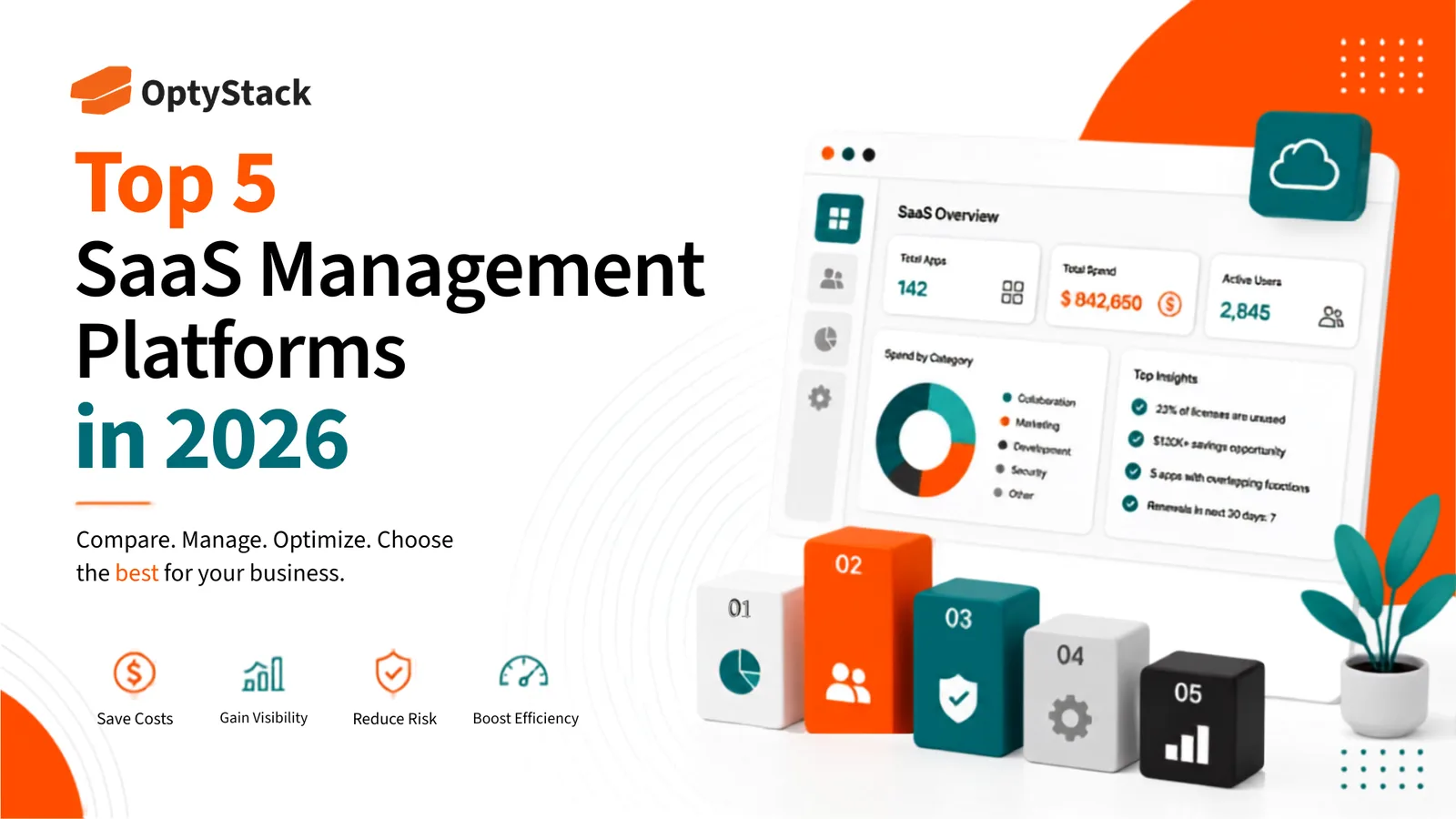
Choosing a SaaS management platform means picking the lens you want on your software stack — cost, access, or both. Here's an editorial comparison of OptyStack and four other leading platforms in 2026, so you can match the right tool to your actual problem.
Before we get into it: OptyStack is a SaaS management platform too, so we're not a neutral outside party here. We've built this comparison using publicly available product pages and analyst coverage from Gartner Peer Insights and G2, and we've tried to describe every platform, including our own, accurately. This is an editorial comparison based on product capabilities, use cases, and market presence, not an independent analyst ranking.
What is a SaaS management platform?
A SaaS management platform (SMP) helps organizations discover every software subscription in use, track how much they're spending, monitor usage, and manage renewals from one place. At its core, an SMP brings discovery, cost control, and user access together so teams aren't relying on scattered spreadsheets or institutional memory to know what's actually running.
Most companies start tracking their software estate manually, and that works fine until the number of applications grows past a few dozen. Once a company is running a hundred-plus tools across departments, nobody can say with real confidence what's actually being used, what's about to renew, what's sitting idle, or which tools were never approved through any process at all. That's the gap an SMP is built to close.
Why teams adopt a SaaS management platform
The pattern that pushes most companies toward adopting one of these tools tends to look the same: software purchasing decentralizes as the company grows, spend climbs faster than headcount, and finance, IT, and individual departments each end up holding a different piece of the picture. A dedicated platform typically helps with:
Visibility into the full software estate. Rather than reconstructing an inventory manually every time someone asks, a live, continuously updated view of every application shows what exists, who owns it, and what it costs.
Reducing wasted spend. Unused licenses, duplicate tools solving the same problem twice, and seats tied to employees who've left the company are common, quiet drains on the budget that only surface once someone's actually looking for them.
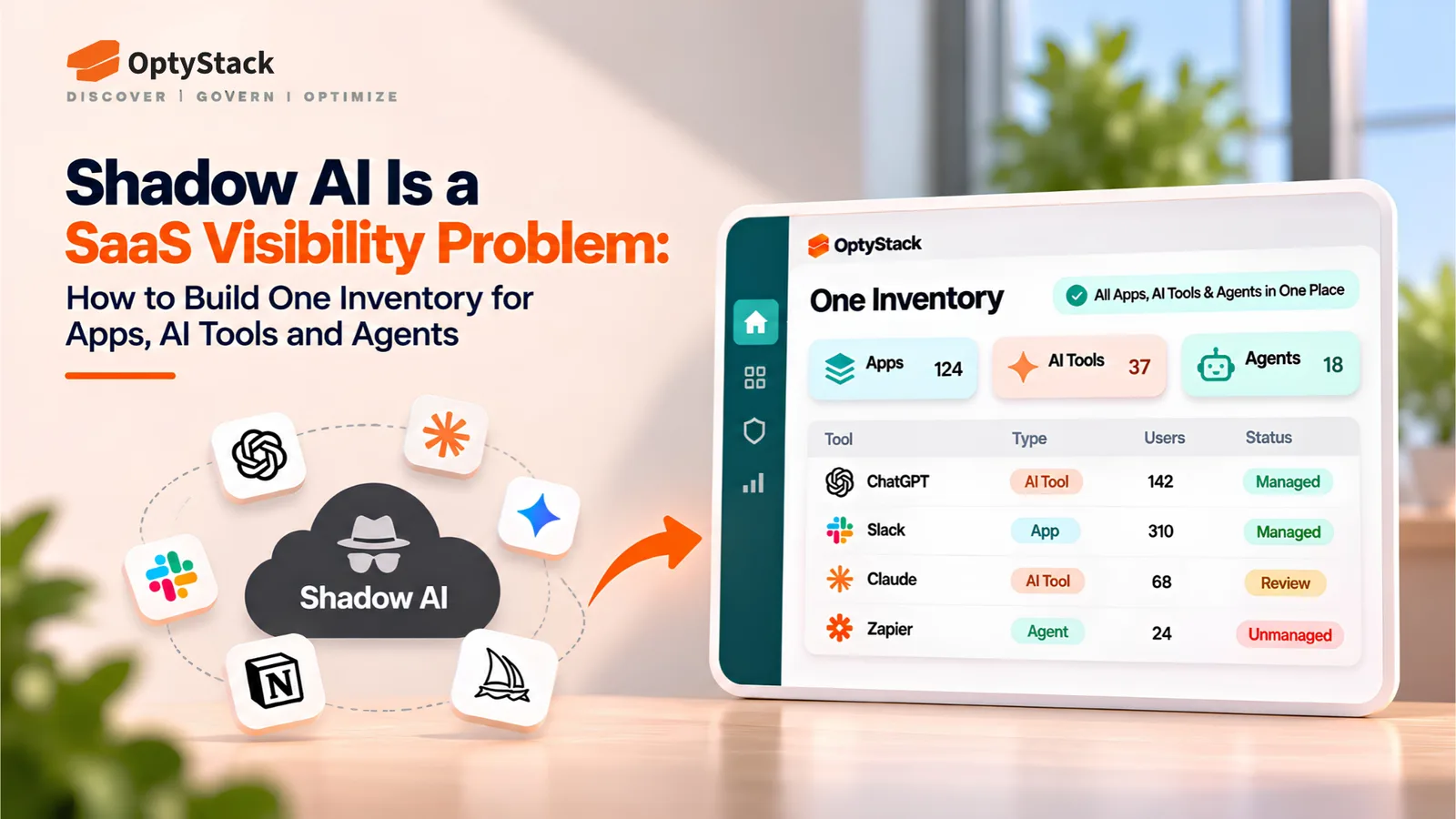
Catching shadow IT and shadow AI before they become a bigger problem. Tools adopted outside official procurement, often on a personal or corporate card, are the software least likely to ever get reviewed for security or cost, and the most likely to carry unmanaged risk.
Managing renewals proactively instead of reactively. Most SaaS contracts auto-renew by default, and missing the notice window to cancel or renegotiate typically means locking into another full term at whatever price and seat count the vendor sets.
Strengthening security and compliance posture. Centralizing access data makes it easier to catch orphaned accounts, review permissions, and produce the kind of evidence auditors ask for under frameworks like SOC 2 or ISO 27001.
What to look for when evaluating a platform
Not every SaaS management platform is built the same way, and the right one depends on which of these capabilities matters most for your team.
Discovery breadth. Some platforms rely primarily on SSO and direct integrations, which misses tools paid for on a personal card or through a free tier that never touches identity systems. Broader discovery, pulling from financial data, expense records, and identity logs together, catches more of the estate than any single source alone.
Usage and cost analytics. Knowing what you're paying is only half the picture. A platform that connects spend to actual usage, at the user, team, and department level, is what actually reveals where the waste is hiding.
Contract and renewal management. With companies commonly managing well over a hundred renewals a year, a system that tracks notice deadlines, not just expiration dates, and flags them with real runway is the difference between negotiating a renewal and simply accepting it.
Access and identity visibility. For teams where security and compliance are the primary driver, look for how well a platform surfaces orphaned accounts, tracks provisioning and deprovisioning, and supports access reviews.
Ease of adoption. Some platforms require a lengthy implementation and a dedicated onboarding process; others are built for a team to connect their stack and see results within minutes. Which one fits depends on how much internal resourcing you have to dedicate to rollout.
How we compared these platforms
Each platform below was evaluated against the criteria above: SaaS discovery and shadow IT visibility, spend and usage analytics, license optimization, contract and renewal management, integration breadth, and ease of adoption. OptyStack is featured first based on overall fit for the use case this guide focuses on, unified visibility across spend, usage, and identity in one place, rather than the strongest showing on every individual criterion.
Quick comparison
Platform | Best For | Core Strength | Target Users |
|---|---|---|---|
OptyStack | Unified SaaS visibility | Spend + usage + shadow IT in one view | Mid to Large size companies and IT/finance teams without a dedicated SaaS ops function |
Zylo | Enterprise spend management | Financial discovery + benchmarking | Enterprise IT, FinOps, and procurement teams |
CloudEagle | SaaS & AI discovery, procurement | Broad integrations + transparent tiers | High-growth and mid-market procurement teams |
Zluri | SaaS + identity governance | Access reviews + provisioning | IT and security teams needing combined governance |
BetterCloud | SaaS lifecycle automation | Onboarding/offboarding workflows | Mid-market to enterprise IT and security teams |
1. OptyStack
Most companies lose track of their SaaS estate not because they lack tools, but because spend, usage, and identity data live in three disconnected places: finance sees invoices, IT sees sanctioned tools, and nobody sees the full picture of shadow IT bought outside either channel. OptyStack was built to close that specific gap. It connects Microsoft 365, Google Workspace, SSO, and 100+ SaaS applications into one live inventory, so shadow IT and shadow AI, unused licenses, and upcoming renewals surface automatically instead of requiring a manual reconciliation across a dozen admin panels.
The platform is built around three stages: discovering what's actually in the estate, prioritizing the highest-impact waste once it's visible, and then optimizing continuously rather than through a one-time cleanup. That structure is aimed specifically at teams that don't have a large dedicated SaaS operations function and need something they can act on quickly rather than a platform requiring months of configuration first.
Best for: Teams that want unified visibility across SaaS spend, usage, shadow IT, and license management in a single place, without a lengthy enterprise sales process to get started.
Key strengths:
Unlimited app discovery available on the free tier, with no credit card required
Combines shadow IT and shadow AI discovery, license reclamation, renewal tracking, and market intelligence in one platform
Connects Microsoft 365, Google Workspace, SSO, and 100+ SaaS applications into a single live inventory
Straightforward, self-serve setup rather than a mandatory sales process to get started
2. Zylo
Zylo has built its position in this category around financial discovery, capturing SaaS spend directly from accounts payable and expense data rather than relying primarily on SSO connections. That approach is meant to catch expensed applications and shadow purchases that integration-only discovery methods can miss entirely.
Best for: Enterprise IT, FinOps, and procurement teams managing large, decentralized SaaS portfolios that want deep benchmarking data alongside spend management.
Key strengths:
Financial discovery that captures spend across accounts payable and expense data, not just SSO-connected tools
A large underlying benchmarking dataset used for renewal pricing intelligence
AI-driven features including automated contract data extraction and natural-language reporting
Recognized as a Leader in recent Gartner Magic Quadrant coverage for SaaS management platforms
3. CloudEagle
CloudEagle has grown quickly in this category, with a particular focus on procurement workflows and vendor negotiation support alongside the standard discovery and optimization features common across this space.
Best for: High-growth and mid-market companies prioritizing procurement workflows, vendor negotiation, and broad integration coverage.
Key strengths:
Wide native integration library supporting broad automated discovery
AI-driven insights for license usage and access management
Recognized in recent Gartner Magic Quadrant coverage for the category
4. Zluri
Zluri positions itself at the intersection of SaaS management and identity governance, aiming to serve both the cost-optimization use case and the access-control use case from a single interface rather than requiring two separate platforms.
Best for: IT and security teams that want SaaS management combined with identity governance and access administration in a single platform.
Key strengths:
Combines spend management with identity governance, positioning it as both an SMP and an emerging IGA platform
Direct API integrations across a large application catalog for detailed usage insight
AI features for contract processing, activity analysis, and license sizing
Named a Leader in recent Gartner Magic Quadrant coverage for the category
5. BetterCloud
BetterCloud has one of the longer operating histories in this category and has built its reputation primarily around workflow automation, particularly for the onboarding and offboarding processes that many other platforms treat as a secondary feature.
Best for: Mid-market to enterprise IT and security teams that need workflow automation across onboarding, offboarding, and access provisioning.
Key strengths:
Mature automation engine for multi-step IT workflows
Deep, longstanding integration with Google Workspace and Microsoft 365
Security policy enforcement and data loss prevention capabilities
Recognized as a Leader in recent Gartner Magic Quadrant coverage, and highly rated on G2 in this category
Final thoughts
Every platform in this list solves some version of the same underlying problem: software has become too easy to buy and too hard to track by hand. Where they differ is in which part of that problem they were built to solve first, spend visibility, procurement leverage, identity governance, or workflow automation, and that's usually the more useful question to ask than which platform is "best" in the abstract.
Where available, a free tier, trial, or product demo is worth using before deciding, since a features list rarely shows how a platform actually fits your existing stack and the way your team already works.
See your full SaaS estate for free, no credit card required. Start with OptyStack.