Questions to Ask SaaS Management Vendors in a Demo
Aryan Malik · October 7, 2026
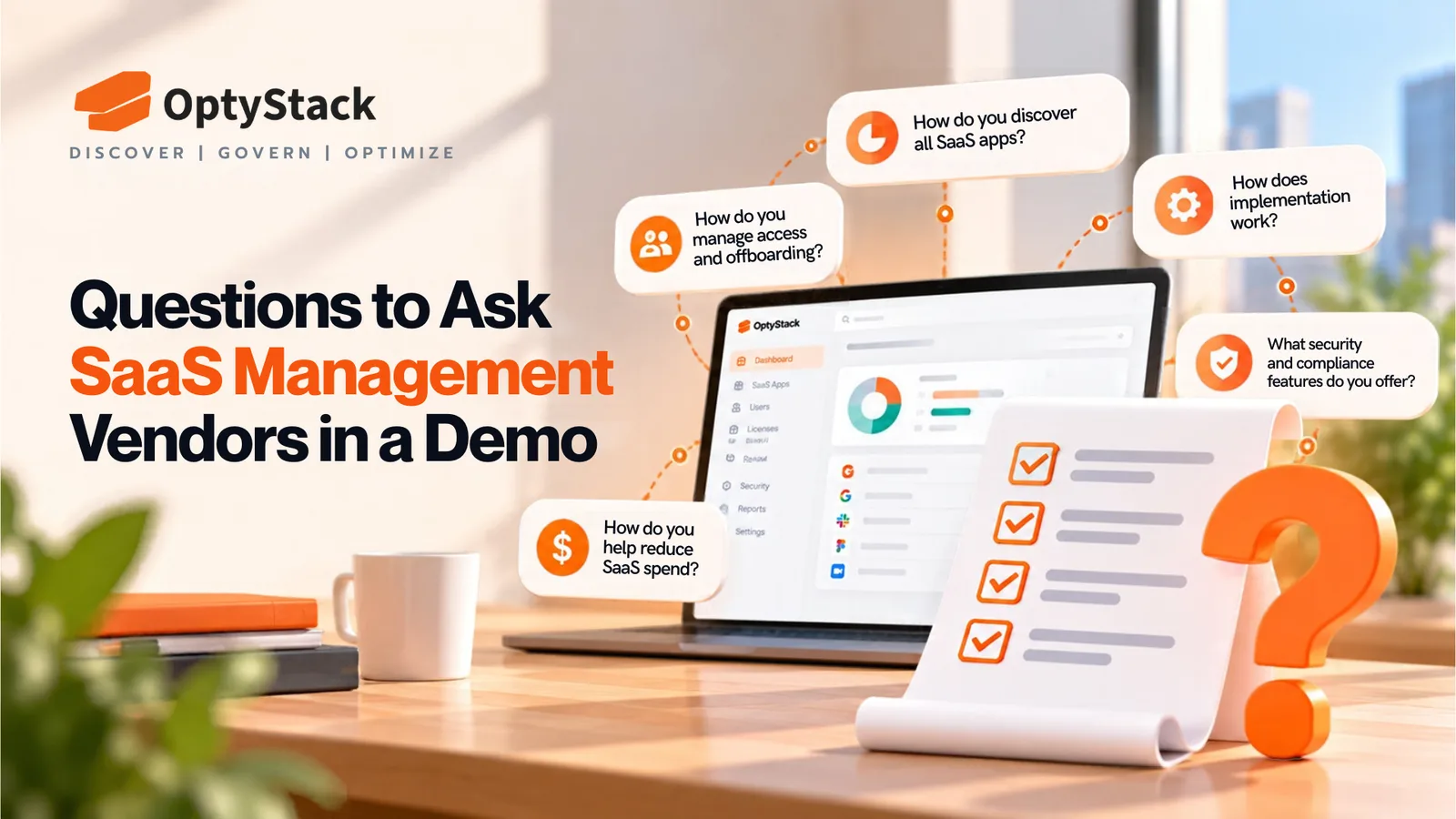
A sales demo is built to show a vendor at its best. Here's a practical list of questions, on discovery methods, data handling, implementation, and pricing, that gets past the script and toward whether the platform will actually work on your real stack.
A sales demo is built to show a vendor's product at its best, with curated data and a script designed to hit every strong point in order. That's a reasonable thing for a vendor to do, and it's also exactly why the questions you ask matter more than the slides you're shown. The questions below are organized to get past the scripted part of the call and toward what actually matters: whether this tool will work on your real stack, not a polished sample one.
Questions about discovery
"Can you connect to a limited slice of our actual stack right now, instead of showing me the demo environment?" A vendor confident in their discovery method should be willing to do this on the call, or within a day or two, not push it off to a formal trial weeks later. Hesitation here is worth noting.
"Walk me through exactly which data sources your discovery pulls from." Push past "we find everything" to a specific answer: identity and SSO logs, expense and billing records, OAuth connections, something else. Each source has a different blind spot, and a vendor who can clearly name theirs is giving you a more honest answer than one who implies total coverage.
"What categories of tools does your platform structurally not see?" Every discovery method misses something. A vendor who can answer this directly, rather than deflecting, is telling you something genuinely useful about where you'd still need another process or tool to fill the gap.
"How long after connecting our accounts would we see a real finding?" Ask for a specific number, hours, days, weeks, rather than a vague "quickly." This is one of the more telling questions in the whole call, since the answer varies enormously between platforms and directly affects how fast the tool proves its value.
Questions about data handling and security
"Where is the data you pull from us stored, and who at your company can access it?" You're handing this vendor billing, identity, and usage data, some of it sensitive. A vague or evasive answer here is worth treating as a real signal, not a minor gap.
"What's your own security certification status, and can we see the actual report, not just a badge?" A SOC 2 or ISO 27001 badge on a website is not the same as a current, verified report covering the right systems and time period. Ask to see it directly.
"What happens to our data if we cancel?" Get a specific answer on deletion timelines and data export, not a general assurance. This is exactly the kind of detail that matters far more after you've already signed than before.
Questions about implementation and support
"What does onboarding actually require from our team, in hours, not just calendar time?" A platform that takes two weeks to deploy but only needs three hours of your team's actual attention is a very different commitment than one that takes two weeks because it needs constant hands-on configuration throughout.
"What's your support response time for a genuine issue, not a feature request?" Ask for a specific SLA, and ask what tier of support that applies to, since enterprise support commitments sometimes differ meaningfully from a base-tier plan.
"Can you connect us with a current customer in a similar situation to ours, not just your best logo?" A reference customer roughly your size, in a similar industry, dealing with a similar problem, tells you more than a reference chosen because they're the most recognizable name on the vendor's customer list.
Questions about pricing and scaling
"What would this cost us in two years at our projected headcount, not just today's rate?" Per-user and usage-based pricing models can scale very differently as a company grows. Get the vendor to walk through the math with your actual numbers, not a generic example.
"Are there any features currently marked as roadmap or coming soon that I should know aren't live yet?" Demos sometimes show a capability that's genuinely still in development. Ask directly which parts of what you just saw are available today versus planned.
"What triggers a plan upgrade, and is that cost predictable or does it depend on usage that's harder to forecast?" An unexpected tier upgrade partway through a contract term is a common, avoidable surprise if this gets clarified upfront.
Questions that reveal more by how they're answered than what's said
"What's a type of company or situation where your platform isn't actually the best fit?" A vendor willing to give a genuine, specific answer here is generally more trustworthy than one who insists their platform fits every use case equally well.
"What's the most common reason a customer churns?" This is an uncomfortable question to ask directly, and that's exactly why it's useful. A thoughtful, specific answer suggests a vendor who's actually reflected on their product's real limitations, not just its strengths.
"If I asked your least happy customer for a quote right now, what would they say?" You're unlikely to get a fully candid answer, but how a salesperson handles this question, defensive and dismissive versus thoughtful and specific, tells you something about how the company handles friction after the contract is signed.
Turning answers into a decision
Write the answers down during the call rather than relying on memory afterward, and compare them against what a second or third vendor says to the same exact questions. The real value of this list isn't any single answer, it's the pattern across vendors: which ones gave specific, confident responses and which ones deflected on the same question repeatedly.
Where OptyStack fits
These questions work regardless of which SaaS management platform you're evaluating, OptyStack included. If you ask OptyStack to connect to a limited slice of your real stack during a demo, that's a reasonable thing to expect, and it's a fair test to apply to any vendor on this list.
It's free to start and doesn't require a credit card, which means you can also just connect your own accounts directly and see what surfaces, without needing a scheduled call to get a first answer.
Start with a real inventory of what's already in your stack. Download the free SaaS audit toolkit, or start free with OptyStack.