When SaaS Management Gets Acquired by Advisory: What CIOs Should Keep Independent
Aryan Malik · October 15, 2026
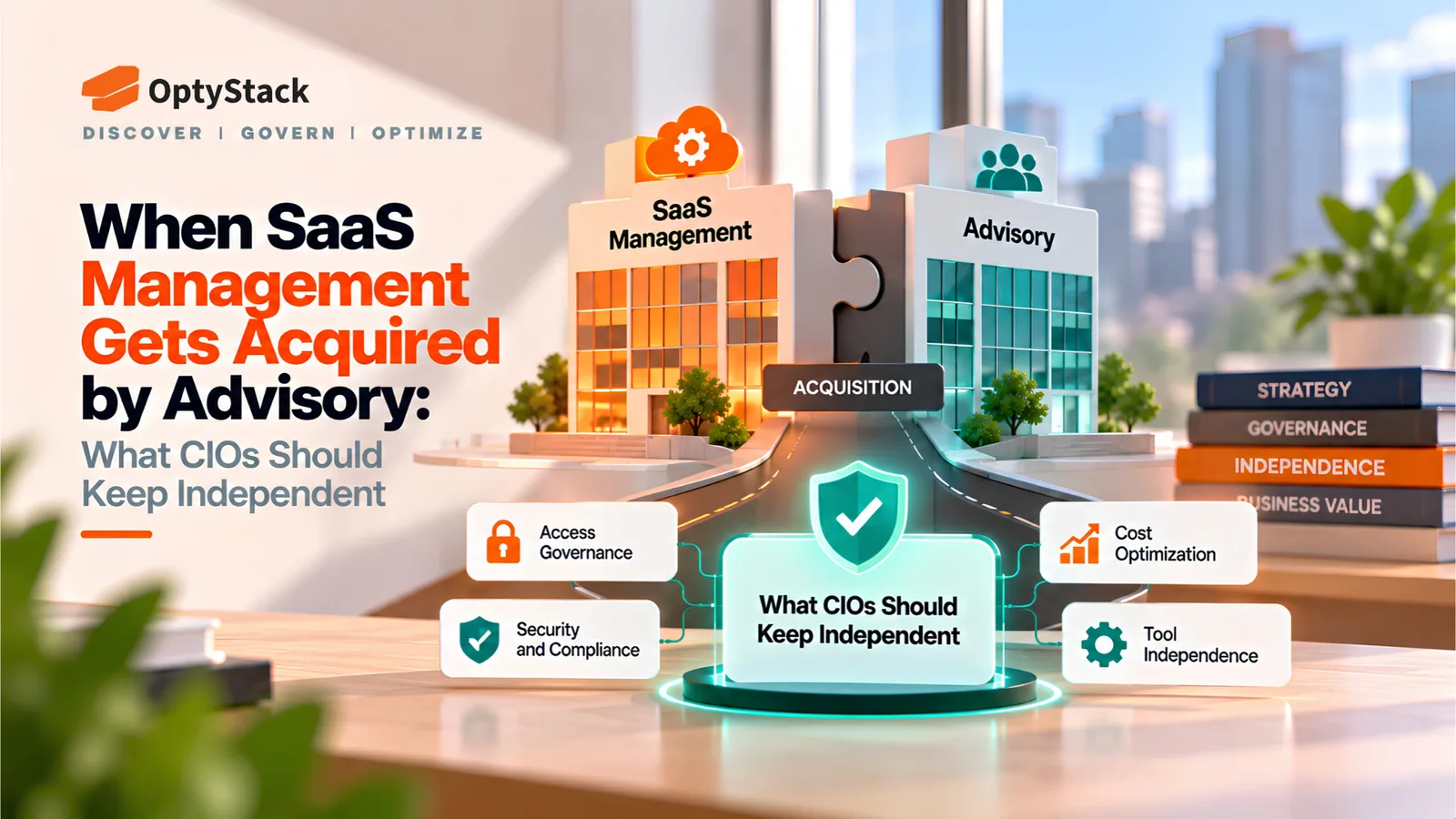
As advisory firms expand into SaaS management, CIOs need to understand how acquisitions affect data governance, vendor evaluations, operational capabilities and exit options. Use this checklist to evaluate vendors and protect your organization's independence.
On October 14, 2026, Infotech, the research and advisory firm formerly known as Info-Tech Research Group, announced the completion of its acquisition of Zluri, a SaaS management and identity governance and administration (IGA) provider. The announcement coincided with the global launch of CIO Analytics, Infotech's API-driven advisory platform. Financial terms were not disclosed. (Read Infotech's announcement)
For CIOs, the deal raises a practical question: when the company advising you also owns a software product, how should you evaluate that relationship?
The acquisition does not establish that customer data will be misused or that vendor evaluations will become biased. It does give buyers a reason to ask clearer questions about data governance, product independence, operational capabilities and exit rights.
What Infotech Acquired
CIO Analytics is an API-driven advisory platform that connects to members' IT systems and combines operational data with Infotech's research, benchmarks, AI-assisted services and analyst expertise.
Infotech launched it with three modules: Service Desk Analytics, Application Discovery, and Identity Governance and Administration. Its announcement says Zluri contributes the application discovery and IGA capabilities. Infotech's stated goal is to help CIOs connect operational data with advisory insight rather than relying on recommendations in isolation.
Zluri provides SaaS management and identity governance capabilities, including visibility into applications, identities, access, usage and software spending. Infotech's announcement does not fully explain how every existing Zluri capability will be packaged, priced or made available through CIO Analytics.
That distinction matters for existing customers. The acquisition is complete, but buyers should not assume that every product, integration or commercial term has changed—or that nothing will change. They should confirm the details directly with their account team.
Why SaaS Management Ownership Matters to CIOs
The Zluri transaction follows two other significant announcements. On October 12, Freshworks announced an agreement to acquire Torii, with the aim of extending Freshservice into software management and AI spend governance. On October 13, Workday announced an agreement to acquire C1.ai, an identity platform for people and AI agents.
These transactions have different strategic objectives, and the Freshworks and Workday acquisitions remain subject to their respective closing processes. Together, they show that established service management, enterprise software and advisory businesses are adding—or seeking to add—SaaS management and identity governance capabilities.
For buyers, the implication is not that independent vendors are necessarily safer or that larger platforms are automatically better. Ownership can change in either direction. The important questions concern how the product will be operated, what happens to customer data, and whether the service continues to meet the organization's needs.
Four Things CIOs Should Keep Independent
1. Advisory methodology and vendor evaluations
Infotech also operates SoftwareReviews, which publishes software evaluations and vendor comparisons. Its Vendor Evaluation Hub describes its approach to evaluating products and vendors against standardized criteria.
That makes governance a reasonable question for buyers—not a reason to assume a conflict. When an advisory organization owns a vendor that may appear in its evaluation ecosystem, CIOs should ask how methodology, disclosures and review processes work.
Useful questions include:
Are evaluation criteria consistent across vendors?
How are ownership relationships disclosed to readers?
What safeguards separate commercial relationships from evaluation decisions?
Can buyers review the methodology used to score products?
Clear answers help procurement teams assess the credibility of advice without making unsupported assumptions about bias.
2. Customer data and its permitted uses
CIO Analytics is designed to connect operational IT data with advisory services. That can create value by giving recommendations a more direct connection to an organization's actual environment. It also makes data governance important.
Before enabling an integration, ask exactly what information is collected, which systems it comes from, and what the platform needs to perform its stated functions.
Clarify whether application inventory, user identities, spending data, usage signals or access information are shared across products. Ask whether customer information may be used for benchmarking or AI-assisted services, and whether that use is aggregated, anonymized or identifiable.
The answers should be reflected in the contract and relevant data-processing terms. Also confirm retention periods, access controls, subprocessors, deletion procedures and how data will be handled if the relationship ends.
3. Operational capabilities and advisory services
Advisory services help CIOs interpret information and decide where to focus. A SaaS management platform serves a different operational role: discovering applications, monitoring spending, reviewing license utilization, tracking renewals and supporting user lifecycle processes.
Some products can cover both strategic and operational needs, but buyers should verify the exact capabilities included in their subscription.
Ask which features are available in the standalone product, which depend on a broader advisory package, and whether integrations or advanced modules require additional fees. Test the workflows that matter most to your organization rather than relying only on a product demonstration.
4. Data portability and exit rights
A vendor relationship should remain manageable even if the vendor changes ownership, pricing or product direction.
Before signing or renewing, verify that you can export application inventories, spending records, renewal information and relevant access data in a usable format. Ask how long exports remain available after termination, whether migration assistance costs extra and what happens to stored data after deletion.
Also check the notice period, auto-renewal terms, service commitments and any contractual provisions triggered by a change of control. A data export that exists only in theory is not a sufficient exit plan; test the process where possible.
A Practical Checklist for Evaluating SaaS Management Vendors
Use the same questions with every vendor you evaluate, regardless of ownership structure.
Discovery coverage: Which sources does the product use—SSO, identity, spending, OAuth or browser signals—and what are the limitations of each?
Spending and renewals: Can you track paid versus active licenses, renewal dates, notice deadlines and contract commitments?
Shadow AI: Can the product help discover AI applications outside approved systems, and what visibility does it provide into AI features embedded in existing tools?
Lifecycle management: Does it support joiner-mover-leaver workflows, and how does it integrate with your identity provider?
Support coverage: What are the support hours, escalation arrangements, local contact options and invoicing arrangements? If you operate in India, confirm IST coverage and GST invoicing where relevant.
Ownership: Who owns the vendor today? Is a transaction pending, and what does your contract say if ownership changes?
Data governance: What data is collected, who can access it, how may it be used, and when is it deleted?
Pricing and exit: Is pricing transparent? Can you export your information in a usable format and leave without unreasonable operational disruption?
For each answer, record whether it is confirmed in writing, stated verbally or still unknown. Then test the highest-priority capabilities against your own data. Compare vendors with different ownership models, but judge them against the same requirements.
Where OptyStack Fits
OptyStack is a standalone SaaS management platform that brings billing, identity and usage signals into a more centralized application inventory. It supports visibility into SaaS spending, unused licenses, renewals, Shadow IT and Shadow AI, alongside user lifecycle management.
For buyers who want to assess a standalone option, the relevant test is the same one used for any vendor: verify discovery coverage, review the workflows you need, understand the product's limitations and confirm contractual terms before committing.
The free OptyStack SaaS Audit Toolkit includes a SaaS inventory, a 25-point audit checklist, a renewal calendar and an audit summary. It helps teams organize application inventories, review spending and prioritize upcoming renewals.
For ongoing contract oversight, explore OptyStack's contract renewal tracking to understand its approach to renewal management.
The takeaway: When SaaS management becomes part of a larger advisory or enterprise platform, CIOs should review data boundaries, operational coverage, transparent governance and exit options. Apply the same standards to every vendor, regardless of who owns it.