SaaS Management vs IT Asset Management Tools
Aryan Malik · October 6, 2026
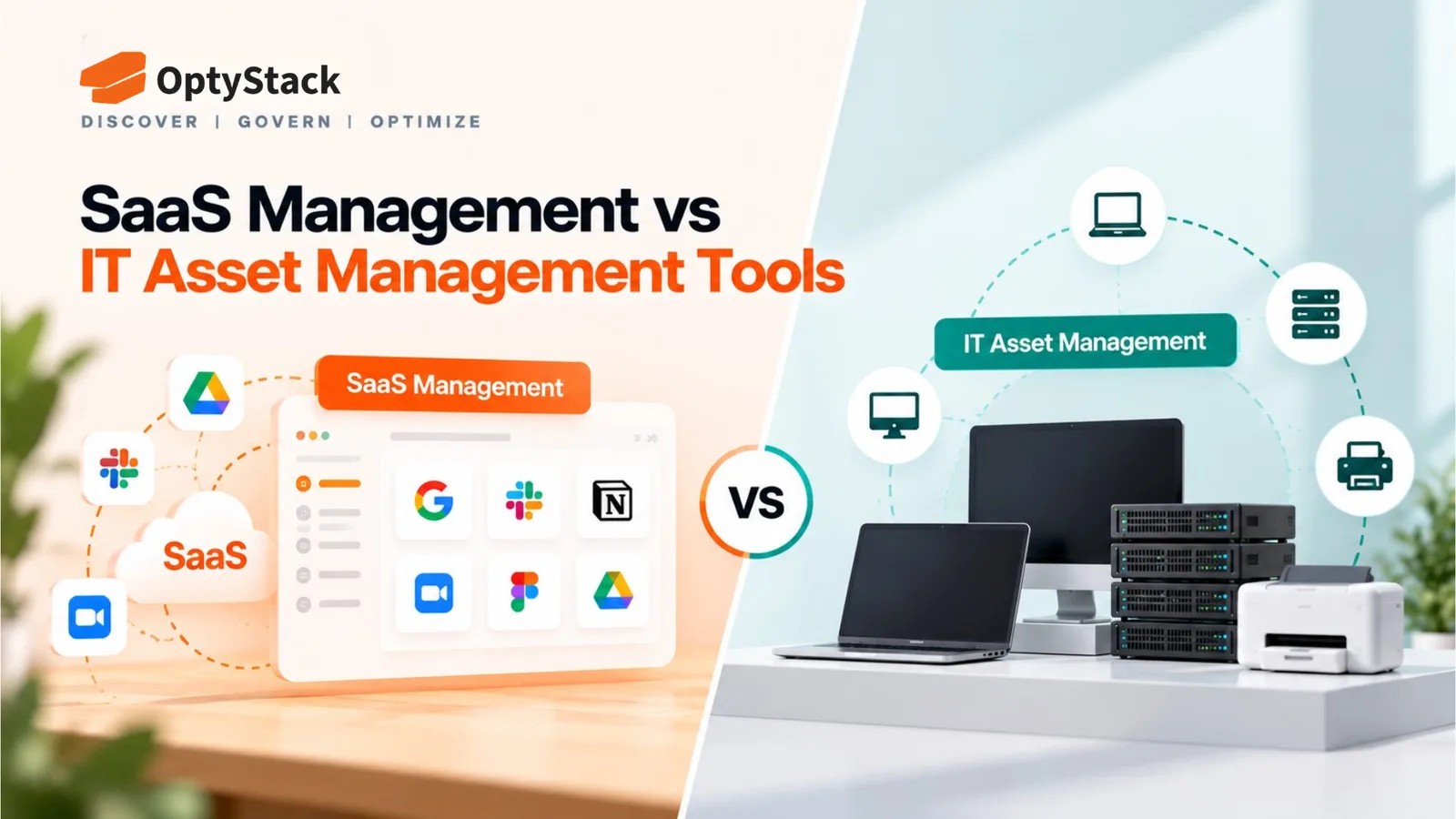
ITAM and SaaS management overlap, but they are designed around different priorities. Learn how the two approaches differ, where they complement each other, and how to decide which tools your organization actually needs.
IT asset management tools and SaaS management platforms are often compared as though they are competing for the same job. In practice, there is significant overlap, but the two categories are usually built around different priorities.
IT Asset Management (ITAM) is designed to give organizations control over their broader technology estate, including hardware, software, cloud resources, contracts, costs, and asset lifecycles. SaaS management is more focused on cloud-delivered applications and the operational questions around discovery, access, usage, spend, licenses, and renewals.
Modern ITAM platforms can include SaaS and cloud management capabilities, so the choice is not always one or the other. The important question is how much depth your organization needs in each area.
What IT Asset Management Tools Are Built to Track
ITAM is fundamentally about managing technology assets throughout their lifecycle, from procurement and deployment through use, maintenance, and retirement.
Depending on the platform and modules included, an ITAM program can cover:
Laptops, desktops, servers, and other hardware
Network equipment and physical infrastructure
Installed software and software licenses
Cloud resources
Contracts and procurement information
Asset ownership and financial information
Maintenance and lifecycle status
Software license compliance
Modern ITAM platforms can extend well beyond physical hardware. For example, ServiceNow describes ITAM as covering hardware, software, and cloud resources, with information such as financial, contractual, lifecycle, and usage data connected to the asset record.
That broader scope makes ITAM useful when an organization needs a centralized view of its entire technology estate rather than only its SaaS applications.
However, ITAM capabilities vary considerably between products. A platform may have strong hardware and software asset management while offering more limited functionality for SaaS usage analysis, application discovery, or subscription optimization.
What SaaS Management Platforms Are Built to Track
SaaS management platforms concentrate on the applications employees access through the cloud and the operational problems created by a growing SaaS environment.
Typical areas include:
SaaS application inventory
Users and application access
License allocation and utilization
SaaS spending
Application usage
Duplicate or overlapping tools
Contract and renewal dates
Shadow IT discovery
User access and lifecycle management
The data sources can also differ from traditional asset discovery. SaaS management may combine identity and SSO data, financial or procurement information, application integrations, and usage signals to build a more complete picture of the SaaS environment.
This matters because an application does not need to be installed on a company-managed device to create cost, security, or governance concerns.
For example, an employee may sign up for a cloud application using a corporate email address and purchase a subscription with a company card. That application can become part of the organization's software environment even though it may not appear in a traditional endpoint inventory.
Modern ITAM platforms can address some of these scenarios, but SaaS management tools are generally designed to provide more focused visibility into the subscription application layer.
ITAM vs SaaS Management: Where the Difference Matters
The distinction becomes clearer when you look at the problems each category is designed to solve.
1. ITAM has a broader technology scope
ITAM can bring together information about physical assets, software, cloud resources, contracts, financial data, and lifecycle status.
SaaS management generally concentrates on cloud applications and the users, licenses, spending, and activity associated with them.
That makes ITAM useful for organizations that need broad asset governance, while SaaS management is useful when SaaS operations are the immediate priority.
2. Discovery methods can produce different visibility
Traditional ITAM environments may rely on sources such as endpoint inventory, configuration management databases, integrations, agents, or network and infrastructure discovery.
SaaS environments can require different signals because applications may be accessed entirely through a browser or personal account.
An endpoint inventory can tell you which software is installed on a managed device. It may not, by itself, provide a complete picture of every cloud service employees are accessing.
3. Physical asset lifecycle is an ITAM strength
If you need to track when a laptop was purchased, who owns it, where it is assigned, when its warranty expires, or when it should be retired, ITAM is the natural category.
SaaS management is not designed to replace that functionality.
4. SaaS operations require application-level visibility
SaaS management focuses on questions such as:
Which applications are employees using?
Who has access to each application?
Which licenses are unused?
How much are we spending?
Which contracts are approaching renewal?
Are multiple teams paying for similar tools?
Which applications were adopted without going through IT?
These questions can sometimes be addressed through ITAM or software asset management modules, but the depth and workflow depend on the platform.
When You Actually Need IT Asset Management
ITAM should be a priority when your organization needs to manage a broad technology estate.
It is particularly relevant when you need to:
Maintain an inventory of laptops, servers, and network equipment
Track physical asset ownership and lifecycle
Manage traditional software licenses
Maintain relationships between assets and configuration records
Track procurement and contractual information
Manage cloud resources alongside other technology assets
Support financial, operational, or compliance processes around technology assets
For organizations with substantial physical infrastructure, ITAM provides a foundation that a SaaS-specific platform is not intended to replace.
When SaaS Management Makes More Sense
SaaS management becomes particularly valuable when the main challenge is controlling a growing cloud application environment.
It can be a strong fit if your organization is dealing with:
SaaS sprawl
Different departments may adopt applications independently, making it difficult to maintain an accurate application inventory.
Unused or over-provisioned licenses
Employees leave teams, change roles, or stop using applications while their licenses remain active.
Shadow IT
Employees can adopt cloud applications without formal procurement or IT approval, creating visibility and governance gaps.
Renewal management
SaaS contracts renew continuously. Without centralized visibility, teams can miss renewal dates or continue paying for applications that are no longer needed.
Duplicate applications
Different teams may purchase separate tools that provide overlapping functionality.
Access and user lifecycle issues
Employees may retain access to applications after changing roles or leaving the organization.
These are fundamentally SaaS governance and optimization problems. A SaaS management platform can provide more focused workflows for them than a general asset inventory alone.
When You Need Both
For larger organizations, the choice does not have to be ITAM versus SaaS management.
Both can serve different layers of the technology environment.
Requirement | ITAM | SaaS Management |
|---|---|---|
Laptop inventory | Strong fit | Outside primary scope |
Hardware lifecycle | Strong fit | Outside primary scope |
Traditional software licensing | Strong fit | Limited/varies |
SaaS application discovery | Available in some platforms | Core capability |
SaaS spend visibility | Available/varies | Core capability |
SaaS usage analysis | Available/varies | Core capability |
Unused SaaS license identification | Available/varies | Core capability |
SaaS renewal management | Available/varies | Core capability |
Shadow SaaS discovery | Available/varies | Core capability |
Physical asset depreciation | Strong fit | Not intended |
This table represents typical positioning rather than a guarantee of features across every product. Modern ITAM platforms increasingly cover cloud and SaaS, while some SaaS management platforms integrate with broader ITAM systems.
The right combination depends on where your organization's visibility gaps actually exist.
What to Ask During a Tool Evaluation
The feature list on a vendor's website rarely tells the whole story. Ask how the platform actually obtains and uses its data.
If you're evaluating an ITAM platform, ask:
How does it discover SaaS applications?
Which data sources are supported?
Can it identify applications accessed only through a browser?
Can it distinguish assigned licenses from actively used licenses?
Does it provide SaaS spend and renewal visibility?
Which SaaS capabilities are included in the base product versus separate modules?
How does it integrate with identity, finance, procurement, and SaaS systems?
If you're evaluating a SaaS management platform, ask:
How does it discover applications outside SSO?
Can it connect application usage with users and licenses?
How does it identify unused or over-provisioned licenses?
Can it track contracts and renewal dates?
How does it discover Shadow IT?
Does it provide visibility into SaaS spending?
Can it integrate with your existing ITAM or CMDB environment?
Also examine the overlap
Cloud infrastructure, software licensing, application contracts, and SaaS can sit across both categories. A product may technically support an area without providing the depth your organization needs.
That is why evaluation should focus on actual workflows rather than simply counting features.
Where OptyStack Fits
OptyStack is a SaaS management platform rather than a hardware-focused ITAM system.
Its focus is the SaaS layer: discovering applications, connecting users and licenses with application data, understanding SaaS spending and usage, identifying Shadow IT and Shadow AI, and helping teams optimize subscriptions and renewals.
OptyStack combines signals such as SSO, spend, and browser activity to help organizations build a clearer view of their SaaS environment. Its product also includes application and user visibility, usage analytics, license optimization, renewal management, and AI-powered recommendations.
It is not intended to replace an ITAM platform for managing laptops, servers, physical asset depreciation, or broader hardware lifecycle processes. Instead, it can complement an existing ITAM environment when an organization needs deeper visibility into its SaaS estate.
OptyStack also offers a free plan with unlimited app discovery and up to three app integrations, while paid plans add capabilities such as unlimited integrations, renewal management, unused license reclamation, and user lifecycle management.
Choosing the Right Approach
ITAM and SaaS management are no longer completely separate categories. Modern ITAM platforms can manage cloud and SaaS assets, while SaaS management platforms can integrate with broader IT systems.
The important distinction is the depth of visibility and control you need.
If your primary challenge is managing hardware, software assets, cloud resources, contracts, and technology lifecycles, ITAM should be part of your foundation.
If your primary challenge is SaaS sprawl, unused licenses, Shadow IT, application usage, spending, access, or renewals, a dedicated SaaS management platform can provide more specialized capabilities.
For many organizations, the strongest approach is to use both: ITAM for the broader technology estate and SaaS management for the application layer.
Start with a real inventory of your cloud application estate. Download the free SaaS audit toolkit, or start free with OptyStack.