Know Your Agent: The Question Singapore Just Asked Banks Is the One Every IT Team Should Ask
Rohit Kumar · November 20, 2026
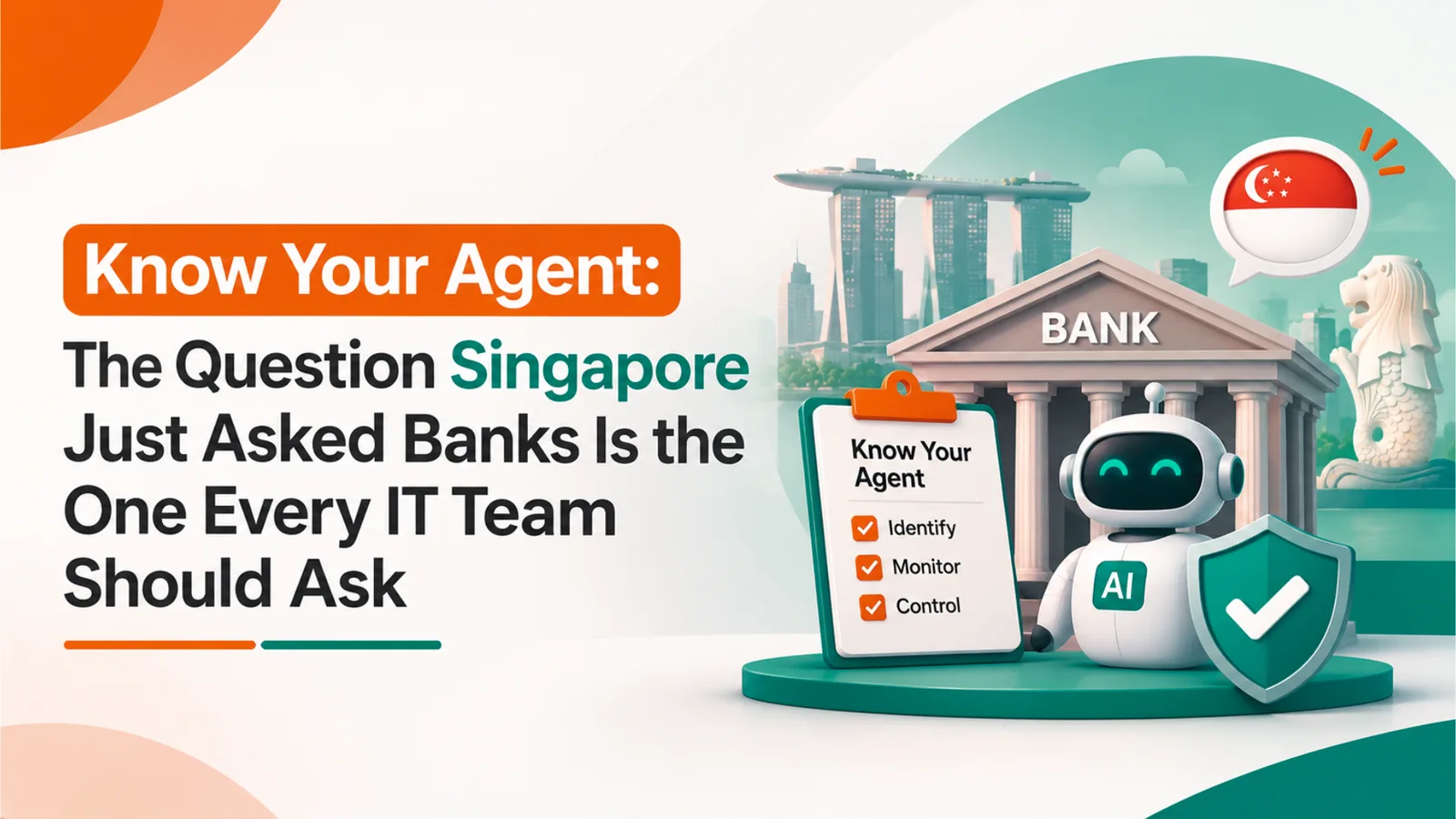
On November 19, 2026, Singapore’s central bank set out a “know your agent” protocol built on identity, authority, and mandate. Those questions apply well beyond banks. This guide shows how IT teams can discover every AI agent, assign a human owner, govern its access, and set the limits it operates within.
On November 19, 2026, at the Singapore Fintech Festival, the Monetary Authority of Singapore (MAS) said it will build a common “know your agent” protocol for banks and payment providers. The protocol is meant to answer four questions before a bank acts on an instruction from an AI agent: who the agent is, whom it represents, what authority it has been given, and what mandate it operates under. MAS managing director Chia Der Jiun said the central problem is simple. A bank does not know whether an agent is acting with the customer’s full authorization, or whether it is staying within its mandate.
Those questions are not only for banks. Any company with AI agents has the same problem: agents act on people’s behalf, and nobody can say with confidence what they are authorized to do. This guide applies the three questions to the work an IT team does.
What MAS Announced, and Why It Matters Beyond Banks
According to AsiaOne’s report on the speech, the protocol will be part of a new phase of MAS’s Safeguards for Agentic Finance at Runtime (SAFR) initiative. It will give institutions information on who an agent is and whom it represents, what authority it holds, what mandate it operates under, and where it came from and how reliable it is. Chia also said consumers should avoid giving AI agents their financial account login credentials, because there are not yet enough safeguards to ensure agents act within their users’ instructions.
MAS’s broader AI risk guidance, which the SailPoint and Allen & Gledhill summaries date to October 7, 2026, asks financial institutions to keep an accurate AI inventory, including agent-specific attributes. The runtime safeguards describe three elements: establishing agent identity and authorization, checking proposed actions against the user’s mandate before execution, and keeping accountability and audit trails. MAS’s guidelines bind the institutions it supervises. The questions behind them apply to any organization that lets software act for its people.
Chia’s own framing is useful for IT teams. He said that “companies would set the mandates for their agents,” and that “autonomy has to be bounded,” with “actions and outcomes” carrying accountability. Those are business rules, not banking rules.
The three terms map to the enterprise like this:
Identity: which agent is acting, and is it registered?
Authority: who approved it, and what access did they grant?
Mandate: what is the agent supposed to do, and what is it not allowed to do?
Most IT teams can answer none of these for every agent in their environment today.
Know Your Agent for the Enterprise
Applying the principle starts with three basic steps.
Discover every agent. Agents built inside SaaS apps, scripts with API keys, OAuth grants to productivity suites, and automations that employees set up on their own all count. Start with OAuth grant reports in Google Workspace and Microsoft 365, the connected-app lists in your identity provider, and the integrations in your project, CRM, and automation tools. Then ask teams which agents they have built.
Assign a human owner. Every agent needs a named person who approves its access and answers for its behavior. An agent with no owner is the enterprise version of an unknown counterparty. Disable it until someone claims it.
Map its access. For each agent, record the systems it can reach, the permissions it holds, and the credential it uses. An agent running on an employee’s personal login inherits that person’s access, and its actions appear in logs under the employee’s name. Identify those cases first, because they are the hardest to explain after an incident.
Discovery alone is not governance, but you cannot govern what you have not found. Gartner’s April 28, 2026 press release lists six steps to manage agent sprawl. The second step is building a centralized agent inventory across sanctioned tools and shadow AI. The third is defining agent identity, permissions, and lifecycle, including reviewing and retiring redundant agents.
Authority: Brokered Sign-In and Conditions, Not Shared Logins
Authority answers a specific question: who is the agent acting for, and under what conditions? The weakest answer is a shared login. A shared account gives every agent the same access, makes actions impossible to attribute, and survives every personnel change.
A stronger model has two parts. First, agents and integrations sign in through a brokered identity layer, rather than holding a standing password or a long-lived key. That gives you one place to see and revoke access. Second, every sign-in is checked against conditions. Conditional access can require approved IP addresses, trusted devices, and approved regions. A sign-in that fails a condition is denied, even when the credential is valid.
OptyStack works this way for connected third-party apps. According to its identity management page, it acts as the identity provider for those apps, imports users from Google Workspace, Microsoft, or Okta, and applies IP address, device, and region conditions to sign-ins. For agents, the same principle applies. An agent should sign in through a controlled path, from a known network, using an identity that can be disabled without touching anyone else.
These controls do not decide what an agent may do once it is inside an app. For that, you need the mandate.
Mandate: Define the Limits Before the Spend
Mandate is the boundary of an agent’s job: what it may do, which data it may touch, and how much it may spend. Gartner’s August 20, 2026 Q&A on CFO governance argues that finance teams should treat their first finance agent as a governance pilot, surfacing gaps in oversight and traceability before scaling. Gartner’s September 26, 2026 research note on enterprise agent cards describes cards that log ownership, define trust limits, and grant expiring access rights.
In practice, a mandate for an IT team covers three things:
Scope: the systems and actions the agent may perform.
Spend: the budget, seats, and credits it may consume, with a limit that stops the agent before the invoice arrives.
Duration: how long the mandate lasts, and when it must be renewed.
License governance is where mandate meets finance. An agent that holds a paid seat, or consumes credits, is spending the company’s money. If nobody reviews that seat, the spend keeps running after the agent stops doing useful work. Renewal dates, seat reclamation, and owner reviews keep the mandate tied to the budget.
A Know Your Agent Checklist
Discover every agent. Include SaaS-embedded agents, scripts with keys, OAuth grants, and browser-based automations.
Record the identity each agent uses. A dedicated identity, a shared account, or a person’s login. Flag every agent running on a personal login.
Assign a human owner and sponsor. Every agent needs a named person who approves its access and can be reached when something goes wrong.
Map authority. Record who approved each agent’s access, which systems it can reach, and the permissions it holds.
Set the mandate. Write down what each agent is for, what it may not do, and its spend and seat limits.
Put sign-in behind conditions. Route agent access through a controlled identity path, with conditions on IP address, device, and region where the platform supports them.
Review on a schedule. Check each agent’s owner, mandate, usage, and renewal date. Retire agents that no longer have a purpose, and reclaim the seats they held.
Where OptyStack Fits
OptyStack covers the discovery, identity, and renewal parts of this checklist. It finds SaaS and AI tools using signals from spend, SSO, and browser activity, and it maps each tool to the people who sign in to it, which gives each agent-bearing tool an owner to assign. It flags shadow AI and ranks each finding by risk. Its identity features apply IP, device, and region conditions to sign-ins for connected apps, and its Pro plan includes unused license reclamation and user lifecycle management.
OptyStack does not set spend caps on AI agents, define per-agent mandates, or discover agents running on devices. It does not create identities for agents. Those controls sit with the agent platforms, your identity provider, and your finance team. OptyStack helps you see the apps and seats involved, and helps close them when they are no longer needed.
To see every SaaS app, AI tool, and identity connected to your organization, start a free trial. If you want to walk through how the inventory maps to owners and renewals, ask OptyStack for a demo.