AI Tool Governance for Mid-Market Companies
Aryan Malik · September 30, 2026
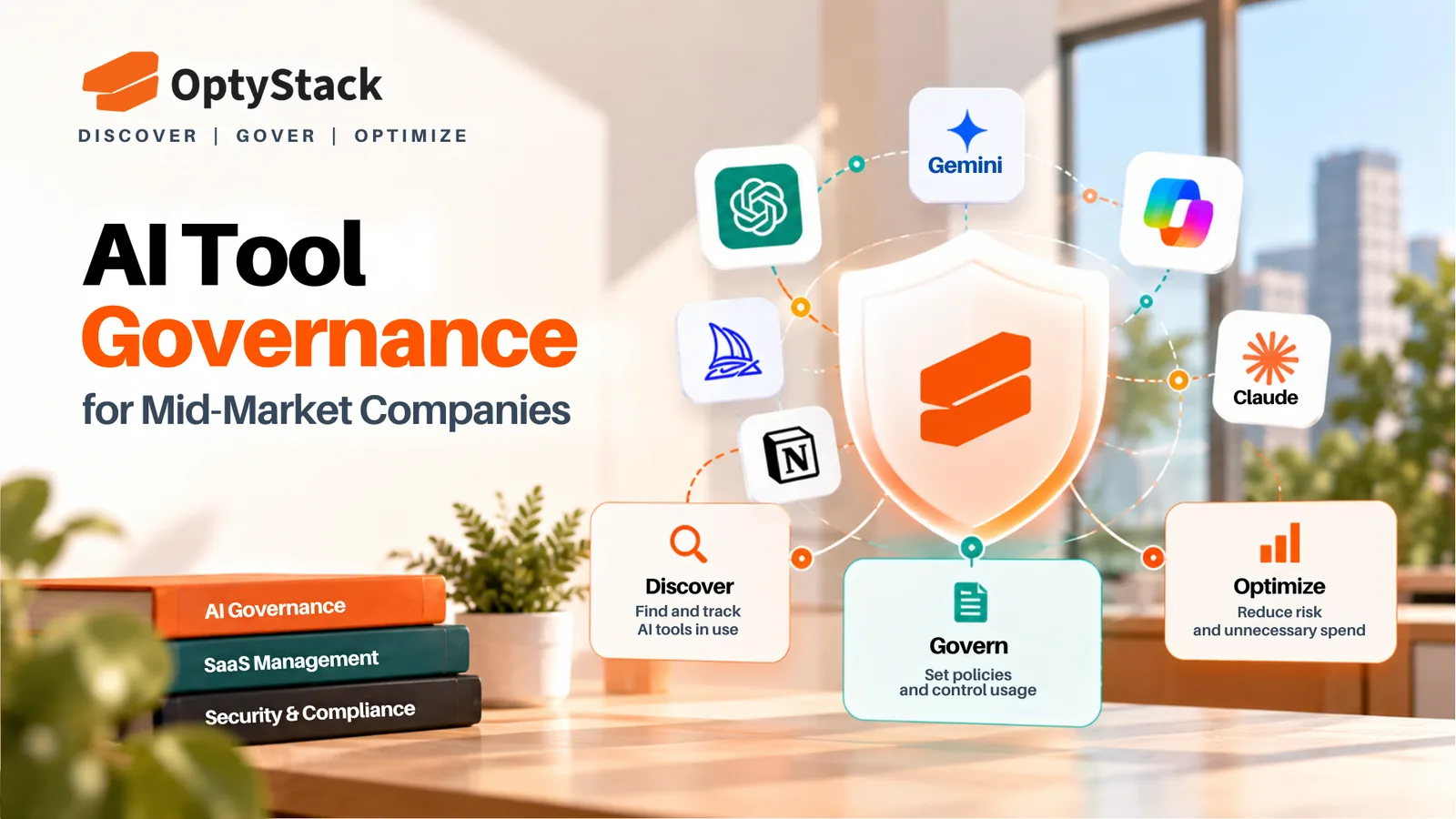
Mid-market companies are the least mature of any size band on AI governance, despite having real risk and real scale. Here's why enterprise governance frameworks are hard to run at this size, and what a lean, workable approach actually looks like instead.
Retool's 2026 State of AI Governance survey, covering 307 senior technology and security leaders, found that mid-market companies, those with 200 to 999 employees, are the least mature of any size band on formal AI governance. Nineteen percent have no formal governance approach at all, compared to 8% at enterprise companies with 1,000 or more employees and 10% at smaller organizations with 50 to 199 employees. Mid-market companies aren't the smallest or the least resourced. They're the group falling furthest behind on this specific problem.
The research cited below uses different definitions of "mid-market," some based on employee count and others on revenue, so the figures should be read as evidence from related but not identical company populations.
Why mid-market sits in an awkward middle
Mid-market companies can have substantial application estates, sensitive business data, and employees adopting AI tools independently, creating real governance requirements without the staffing of a large enterprise. They typically don't have a dedicated AI governance function, a large legal team, or a security staff sized to run the kind of multi-committee review process an enterprise can afford.
Adoption is often outpacing governance specifically at this size. A 2026 Censuswide survey of 401 US IT leaders, commissioned by Netrio, found that 82% of mid-market organizations (200 to 5,000 employees, by this survey's definition) report AI in production or widespread use, but only 26% have it scaled and governed enterprise-wide. The same survey found 42% had a confirmed AI-related security incident in the past year.
Enterprise-scale governance models can be difficult to operate with mid-market resources. A framework built around a dedicated AI ethics office, a standing review committee, and a multi-week approval cycle assumes staffing a mid-market company usually doesn't have. Attempting to run that model with a fraction of the resources can produce a process too slow to actually follow, which risks pushing AI adoption further into the shadows rather than governing it.
What a workable mid-market approach actually needs
A single accountable owner, not a committee. RSM's 2026 Middle Market AI Survey, covering 1,030 senior business leaders, found that 67% of middle market companies apply formal governance controls before moving an AI project into pilot or production. Getting into that group generally starts with naming one person, not a rotating group, responsible for approvals and policy updates. A committee model designed for enterprise scale can become difficult to operate when governance is an additional responsibility for people who already have full-time roles.
A tiered risk classification, applied quickly. Not every AI use case carries the same risk, and treating them identically either slows down low-risk requests unnecessarily or under-scrutinizes the ones that actually matter. A simple three-tier model, low-risk internal tools reviewed quickly, tools touching sensitive data reviewed more thoroughly, and tools with regulatory implications reviewed by whoever handles legal or compliance, keeps the process proportionate without requiring a large staff to run it.
A short, usable policy over a long, comprehensive one. A governance document written to cover every conceivable scenario tends to go unread. A policy that fits on a couple of pages, naming approved tools, data rules, and a clear request path for anything new, is more likely to actually shape behavior than an exhaustive one nobody finishes.
Vendor contract terms that actually address AI use. Grant Thornton's 2026 AI Impact Survey found that only 14% of organizations in the $100 million to $1 billion revenue band had a formal AI enterprise strategy implemented in operations. That gap makes vendor governance especially important: AI features can enter the stack through software vendors even when the company's own AI strategy is still developing. Confirming what data rights a vendor's AI features carry, and building that confirmation into vendor review rather than treating it as a separate, optional step, closes part of that gap directly.
Visibility into what's actually being used, not just what's been approved. A policy describing sanctioned tools is only useful if it's checked against what employees are actually doing. Without some way to see actual AI tool usage across the company, a governance program is really just a set of assumptions.
Common mistakes mid-market companies make
Copying an enterprise framework wholesale. A governance model built for a thousand-person organization with dedicated staff, applied to a two-hundred-person company with none, tends to either collapse under its own weight or get quietly ignored.
Writing a policy once and not revisiting it. AI tools and vendor terms change quickly enough that a policy written a year ago likely no longer reflects the tools actually available or in use.
Treating governance as a legal exercise rather than an operational one. A policy that exists mainly to satisfy a board request, without a practical review process behind it, tends to produce exactly the gap RSM and Netrio's research both describe: a written policy that isn't matched by actual operating controls.
Waiting until the AI footprint is larger to start. The longer ungoverned AI use continues, the more difficult it can become to reconstruct what tools are being used, what data they handle, and who owns the resulting risk. Starting with a lightweight process now is easier than retrofitting governance onto a much larger footprint later.
Where OptyStack fits
Governance depends on knowing what AI tools are actually in use across the company, and building that picture by hand, from expense records, identity logs, and scattered conversations with individual teams, is a heavier lift for a mid-market company without dedicated governance staff than for an enterprise with a team built for exactly this.
OptyStack helps mid-market teams surface AI and SaaS applications across their estate by bringing identity, usage, and spend data together, so a lean governance process has real visibility to work from instead of relying on assumptions about what's actually being used.
It's free to start and doesn't require a credit card.
Start with a real inventory of what's already in use. Download the free SaaS audit toolkit, or start free with OptyStack.