Shadow IT vs Shadow AI: What's Changed
Aryan Malik · September 30, 2026
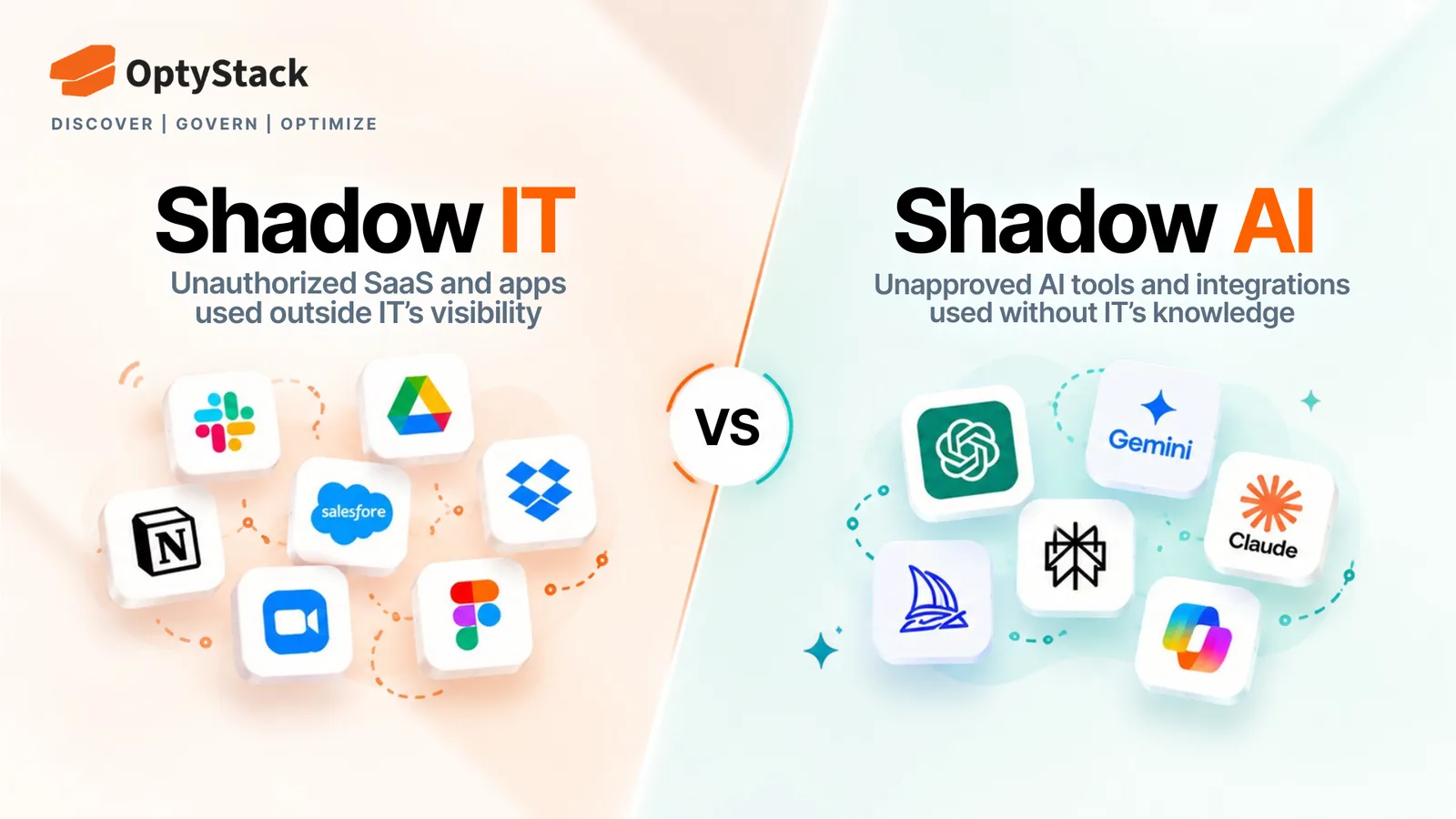
Cisco found a decade ago that enterprises ran 15 to 22 times more cloud apps than IT knew about. Shadow AI is a faster-moving version of the same problem. Here's what's actually different about shadow AI, what hasn't changed, and a side-by-side comparison of both.
Cisco's original Cloud Consumption research, published around 2015, found that the typical enterprise ran 15 to 22 times more cloud applications than IT had actually authorized. CIOs in that study estimated roughly 51 cloud services running in their organization. The real number, based on Cisco's own network traffic analysis, was 730. Shadow IT isn't a new problem. What's changed is how the newest category, AI tools, is expanding.
What classic shadow IT actually looked like
The shadow IT Cisco was describing a decade ago was mostly cloud storage, file-sharing tools, and SaaS applications that employees signed up for because the sanctioned option was too slow, too limited, or simply didn't exist yet. Gartner, in a widely cited 2016 prediction, projected that by 2020 a third of successful enterprise attacks would target shadow IT resources specifically, a signal of how seriously the industry had already started treating unauthorized cloud usage as a genuine security problem, not just an IT nuisance.
What's actually different about shadow AI
The entry barrier is often lower, though not universally so. Many traditional shadow IT services required a separate account, payment method, procurement step, or other visible interaction. AI tools can reduce that friction further, particularly when employees use free services or AI capabilities already embedded in software they access.
The pace of new options is expanding fast, alongside adoption. Netskope's 2026 Cloud and Threat Report tracked the number of distinct generative AI applications it monitors across its customer base growing from 317 to more than 1,600 within a single year. The older shadow IT problem was already large, but the number of available AI applications is expanding alongside adoption at a much faster pace.
What gets shared with these tools is often more sensitive by design. A shadow file-sharing tool mainly stores information. A shadow AI tool is frequently used because it can process and summarize content, which tends to pull in exactly the kind of information, customer data, internal strategy, proprietary code, a company would most want to keep contained.
It hides inside tools that already passed review. A meaningful share of shadow AI risk today isn't a new, separate application at all, it's an AI feature quietly added to a SaaS product a company already approved and uses daily. Classic shadow IT detection assumed a new, distinct app showing up somewhere. AI capability appearing inside existing, sanctioned software is a detection problem the older shadow IT playbook wasn't built to catch.
Organizations increasingly suspect the problem exists, but that awareness hasn't closed the visibility gap. Gartner's 2025 survey of 302 cybersecurity leaders found that 69% of organizations suspected or had direct evidence of employees using prohibited public generative AI tools. The challenge is no longer convincing organizations that shadow AI exists. It is maintaining accurate visibility into where it's actually being used. A 2026 Cloud Security Alliance survey found that 82% of organizations had discovered previously unknown AI agents in the past year, despite 68% reporting high confidence in their existing visibility beforehand.
Shadow IT vs. shadow AI at a glance
Aspect | Traditional Shadow IT | Shadow AI |
|---|---|---|
Adoption | A new, standalone application or service | Standalone AI tools plus AI features embedded in existing software |
Entry barrier | Often required an account or signup | Often browser-based, free-tier, or already embedded in approved tools |
Data interaction | Store, share, or process files | Analyze, summarize, generate, and transform content directly |
Discovery methods | SSO logs, expense records, network traffic, user reports | Same sources, plus monitoring tuned specifically for AI usage |
Primary risk | Unknown applications and unmanaged data flows | Data exposure through prompts, AI-generated outputs, and embedded or agentic capabilities |
Rate of change | Application inventory changes gradually | New tools and AI features can appear and evolve quickly |
Governance response | Application approval processes | Application approval plus data-handling and AI-use governance |
What hasn't changed at all
The root cause is identical. Both categories exist because sanctioned tools move slower than the people who need to get work done. Faster approval processes and better-matched sanctioned tools reduce both forms of shadow adoption for the same underlying reason.
Decentralized buying is still the mechanism. Whether it's a 2015 file-sharing signup or a 2026 AI chatbot, the pattern is the same: an individual or a small team makes a fast, local decision without routing it through any central process.
Detection still requires combining multiple data sources. Financial records, identity logs, and direct conversations with teams were the tools available to find classic shadow IT, and they remain necessary for shadow AI too. What's changed is how quickly the picture built from those sources goes stale, and what else needs to be added to it, not the basic method of building it.
What this means for how companies should respond
A one-time discovery sweep is even less sufficient than it used to be. Given how quickly new AI tools appear and how often AI features get added to existing approved software, a governance process built around periodic, infrequent checks falls behind faster than it did in the classic shadow IT era.
Detection needs to include AI features inside already-approved tools, not just new standalone applications. A review process that only asks "what new apps have appeared" misses a meaningful and growing share of the actual risk.
The response strategy that worked for shadow IT still applies: build a fast path, not just a ban. Gartner's own guidance on shadow IT, going back years, consistently argued the solution wasn't cracking down on unauthorized tools but making the sanctioned path fast enough that people didn't feel the need to route around it. That advice holds for shadow AI, possibly with even more urgency given how quickly employees can find an alternative.
Where OptyStack fits
Detecting shadow AI on top of everything classic shadow IT already required, identity logs, OAuth connections, expense records, financial data, means the discovery workload has grown even as the underlying method stays similar.
OptyStack brings identity, usage, and spend signals together across your SaaS estate to surface both shadow IT and shadow AI applications, including AI capability that's shown up inside tools already sanctioned, so the picture doesn't depend on a periodic manual sweep alone.
It's free to start and doesn't require a credit card.
Start with a real inventory of what's already in your stack. Download the free SaaS audit toolkit, or start free with OptyStack.