Shadow AI Risks: Data Leakage, Compliance and Cost
Aryan Malik · September 28, 2026
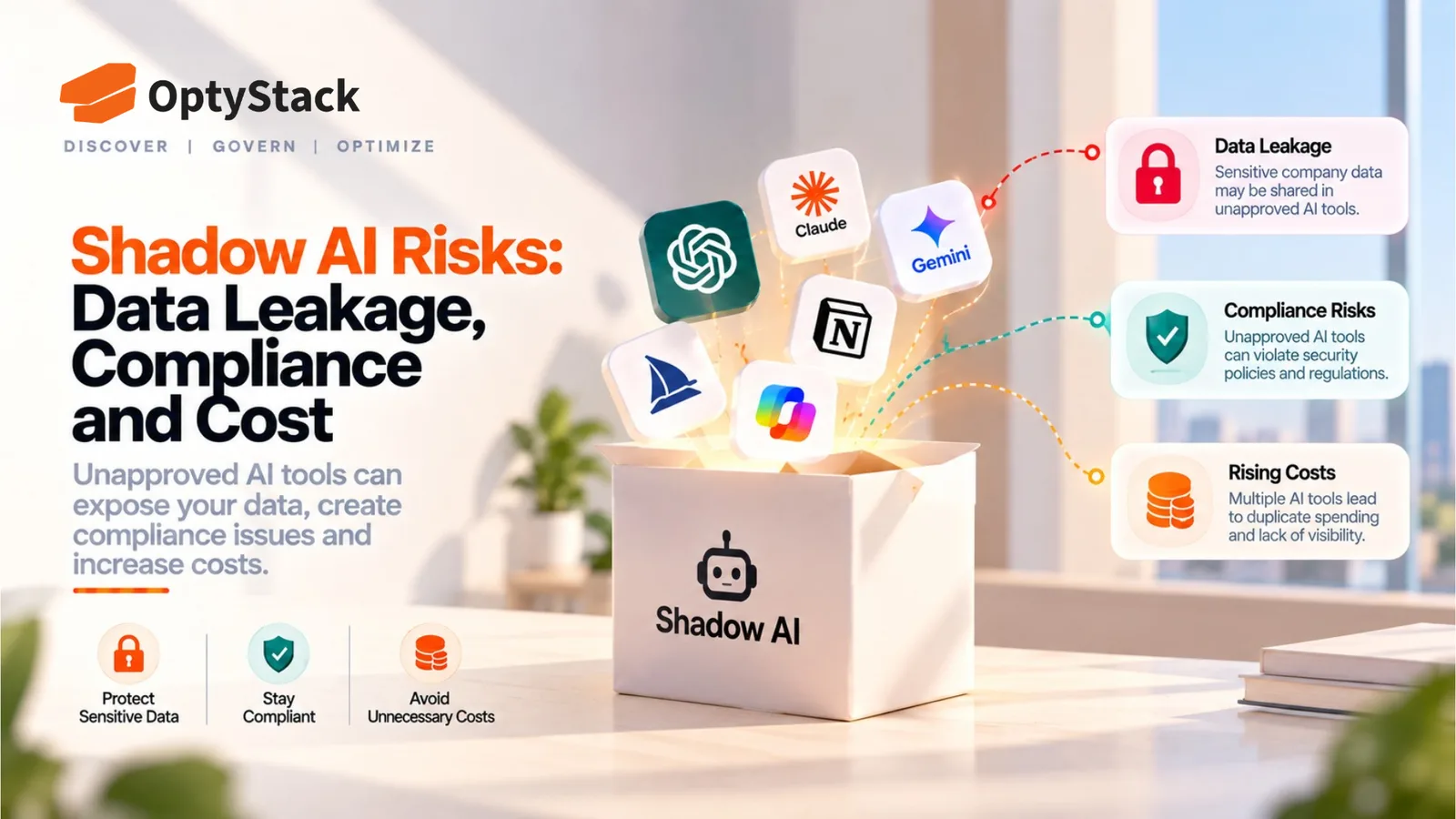
Shadow AI creates risks that extend beyond cybersecurity. Unapproved AI tools can expose sensitive data, complicate compliance, increase SaaS costs, and create access gaps. Learn how companies can identify these risks and build a practical approach to managing Shadow AI.
An employee pastes a customer document into an AI assistant to summarize it. A developer uses a personal AI account to debug code. Finance discovers an AI subscription on a corporate card that nobody added to the software inventory.
None of these actions necessarily looks like a security incident on its own. Together, they can create a visibility problem that affects data security, compliance, and SaaS spending.
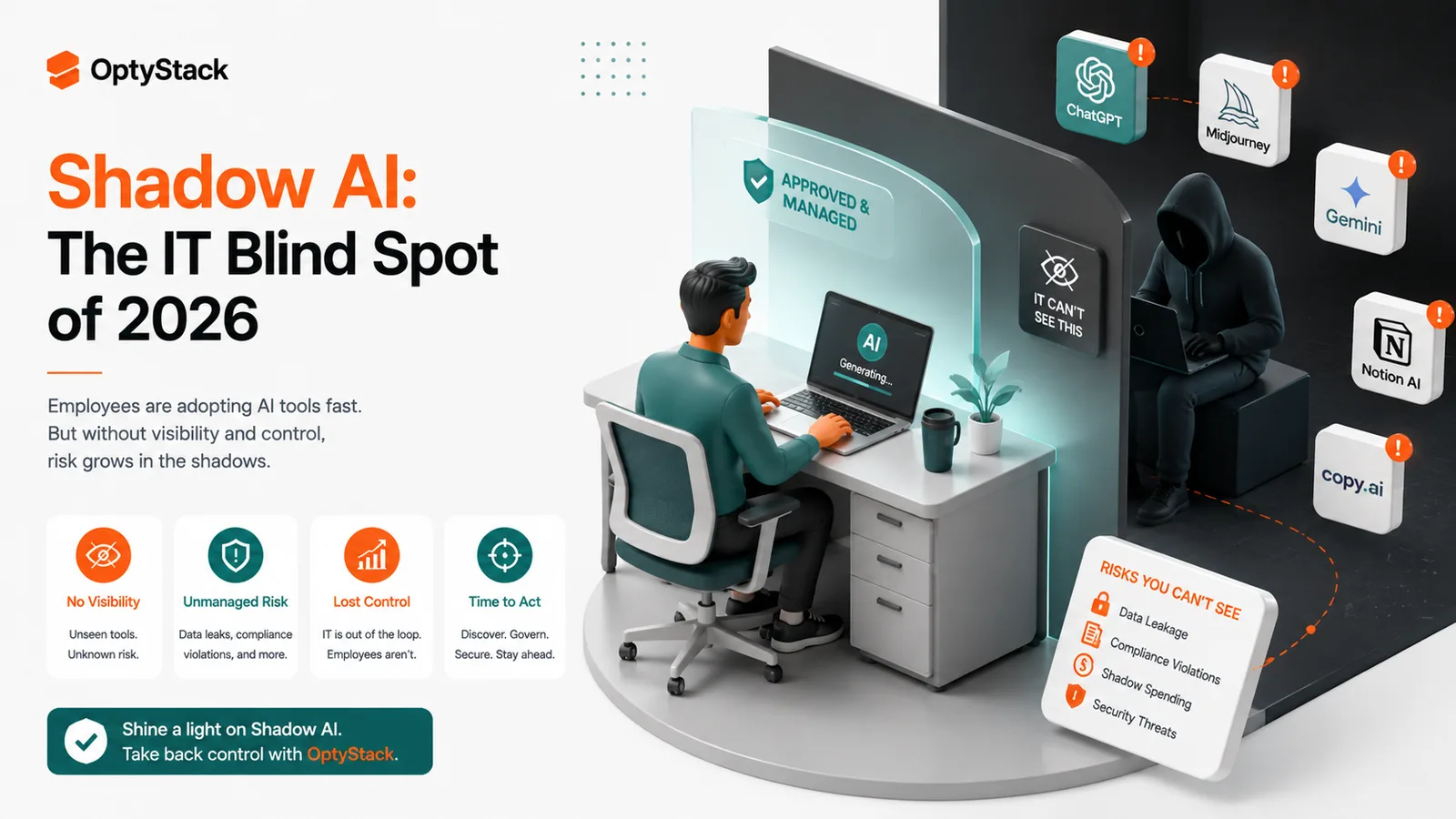
This is the risk of Shadow AI: employees can adopt AI tools quickly, while organizations may struggle to see which applications are being used, what information is being shared, and who is responsible for each tool.
Netskope's 2026 Cloud and Threat Report found that incidents involving users sending sensitive data to generative AI applications doubled over the previous year. The report also found that 47% of generative AI users were using personal AI applications.
1. Data Leakage Through AI Prompts
The most immediate Shadow AI risk is sensitive information leaving an organization's controlled environment.
Employees may paste information into an AI tool because it helps them complete a task faster. The information could include:
Source code
Customer information
Intellectual property
Internal documents
Financial information
Credentials or configuration details
Regulated or confidential data
Netskope's research identifies intellectual property, regulated data, source code, and secrets among the sensitive information transferred to generative AI applications in violation of organizational policies.
The difficulty is not necessarily that employees intend to expose information. Often, they are trying to solve a legitimate business problem.
A simple Shadow AI example
Imagine a developer troubleshooting an application.
They copy an error log into a personal AI account to understand the problem. The log contains internal service information and part of the application's source code.
From the developer's perspective, this is simply a debugging shortcut.
From the organization's perspective, several questions now exist:
What information was sent?
Which AI service received it?
Was the account company-managed?
Does the organization have an approved relationship with the vendor?
What controls apply to the information?
Can the company determine whether similar activity is happening elsewhere?
Without visibility into the application and account, those questions can be difficult to answer.
Personal accounts create another blind spot
An organization-managed AI application may be subject to company policies, identity controls, and other safeguards.
A personal account can sit outside those controls.
Netskope's 2026 AI research found that 56% of AI users used only organization-managed applications, 14% used both managed and personal applications, and 30% used only personal applications.
The figures do not mean that every personal AI account is being used improperly. They demonstrate that providing an approved AI tool does not necessarily eliminate the use of alternatives.
2. Compliance and Privacy Exposure
Shadow AI can make compliance more difficult because organizations may lose visibility into where business or personal data is being processed.
Using an AI application does not automatically create a regulatory violation. The actual compliance implications depend on factors such as the data involved, the organization's legal obligations, the applicable jurisdiction, the vendor's practices, contractual arrangements, and how the service is configured.
Consider an employee processing customer information through an AI application that has never gone through the organization's privacy or vendor review.
The organization may not know:
What information the application receives
Where the information is processed
How long it is retained
Who can access it
What contractual protections apply
Whether the application is approved for that type of information
What evidence exists to demonstrate appropriate controls
This distinction matters because internal policy violations and regulatory violations are not the same thing.
An employee can violate an organization's AI policy without necessarily violating a specific regulation. Conversely, using an AI service to process personal or regulated information can create compliance obligations depending on the circumstances.
IBM's research on Shadow AI identifies data leaks, compliance violations, and loss of control over sensitive business information as potential risks associated with unauthorized AI use.
Incomplete inventories make compliance harder
A company cannot effectively assess its AI exposure if it does not know which AI applications are actually being used.
This makes Shadow AI partly an inventory and visibility problem.
A policy might prohibit employees from entering confidential information into unapproved AI services. But if the organization cannot identify those services, it becomes difficult to determine where additional controls, education, or investigation are needed.
3. Shadow AI Can Increase Software Costs
Not every Shadow AI risk appears on a security dashboard.
Some appear on the finance team's credit-card statement.
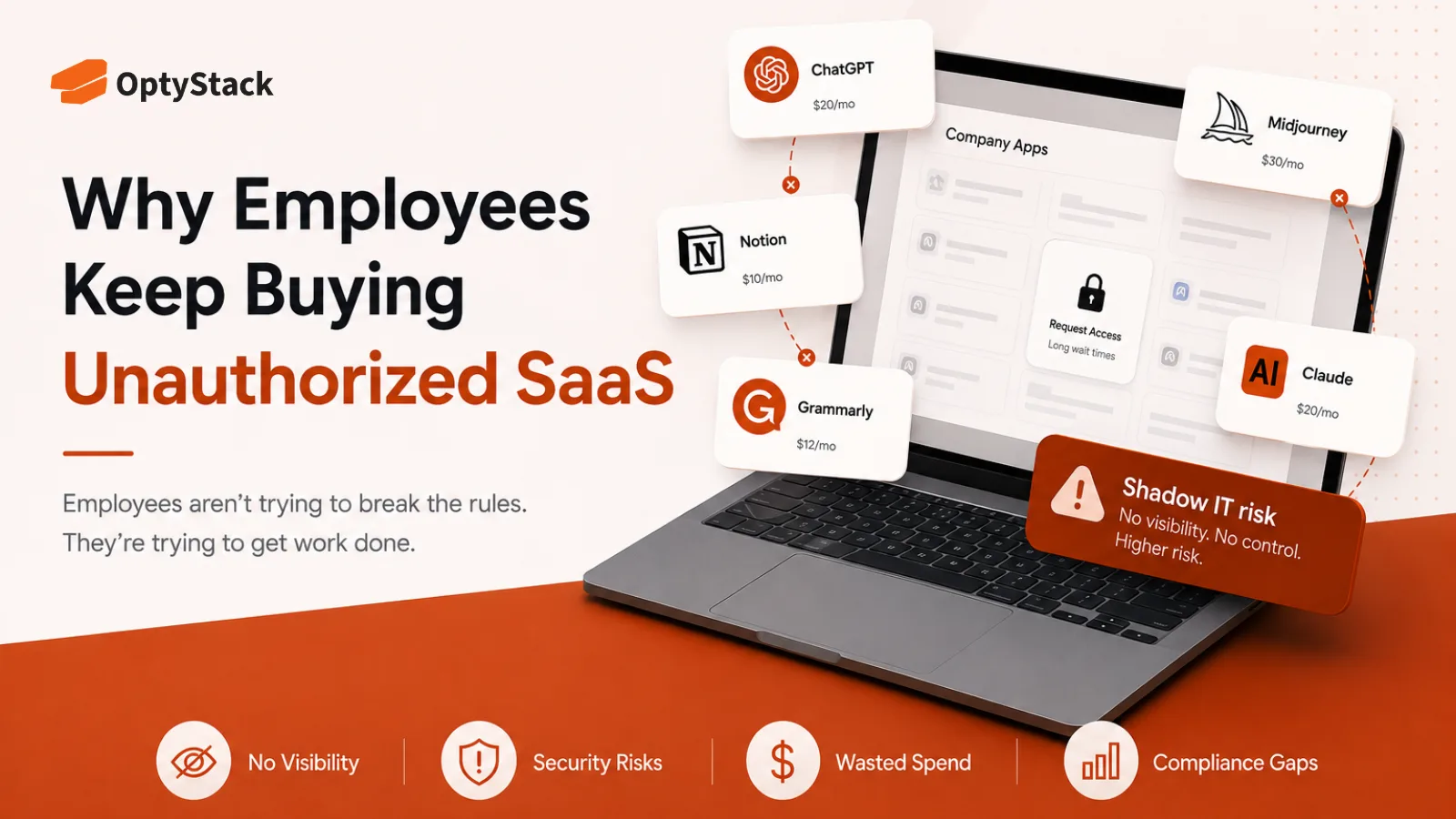
Employees can independently purchase AI subscriptions, create separate workspaces, or use overlapping AI products that provide capabilities already available elsewhere in the company.
For example, suppose a marketing team already has access to an approved AI platform. Several employees independently subscribe to another AI writing service because they prefer its features.
The organization may now be paying for overlapping capabilities without a clear view of:
Who owns each subscription
Which tools are actively used
Whether subscriptions are centrally managed
Whether equivalent functionality already exists
Which subscriptions should be renewed
The financial problem is therefore not simply the cost of one AI subscription.
It can come from fragmented purchasing, duplicate functionality, unused seats, and weak ownership visibility.
This becomes increasingly relevant as AI products introduce per-user subscriptions, usage-based pricing, and AI add-ons within existing SaaS applications.
4. Shadow AI Can Create Access and Identity Gaps
An AI application can become another identity and access-management problem when employees create accounts outside normal provisioning processes.
A personal account may not be connected to the organization's identity provider. An independently created workspace may not appear in the company's application inventory. An employee who leaves may continue to control an account that contains business-related conversations, files, or other information.
The same issue can occur with AI capabilities embedded inside existing SaaS applications.
The application itself may be approved, but a newly introduced AI feature can change how employees interact with data or what information the application can access.
This makes AI governance partly an identity-lifecycle issue: organizations need to understand not only which AI applications exist, but also who is using them and how those accounts are connected to business systems.
5. AI Agents Are Expanding the Risk Surface
Shadow AI is no longer limited to employees manually typing prompts into chatbots.
AI agents can interact with applications, data sources, APIs, and other systems. Model Context Protocol (MCP), for example, provides a way for AI systems to connect with external data sources and tools.
Netskope's 2026 AI Report found that MCP users increased by 250% and transactions increased by 375% over a 10-week period covered by its analysis. The report also found that downstream data-policy violations more than doubled over the previous year as AI applications became increasingly connected to data sources and tools.
This changes the security question.
Instead of only asking:
“What information did an employee send to an AI?”
Organizations increasingly need to ask:
“What information can an AI system access, retrieve, or return?”
That distinction becomes more important as AI moves from answering questions to interacting with business systems and taking actions.
How Companies Can Reduce Shadow AI Risk
Trying to eliminate every form of AI experimentation is unlikely to be practical. A more sustainable approach is to establish visibility first and then apply controls based on the actual risk.
1. Discover AI applications
Combine identity, SSO, browser, expense, and application data where available. No individual source provides a complete picture.
2. Classify the risk
Consider the application's purpose, users, data access, integrations, spend, and approval status.
3. Define clear data rules
Employees should know what types of information can and cannot be submitted to external AI services.
4. Provide useful approved alternatives
If employees have legitimate use cases that approved tools cannot support, overly restrictive policies can encourage workarounds.
5. Review continuously
AI applications, embedded features, subscriptions, and integrations change quickly. Periodic reviews can miss changes that happen between audit cycles.
Where OptyStack Fits
Managing Shadow AI requires more than knowing which AI applications exist. Teams also need context around who is using them, where they appear, what they cost, and how they fit into the broader SaaS environment.
OptyStack provides Shadow IT and Shadow AI discovery by combining signals from browser activity, SSO, and spend data. It maps discovered applications to users, teams, spend, and risk so IT, security, and finance teams can investigate unmanaged tools and prioritize what needs attention.
This makes it possible to bring AI applications into the same SaaS visibility process as other software instead of managing them as a completely separate inventory.
OptyStack also offers a free plan with unlimited app discovery, up to three app integrations, a basic dashboard, and savings suggestions.
Shadow AI is ultimately a visibility problem before it becomes a remediation problem. You cannot properly evaluate an AI application you do not know exists, and you cannot manage AI-related spend, access, or risk effectively when those signals remain scattered across separate systems.
Start free with OptyStack and bring Shadow AI into view.