SaaS Audit Mistakes That Cost Companies Money
Aryan Malik · September 24, 2026
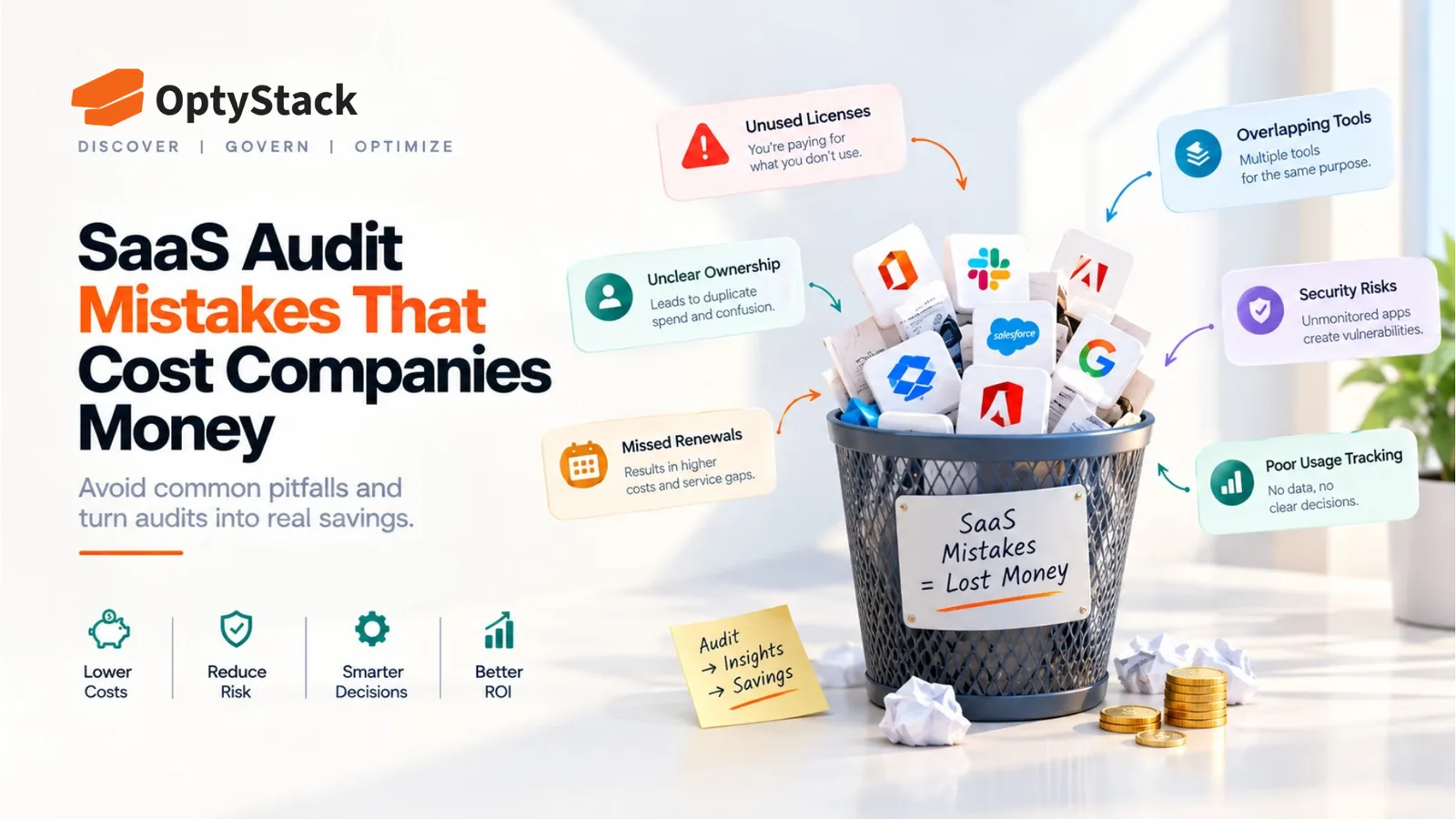
A thorough audit and an effective one aren't the same thing. Here are the SaaS audit mistakes that quietly cost the most, from confusing contract end dates with notice deadlines to letting identified savings never turn into realized ones.
A thorough SaaS audit and an effective one aren't guaranteed to be the same thing. Plenty of companies run a genuinely comprehensive audit, spend real time and effort on it, and still see the same waste reappear a year later because the process itself had a structural flaw that no amount of thoroughness could fix. The mistakes below are the ones that quietly cost the most, because they're rarely obvious until the second or third audit reveals the pattern.
Treating the audit as a one-time event
The mistake. Running a comprehensive review once, then not touching the process again until the same time next year. This is one of the most damaging failure modes, because it makes every other mistake on this list worse, since a year-long gap gives waste plenty of time to compound before anyone catches it.
What it costs. Unused licenses and forgotten subscriptions don't just persist between audits, they accumulate. A tool discovered as waste during an annual audit has often been quietly costing money for the better part of the year already, and the fix, however good, only stops the bleeding going forward rather than recovering what was already lost.
Confusing the contract's end date with the actual deadline
The mistake. Tracking when a contract expires without separately calculating the notice deadline, the date by which you actually have to act to avoid an automatic renewal. Many software contracts require notice well before the end date itself, and that window varies by vendor and contract, sometimes landing anywhere from 30 to 90 days.
What it costs. Missing a notice window generally means locking into another full contract term at whatever price and seat count the vendor sets, with no opportunity to negotiate or downsize. This single mistake can cost more in one missed deadline than an entire year of the audit process would have cost to run properly.
Auditing only the tools everyone already knows about
The mistake. Building the audit's scope entirely from a known list of sanctioned applications, without cross-referencing expense records, identity logs, or OAuth connections to find what's outside that list.
What it costs. The tools most likely to represent unmanaged waste and unmanaged risk are, by definition, the ones nobody's tracking. An audit that never looks beyond the known list systematically misses exactly the category of spend and access most worth finding.
Treating every finding with the same urgency
The mistake. Producing a long list of findings with no prioritization, so a minor, low-cost issue gets the same attention as a significant one.
What it costs. When everything looks equally important, in practice nothing gets addressed first, and the highest-value findings, the ones actually worth real money, can sit unresolved for just as long as trivial ones simply because there was no clear signal about where to start.
Assigning findings to a team instead of a person
The mistake. Recording an action item as owned by "IT" or "Finance" rather than a specific named individual.
What it costs. A finding with diffuse ownership is a finding nobody feels personally responsible for resolving. This is one of the quieter ways audits fail to produce lasting change, since the documentation looks complete even though nothing downstream of it actually happens.
Trusting self-reported vendor data without verification
The mistake. Accepting a vendor's own usage or billing figures at face value during the audit, without cross-checking them against your own identity logs or actual invoiced amounts.
What it costs. Discrepancies between what's billed and what was actually agreed to, or between a vendor's reported usage and your own login data, can happen more often than a company might expect if it has never specifically checked, and they only surface when someone actually verifies rather than takes the vendor's numbers as given.
Fixing the symptom without fixing the cause
The mistake. Resolving individual findings, canceling a specific unused license, removing a specific duplicate tool, without asking why the underlying process allowed that waste to form in the first place.
What it costs. The same category of waste tends to reappear in the next audit cycle, at roughly the same scale, because whatever gap in offboarding, approval, or renewal review produced it the first time is still there. Companies that only ever fix symptoms end up re-solving the same problem repeatedly rather than actually closing it.
Letting the data go stale between the audit and the decision
The mistake. Basing renewal or cancellation decisions on usage and cost data pulled weeks or months before the decision actually gets made, without a fresh check closer to the actual deadline.
What it costs. Usage patterns shift. A tool that looked clearly underutilized during the audit might see a legitimate spike in use by the time the renewal decision is finalized, and acting on outdated data risks cutting something that's since become genuinely necessary, or missing that a tool flagged as fine has since become a real waste item.
Not tracking whether identified savings were actually realized
The mistake. Documenting a list of potential savings from the audit without following up on whether those savings actually materialized.
What it costs. Identified savings and realized savings are not the same number, and the gap between them is where a lot of an audit's real value quietly disappears. Consider a hypothetical audit that identifies $60,000 in annual savings: $25,000 from reclaiming licenses tied to former employees, $20,000 from downgrading three overprovisioned plan tiers, and $15,000 from canceling a duplicate project management tool. If the license reclamation happens but the plan downgrades get deprioritized and the duplicate tool never actually gets canceled because the team using it pushed back, the audit only realizes $25,000 of the $60,000 it identified. Without tracking that gap explicitly, the audit report still shows $60,000 in findings, which overstates the actual financial impact and hides exactly where follow-through broke down.
How to avoid compounding these mistakes
Most of these failures share a common root: treating the audit as a discrete project with a start and end date, rather than an ongoing discipline with continuous inputs. Building a recurring cadence, assigning real ownership to both applications and findings, and tracking outcomes rather than just documenting findings addresses nearly every mistake on this list simultaneously, since they're mostly variations on the same underlying gap.
Where OptyStack fits
Avoiding these mistakes manually requires consistent, ongoing discipline across data-gathering, ownership tracking, and follow-through, which is exactly the kind of process that tends to erode over time without something keeping the underlying data current between audits.
OptyStack keeps application, spend, usage, and renewal data connected continuously across your SaaS estate, so the gaps that cause these mistakes, stale data, missed deadlines, unmonitored shadow IT, are far less likely to go unnoticed between formal reviews.
It's free to start and doesn't require a credit card.
Stop repeating the same audit mistakes. Start free with OptyStack.