The ROI of SaaS Management: What Could You Save?
Aryan Malik · August 26, 2026
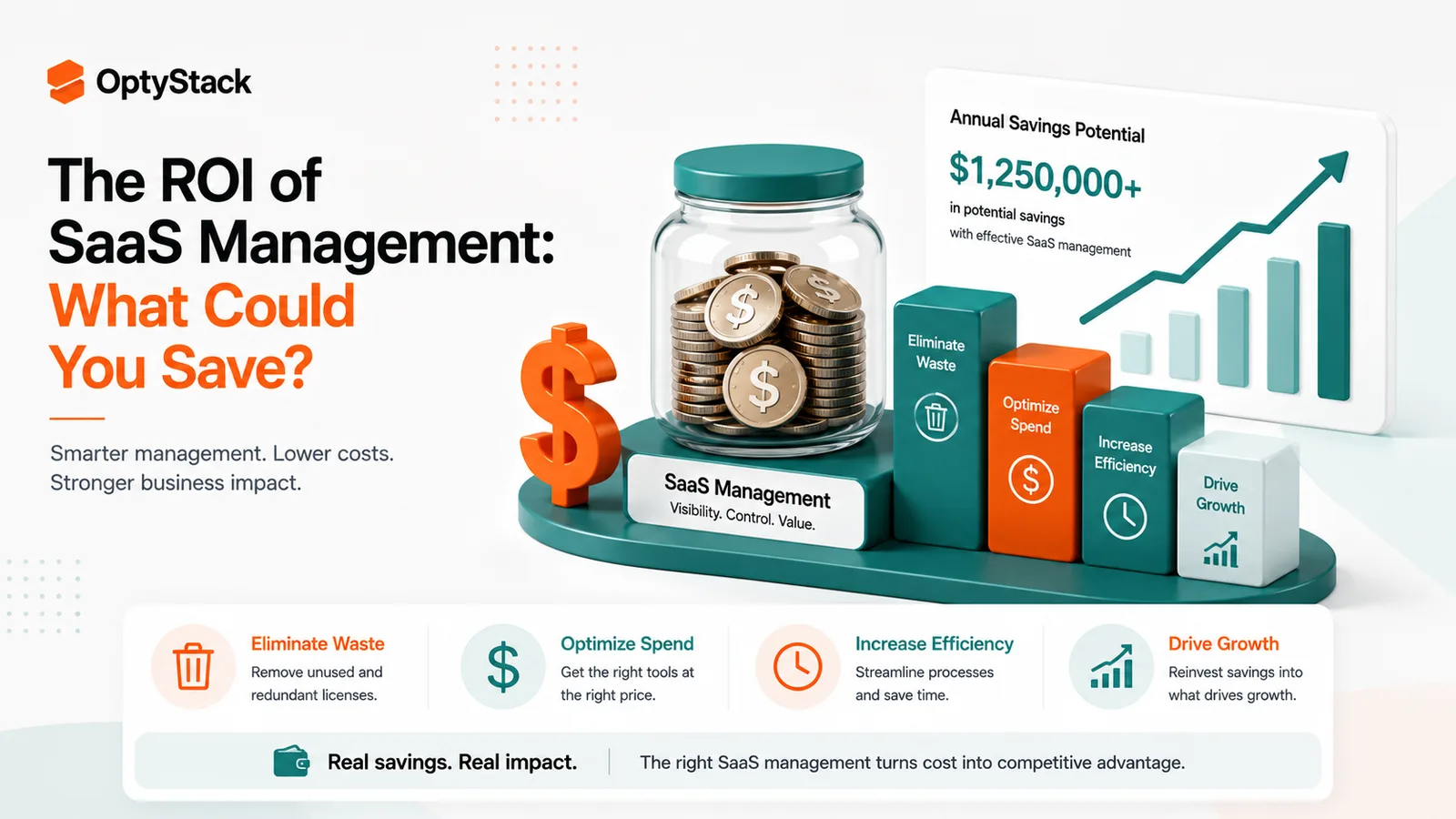
SaaS management ROI is more than cutting unused licenses. Learn how to calculate savings from license reclamation, duplicate software, renewals, cost avoidance, and reduced manual work.
Most companies know they spend a lot on SaaS. What they don't always know is how much of that spend is actually necessary.
There are the obvious costs: unused licenses, duplicate applications, subscriptions that nobody remembers buying, and contracts that renew with the same seat count year after year. Then there are the harder costs to see—time spent reconciling invoices, chasing application owners, finding out who still has access, and discovering a redundant tool only after the renewal has already happened.
That's what makes the ROI of SaaS management different from a simple software purchase calculation. The return isn't just the money you save by canceling a few licenses. It's the combination of spend recovered, costs avoided, and time saved because the company finally has a clear view of its SaaS environment.
What Does SaaS Management ROI Actually Mean?
SaaS management ROI is the financial return a company gets from improving how it discovers, manages, uses, and pays for its software.
The calculation can include several different types of value:
Direct savings: unused seats reclaimed, duplicate applications removed, or plans downgraded.
Cost avoidance: renewals reduced before another year of unnecessary spend gets locked in.
Time savings: less manual work spent finding software, reconciling subscriptions, and preparing renewal reviews.
Risk reduction: better visibility into who has access to applications and which tools are operating outside the normal process.
The important part is to separate these categories. A $20,000 license reduction is a direct saving. Ten hours a month that your IT team no longer spends maintaining a spreadsheet is operational value. They both matter, but they shouldn't be presented as the same thing.
Where the Biggest SaaS Savings Usually Come From
Unused licenses are the easiest place to start
Unused seats are often the most straightforward savings opportunity because reclaiming them doesn't require replacing a tool people depend on.
Zylo's 2026 SaaS Management Index found that organizations use only about 54% of their provisioned SaaS licenses on average, with unused licenses contributing to an estimated $19.8 million in annual waste per organization in its benchmark data.
That figure isn't a promise of what any individual company will save. Your number depends on the size of the software estate, contract structure, licensing model, and actual usage.
But the calculation is easy to understand.
If a company spends $1 million a year on SaaS and finds that 10% of its spend is tied to licenses it can safely reclaim or reduce, that's $100,000 in annual savings. At 20%, it's $200,000.
The point isn't that every company will hit a particular percentage. It's that even a relatively small improvement in utilization can produce a meaningful financial return when the underlying spend is large.
Duplicate software creates savings at the application level
The next opportunity is looking beyond individual seats.
Two departments may be paying for different applications that solve essentially the same problem. A company might have multiple project-management platforms, several design tools, or overlapping AI products.
Removing a duplicate contract can produce a larger saving than reclaiming a handful of inactive seats—but it requires more care.
The teams using those applications need to understand what is changing, what they will move to, and whether they actually depend on a feature that the replacement doesn't provide.
That's why application consolidation is usually a bigger project than license reclamation, even when the potential saving is higher.
Renewals create another window for savings
A company doesn't need to wait until it is ready to cancel an application to save money.
Renewals are when seat counts, pricing, contract terms, and plan levels can all be reconsidered.
Suppose a company is paying $150,000 a year for a platform but has 20% of its seats unused. Going into the renewal with that information gives the company something concrete to negotiate with. The same is true when usage has dropped, a cheaper tier covers the actual requirements, or another application has taken over part of the workload.
The saving doesn't come from the SaaS management platform itself. It comes from having the information early enough to make a better contract decision.
How to Calculate Your Own SaaS Management ROI
You don't need a complicated financial model to get started.
Step 1: Calculate your current SaaS spend
Bring together subscription invoices, corporate card charges, expense records, procurement data, and other known software costs.
Use actual spend rather than the budgeted number. The point is to understand what the company is paying today.
Step 2: Separate applications from licenses
Look at both levels.
At the application level, identify duplicate tools, redundant functionality, and subscriptions that no longer have a clear business purpose.
At the license level, identify unused, inactive, over-provisioned, or misallocated seats.
The distinction matters because a company can be using an application heavily while still paying for far more seats than it needs.
Step 3: Estimate realistic savings
Don't assume everything you flag will become a saving.
Some licenses will be reclaimed immediately. Others may need to stay until renewal. Some duplicate applications may turn out to have business-critical features that justify keeping both.
A useful model is:
Expected savings = reclaimable licenses + contract reductions + avoided duplicate spend + plan optimization
Then keep cost avoidance separate from direct savings.
For example, if you identify:
$40,000 of unused licenses
$25,000 from reducing an oversized contract
$35,000 from consolidating duplicate applications
your potential direct savings are $100,000.
Step 4: Include the cost of managing SaaS manually
There is another side to the calculation.
How many hours does IT spend maintaining spreadsheets? How much time does Finance spend reconciling software charges? How long does Procurement spend preparing for renewals because usage information is scattered across different systems?
You can estimate that operational cost using:
Hours spent × loaded hourly cost = manual management cost
It won't capture every benefit of SaaS management, but it gives leadership a much clearer comparison between the current process and a more automated one.
What a Good ROI Measurement Looks Like
The strongest SaaS management programs don't stop after reporting a large savings number.
They keep measuring what happened.
Track the amount of unused license spend reclaimed. Measure reductions achieved at renewal. Record duplicate applications consolidated. Keep an eye on the time required to prepare renewal and audit reviews.
Then compare those results with the cost of the SaaS management program itself.
That gives you a more useful picture than simply saying, “We saved money.”
You can answer questions such as:
How much did we save?
How much did we avoid spending?
How much manual work disappeared?
How quickly did the investment pay for itself?
What Can Make SaaS Management ROI Harder to Prove?
Not every benefit appears as a line item in the budget.
Preventing a duplicate purchase doesn't always look like savings because the money was never spent. Avoiding a risky application isn't easy to express as an ROI figure unless something goes wrong later.
The same applies to better access visibility. Knowing which users have access to an application has value even if there is never a security incident.
That's why a good ROI model should distinguish between realized savings, cost avoidance, operational efficiency, and risk reduction rather than forcing everything into one number.
Where OptyStack Fits
The challenge is getting enough visibility to calculate those numbers in the first place.
OptyStack brings spend, identity, usage, and application information together so teams can see where SaaS money is going and which areas deserve attention. Its license-management capabilities can surface unused seats, dormant accounts, reclaim candidates, and renewal opportunities, while its broader SaaS visibility helps identify duplicate and unmanaged applications.
That gives teams a way to build a savings pipeline from actual data instead of estimating from last year's spreadsheet.
You can see which licenses can be reclaimed now, which contracts need attention before renewal, and where overlapping applications are creating unnecessary spend.
OptyStack is free to start and doesn't require a credit card.
Find out what your SaaS management ROI could look like. Start free with OptyStack.
Frequently Asked Questions
What is the ROI of SaaS management?
It is the financial and operational return generated by better control of SaaS spend, including direct savings, cost avoidance, reduced manual work, and better use of existing software.
How much can SaaS management save?
There isn't one reliable percentage that applies to every company. Savings depend on the size of the SaaS estate, utilization, duplicate applications, contract terms, and how much waste already exists.
What should be included in a SaaS ROI calculation?
Include direct savings from reclaimed licenses and reduced contracts, cost avoidance from better renewals and procurement, and measurable operational savings from reducing manual SaaS administration. Keep risk reduction separate unless you have a defensible method for quantifying it.
How do you measure SaaS savings?
Start with a baseline of current SaaS spend, then track reclaimed licenses, reduced seat counts, plan downgrades, consolidated applications, and renewal savings. Compare those results with the cost of managing the SaaS environment.
Is SaaS management worth the investment?
For companies with large or rapidly growing SaaS portfolios, the answer depends on how much waste, complexity, and manual work already exists. The best way to evaluate it is to establish a baseline, identify realistic savings opportunities, and measure the results against the cost of the program.
Know What Your SaaS Spend Is Actually Returning
SaaS management shouldn't be judged by how many applications appear on a dashboard.
The real question is whether the company is getting enough value from what it pays for.
If unused licenses can be reclaimed, overlapping tools can be consolidated, renewals can be negotiated with better information, and IT can spend less time maintaining spreadsheets, the return becomes much easier to see.
The numbers won't be the same for every company. But once you know what you're paying for and how much of it people actually use, you can finally calculate what better SaaS management is worth.
Start free with OptyStack and see where your SaaS spend can work harder.