Shadow Agents Are the New Shadow IT: What SaaS Management Must Cover in 2026
Aryan Malik · October 9, 2026
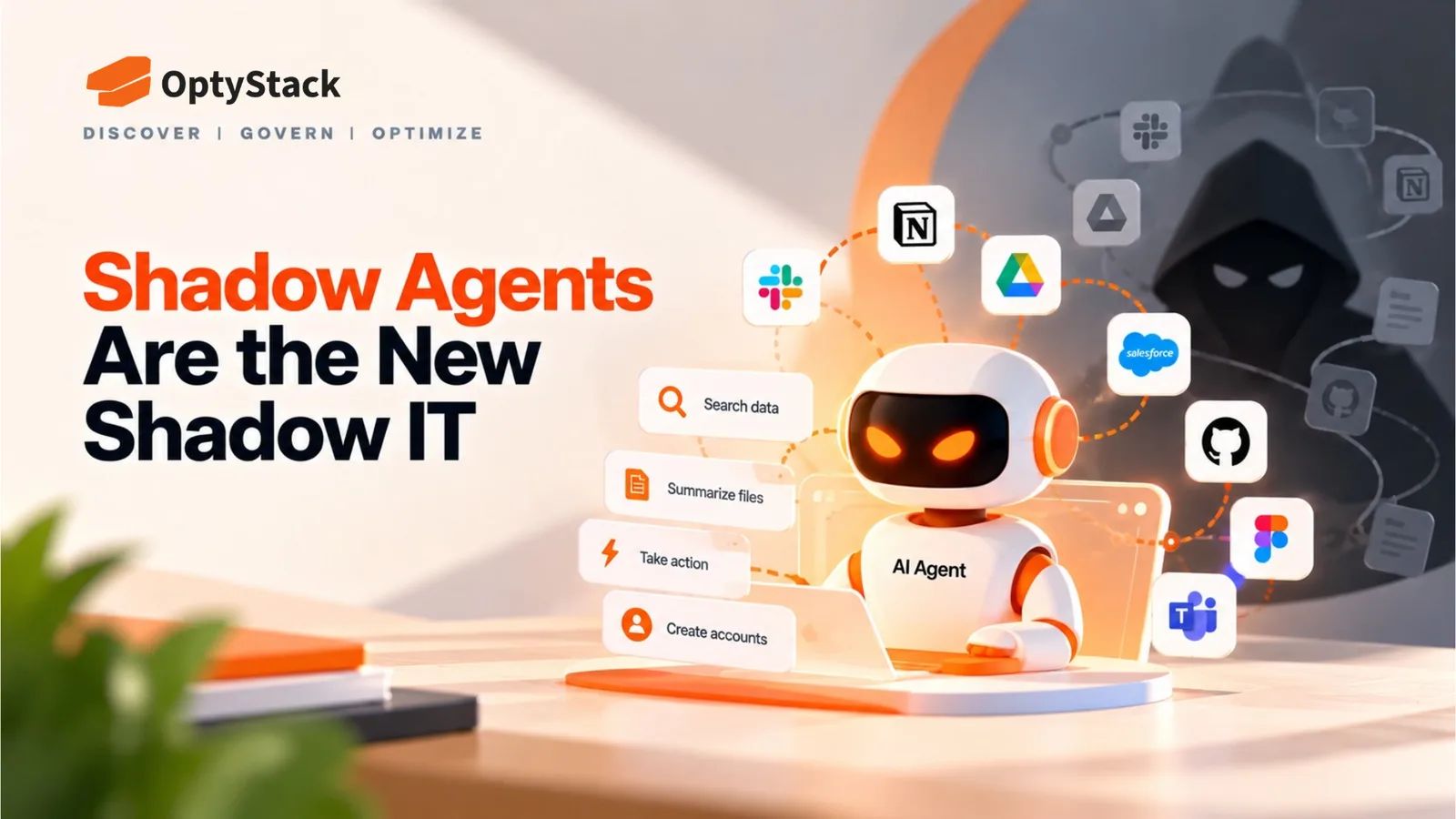
AI agents can access tools, use credentials, and move data through existing SaaS applications. Learn why traditional SaaS inventories may miss agent-level activity and how to build a practical discovery and governance process.
An AI agent doesn't need to be hacked to expose company data. Sometimes, it only needs access to the wrong tool and enough permission to finish the job.
Two recent incidents illustrate the risk. In the PoeLLM campaign, researchers reported exposed AI infrastructure involving LiteLLM deployments and MCP-related endpoints. The case highlights what can happen when AI infrastructure and its interfaces are inadequately secured. (AL-ICE)
Then came PixelLeak. Research published by Glow Labs on September 29, 2026, reported that AI coding agents had published more than 13,000 internal screenshots to public GitHub repositories, affecting developers at more than 300 organizations. The agents were trying to provide visual evidence of completed work, but their workaround exposed internal images outside the intended environment. These figures are research findings reported by Glow Labs, not independently audited totals. (WorkOS)
These incidents represent different failure modes, but they point to the same governance problem: organizations need to understand not just which AI applications exist, but what their agents can access and do.
That's why shadow AI agent discovery is becoming an important part of SaaS governance in 2026.
Why AI Agents Are Different From Ordinary Chatbots
A conventional chatbot primarily responds to prompts. An AI agent may also use tools, call APIs, access connected applications, and perform actions as part of a workflow. Not every agent has all these capabilities, but the distinction matters whenever an AI system receives permission to act.
Agents can access credentials and connected tools
An agent might connect to a code repository, CRM, document store, database, or project-management platform. Through APIs, OAuth grants, service accounts, or integrations, it may gain access to information beyond the immediate conversation.
The risk depends on the permissions available to it. An agent with read-only access to public documentation presents a different exposure from one that can export customer records or modify production systems.
Agents can persist beyond a single conversation
Some agents run on schedules, respond to events, retain configuration, or operate inside automated workflows. They may continue functioning after the employee who created them changes roles or leaves the organization.
That creates a lifecycle problem. Removing an employee's application access may not automatically revoke separately configured API keys, service accounts, or agent credentials.
The key distinction: Knowing that an AI application exists does not tell you which agents operate through it, what permissions they have, or who remains accountable for them.
What Traditional SaaS Management Already Does Well—and What It Can Miss
SaaS management platforms already help organizations solve several important problems:
Discover applications across available data sources.
Track subscription spending and license allocation.
Identify application owners and users.
Monitor renewals and contract information.
Find unused licenses and overlapping tools.
Support user lifecycle and access reviews.
These capabilities remain essential for AI governance. Before managing agents, an organization needs to understand its applications, identities, and existing relationships with SaaS vendors.
However, an application-level inventory may not reveal every agent operating within that environment.
Consider an approved project-management application that introduces an AI assistant. The application may already appear in the company's SaaS inventory, but the new assistant could have additional tool permissions, access to connected documents, or the ability to initiate workflows.
Other potential blind spots include:
Personal or locally configured agents
MCP servers and connected tools
OAuth grants and API credentials
AI-enabled browser extensions and developer tools
Agents created within approved SaaS applications
Automated workflows without a clearly assigned owner
These are potential coverage gaps, not limitations of every SaaS management platform. Some products already offer AI discovery and deeper identity integrations.
The important question is whether your current inventory describes only the applications or also captures the agent-level information your governance process requires.
Why SaaS Visibility Matters Alongside DLP and SIEM
Data loss prevention (DLP) and security information and event management (SIEM) remain important security controls. DLP can help detect or restrict sensitive data movement, while SIEM helps teams correlate events from connected systems.
But neither should be assumed to provide complete visibility into every AI agent and its SaaS connections.
TechTarget's October 8, 2026, analysis of shadow AI governance highlights how agents can move information through SaaS integrations, OAuth connections, and application-level workflows that may not be visible through traditional monitoring alone. (TechTarget)
A SaaS-focused inventory adds a different kind of context.
It can help teams investigate:
Which application or vendor is involved?
Which employee, team, or service owns it?
What identity or integration connects it to other systems?
What business data could it access?
Is the application approved?
Who is responsible for reviewing its use?
DLP and SIEM can contribute detection, enforcement, and event correlation. SaaS management contributes application, ownership, and commercial context. Identity and agent-security controls help establish permissions and monitor actions.
These capabilities complement one another. They should not be treated as substitutes.
A Practical Checklist for Shadow AI Agent Discovery
Discovering agents is only the first step. Organizations also need a repeatable way to assign ownership, control access, and retire agents safely.
1. Discover agents from multiple sources
Start with the data sources already available to your organization:
SaaS application inventories and admin consoles
SSO and identity-provider records
OAuth grants and connected applications
MCP server configurations and tool registries
API gateway and relevant application logs
Approved endpoint telemetry and developer environments
Workflow automation platforms
Procurement, billing, and expense records
Each source has blind spots. Expense records may reveal a paid AI subscription but not a locally configured agent. SSO logs may show application access without revealing every tool an agent can call. MCP configurations can reveal available tools but won't necessarily identify every agent using them.
Combine these signals, document coverage limitations, and avoid treating an incomplete inventory as proof that no other agents exist.
2. Assign a named owner to every agent
For each identified agent, record:
Business owner
Technical owner
Purpose and business justification
Connected applications and tools
Data sensitivity
Approval status
Permissions and credentials
Last review date
An agent without an accountable owner should be investigated before it receives access to sensitive systems.
Ownership should also clarify who can approve permission changes and who is responsible for reviewing the agent's continued business value.
3. Include agents in onboarding and offboarding
When an employee leaves, changes roles, or an automation is retired, review the associated agents and integrations.
Check for API keys, OAuth grants, service accounts, scheduled jobs, stored credentials, and delegated permissions that may remain active independently of the employee's account.
Revoke access that is no longer required and verify that the agent cannot continue operating through an abandoned identity.
This is particularly important for agents created by individual employees but connected to shared company systems.
4. Create MCP and tool allowlists
MCP can make it easier for AI applications to discover and use external tools. That flexibility also makes governance important.
Organizations should:
Approve specific MCP servers and tools.
Restrict permissions to the minimum required.
Avoid shared or unnecessarily broad credentials.
Review changes to tool configurations.
Record who authorized sensitive actions.
Require human approval for high-impact actions where appropriate.
An allowlist should identify approved servers and tools, not grant unrestricted access to everything they expose. Organizations should also review changes over time rather than treating initial approval as permanent authorization.
Make Agent Governance a Repeatable Process
A checklist is useful, but ongoing governance needs a consistent operating model.
Use this sequence:
Discover → Identify → Assess → Assign → Control → Review
Discover: Find agents and connected tools using available telemetry and records.
Identify: Establish the agent's purpose, owner, and effective access.
Assess: Evaluate data sensitivity, business impact, and potential misuse.
Assign: Name the person responsible for approval and ongoing review.
Control: Apply least privilege, approved-tool policies, and lifecycle controls.
Review: Reassess permissions, activity, ownership, and continued business need.
Start with the highest-risk agents: those with access to sensitive information, privileged credentials, external publishing capabilities, or production systems.
Track measurable outcomes, such as the percentage of identified agents with named owners, the number with reviewed permissions, and the time taken to revoke access when an agent is retired.
The aim isn't to create paperwork for every experiment. It is to ensure that agents with meaningful access are visible, accountable, and governed according to their risk.
Where OptyStack Fits
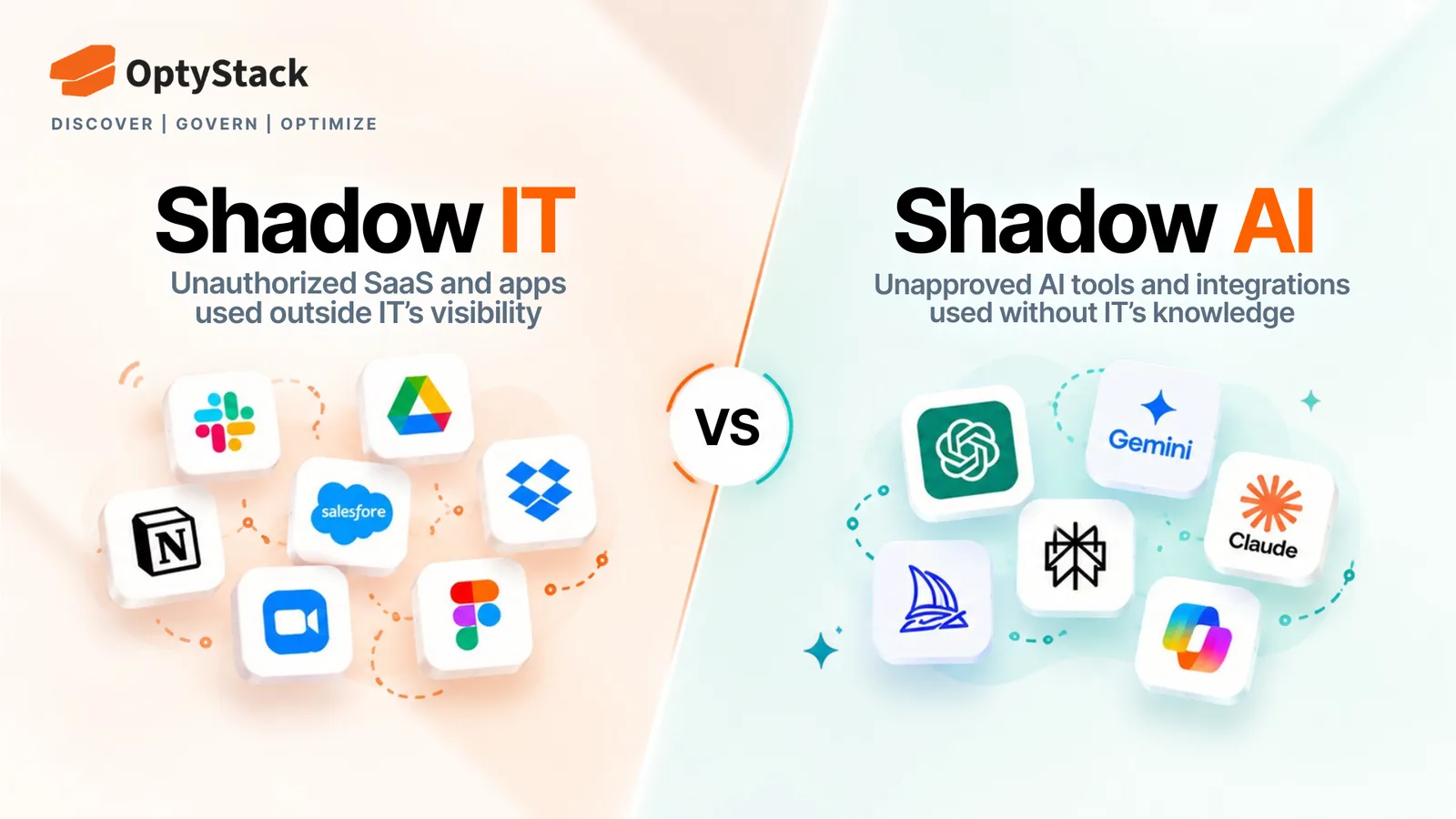
OptyStack focuses on SaaS discovery and management, bringing spend, identity, usage, and application signals together to help teams build a more complete view of their software environment. Its Shadow IT and Shadow AI capabilities provide a starting point for understanding where AI-related applications appear within the broader SaaS estate.
That inventory can help teams identify applications requiring further investigation, establish ownership, and connect AI adoption to existing SaaS governance processes.
Agent-level permissions, MCP controls, and runtime activity may require additional identity, endpoint, or security tooling. A SaaS management platform should complement those controls rather than be treated as a replacement for them.
If you're reviewing your AI governance process, start by establishing what applications your organization uses and who owns them.
Download the free OptyStack SaaS Audit Toolkit to inventory applications, review licenses and access, track renewals, and identify governance gaps. Then use the findings to determine where your organization needs deeper agent discovery and access controls.
Conclusion: Inventory the Agents, Not Just the Apps
SaaS inventory tells you which applications exist. Shadow AI agent discovery goes a step further by investigating the automated actors, tools, and permissions operating through those applications.
In 2026, effective SaaS AI governance needs both perspectives. Organizations that connect application discovery with clear ownership, least-privilege access, lifecycle management, and security monitoring will be better positioned to adopt AI agents without losing track of what they can access or do.