FinOps for SaaS: Bringing Finance and IT Together
Aryan Malik · October 7, 2026
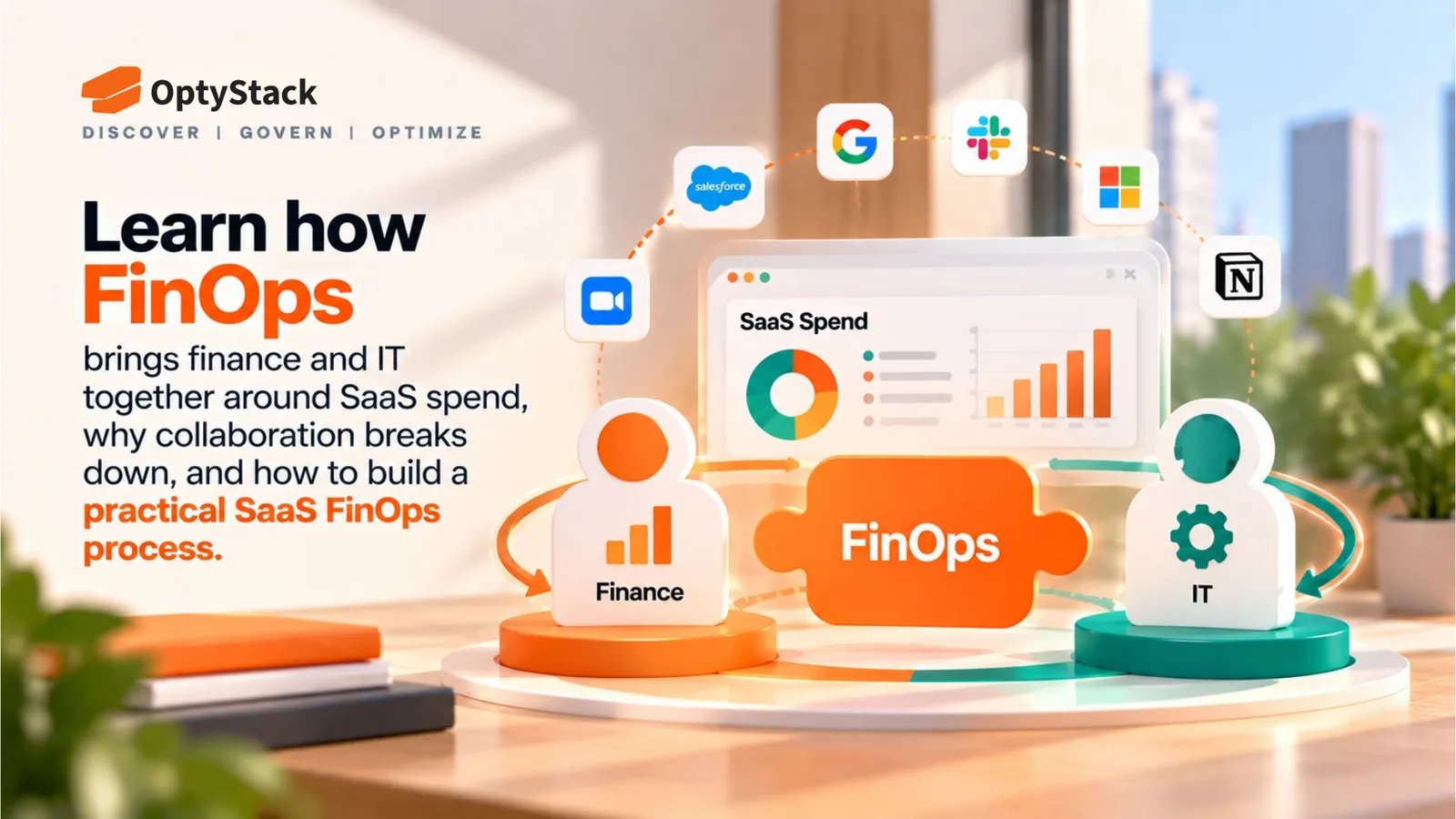
FinOps has expanded beyond cloud, with SaaS now firmly within its scope. Here's why managing SaaS requires closer Finance-IT collaboration and how organizations can build a practical process without a formal FinOps team.
The FinOps Foundation's sixth annual State of FinOps report, based on 1,192 respondents representing more than $83 billion in annual cloud spend, found that 78% of FinOps practices now report into the CTO or CIO organization, up 18 percentage points since 2023. Only 8% report to the CFO. At the same time, 90% of respondents now manage SaaS spend or plan to within the next year, up from 65% in 2025.
SaaS has therefore moved firmly into FinOps scope while the practice itself has become increasingly technology-led.
That creates an interesting organizational problem. SaaS spending sits between a technical decision—what tools get adopted, who uses them, and how they're configured—and a financial one: what the company is spending, whether that spending is predictable, and whether it continues to deliver enough value.
Managing SaaS well requires both sides to work from the same information. Finance brings budget, contracts, and financial accountability. IT brings application, identity, usage, and technical context. FinOps can provide the operating discipline that connects those perspectives.
Why SaaS Specifically Strains the Finance-IT Relationship
Software buying has become increasingly decentralized. A department can adopt a SaaS application through a free trial, a corporate card, or a direct vendor purchase without necessarily involving procurement or IT. Finance may see the charge without knowing who owns the application or why it was purchased. IT may not know the application exists until someone asks for help with it.
That creates a basic visibility gap: one team sees the financial transaction while another may have the operational context.
Spend and usage data live in different systems. Finance typically has access to invoices, budgets, purchase records, and payment information. IT may have access to identity-provider data, application administration consoles, SSO records, and usage information. Neither source provides the complete picture on its own.
Reconciling those sources manually is possible, but it becomes difficult as the number of applications, users, departments, and vendors grows.
SaaS pricing is becoming more varied. Not every SaaS product is purely seat-based anymore. Vendors increasingly use usage-based or hybrid pricing alongside traditional per-seat models. That means forecasting can depend on operational usage patterns that IT understands better than finance.
A finance team can see that a bill increased. IT may be the team that can explain why.
FinOps itself is expanding beyond cloud. The 2026 State of FinOps report found that 90% of respondents now manage SaaS or plan to within the next year. It also found that FinOps teams collaborate most often with IT Financial Management teams, followed by ITAM/SAM, ITSM, and other adjacent disciplines.
The direction is clear: SaaS is increasingly being managed within a broader technology-value discipline, which makes cross-functional collaboration more important rather than less.
What Good SaaS-Focused FinOps Collaboration Looks Like
The objective isn't to create another meeting between Finance and IT. It is to make sure both teams can make decisions using the same underlying picture.
Shared Visibility Into Spend and Usage
Finance should be able to see relevant usage information alongside cost, while IT should be able to understand the financial impact of the applications it manages.
Consider a SaaS application with 500 purchased seats but only 310 active users. Finance can see the subscription cost, while IT may be able to identify which accounts are inactive.
Put those signals together and the organization can ask a much more useful question:
How many licenses do we actually need at the next renewal?
The same principle applies to applications with increasing usage, duplicate tools, unusual spending changes, or subscriptions that are approaching renewal.
Joint Ownership of New SaaS Spend
IT and Finance evaluate SaaS purchases from different perspectives.
IT may assess security, integration, identity management, technical requirements, and operational fit. Finance may evaluate budget impact, contract terms, payment structure, and total cost.
A process that includes both perspectives before significant purchases are approved can catch issues that either function might miss independently.
This does not mean every small SaaS purchase needs a lengthy approval process. It means the organization should define which purchases require financial and technical review.
A Shared Forecasting Model
Forecasting SaaS spend becomes harder when costs depend on changing usage, headcount, contract commitments, or multiple pricing structures.
Finance needs the operational context behind those changes. IT needs the financial context to understand when a change in usage becomes material enough to require action.
A useful forecasting process should therefore bring together:
Current subscription cost
Expected headcount changes
Active and purchased licenses
Usage trends
Contract commitments
Upcoming renewals
Pricing changes
Expected new applications
Known consolidation or optimization opportunities
The FinOps Foundation's 2026 report identifies forecasting, budgeting, allocation, planning, and reporting among the key capabilities teams are applying as FinOps expands across technology categories.
Shared Ownership of Renewal Decisions
Renewals are one of the clearest points where Finance and IT need to work together.
Finance may know the contract value and cancellation deadline. IT may know whether employees actually use the application and whether it remains technically appropriate.
A renewal decision made without usage information can preserve unnecessary spend. A decision made without financial or contractual information can miss an opportunity to renegotiate or consolidate.
A good renewal process therefore brings together:
Cost + usage + contract terms + ownership + business need.
That combination gives both teams enough context to make a defensible decision.
Where Finance-IT SaaS Collaboration Breaks Down
Each Function Assumes the Other Has the Full Picture
Finance may assume IT is monitoring SaaS usage closely.
IT may assume Finance is tracking all SaaS spending.
Neither assumption is guaranteed.
The resulting gap can contain unused licenses, duplicate applications, unmanaged subscriptions, approaching renewals, or applications with unclear ownership.
There Is No Shared Source of Truth
When Finance works from an ERP or expense export while IT works from an identity provider and application admin consoles, both teams can have accurate information that still doesn't line up.
The issue isn't necessarily that either dataset is wrong. It is that the datasets answer different questions.
A useful SaaS management process connects the financial and operational context so that teams can investigate the same application from multiple angles.
Optimization Findings Do Not Automatically Become Actions
Identifying waste is only part of FinOps.
Someone still has to reclaim licenses, change a plan, consolidate applications, cancel a subscription, update an owner, or renegotiate a contract.
This is particularly important as FinOps expands into SaaS. The 2026 report notes that mature FinOps practices are increasingly focused on governance, organizational alignment, forecasting, and broader technology value rather than optimization alone.
For SaaS, that means assigning an owner to each meaningful action instead of treating a dashboard finding as the end of the process.
Building Finance-IT Collaboration Without a Formal FinOps Team
Not every organization needs a dedicated FinOps department to start applying FinOps principles to SaaS.
A small company can begin with a recurring review between one Finance representative and one IT representative. The important part is having a consistent process and shared information.
Start With One Shared Dataset
It doesn't need to be perfect.
A shared SaaS inventory containing applications, owners, users, licenses, spend, contracts, and renewal dates is already more useful than two disconnected reports.
The data can become more sophisticated as the process matures.
Assign One Owner From Each Function
Instead of giving “Finance” and “IT” collective responsibility, designate specific people.
For example:
Finance owner: spend, contracts, budget, forecasting
IT owner: application inventory, usage, identity, access
Business owner: application value and functional requirement
This makes follow-up much easier.
Establish a Monthly SaaS Review
A simple recurring review can cover the same core questions every month:
What new SaaS applications appeared?
What changed in spend?
Which licenses are unused or underused?
Which applications overlap?
Which renewals are approaching?
Which applications need an owner or governance review?
What optimization actions are still open?
Who owns each action and when is it due?
This creates a lightweight operating rhythm without requiring a large FinOps organization.
Move From Visibility to Action
The FinOps Foundation's 2026 report emphasizes that understanding cost comes before optimization. Teams need reliable allocation, forecasting, budgeting, planning, and reporting foundations before optimization can consistently produce value.
The same principle works for SaaS.
First establish what applications exist and what they cost. Then connect that information to usage, ownership, contracts, and renewals. Only after that can Finance and IT confidently decide what to keep, right-size, consolidate, reclaim, or retire.
A Simple SaaS FinOps Operating Model
For organizations starting from scratch, the process can be kept straightforward:
Inventory → Measure → Prioritize → Act → Repeat
Inventory: Identify every SaaS application the organization pays for or uses, including applications purchased outside formal procurement channels.
Measure: Record spend, licenses, active users, owners, usage, contracts, and renewal dates.
Prioritize: Focus on unused or underused licenses, duplicate applications, unmanaged tools, significant spending changes, and upcoming renewals.
Act: Decide whether to keep, right-size, reclaim, consolidate, renegotiate, or retire the subscription.
Repeat: Refresh the data regularly so the inventory and renewal calendar do not become outdated.
This is also the structure used in the OptyStack SaaS Audit Toolkit, which includes a SaaS Inventory, 25-Point Audit Checklist, Renewal Calendar, and Audit Summary. The toolkit is designed to help teams record applications, owners, seats, activity, spend, contracts, renewal dates, and audit actions.
Where OptyStack Fits
Building this shared view manually can become difficult when spend, identity, usage, and application information live across separate systems.
OptyStack brings spend, identity, usage, and application signals together to help teams build a current view of their SaaS environment. That gives Finance and IT a common reference point for understanding applications, users, licenses, spending, and potential optimization opportunities.
The platform also focuses on areas such as license optimization, Shadow IT and Shadow AI discovery, renewal management, and SaaS governance.
It's free to start and doesn't require a credit card.
Start With a Real SaaS Inventory
Before trying to optimize SaaS spend, establish what is actually in the environment.
The free OptyStack SaaS Audit Toolkit gives you four working components:
SaaS Inventory — record applications, owners, seats, activity, spend, contracts, and renewal information.
25-Point SaaS Audit Checklist — review discovery, ownership, licenses, cost, renewals, access, security, and governance.
Renewal Calendar — track renewal dates, notice periods, cancellation deadlines, auto-renewals, and decisions.
Audit Summary — get a consolidated view of applications, annual spend, unused apps, upcoming renewals, and audit progress.
The toolkit includes sample data to demonstrate the formulas and dashboard. That sample data should be replaced with your organization's actual spend, usage, contract, and application information before using it for decision-making.
Start with a real, shared inventory of your SaaS spend and usage. Download the free SaaS audit toolkit, or start free with OptyStack.