How Often Should You Audit Your SaaS Stack?
Aryan Malik · September 21, 2026
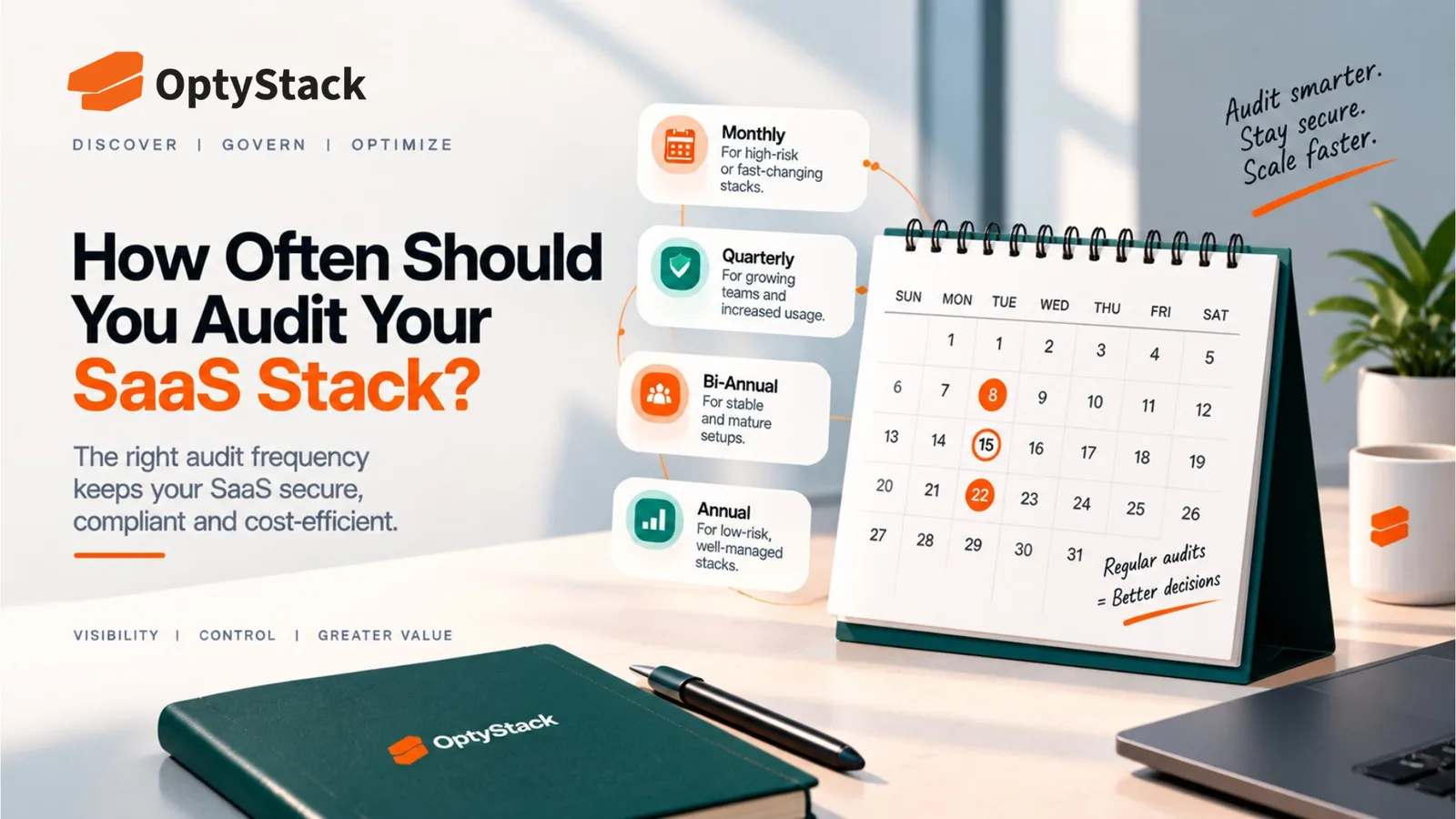
A ten-person startup and a three-thousand-person enterprise shouldn't audit their SaaS stack on the same schedule. Here's a practical framework for setting the right audit cadence based on growth rate, data sensitivity, compliance needs, and what past audits have found.
There's no single correct answer to how often a SaaS audit should happen, and any article that gives you one number without asking about your company first is oversimplifying. A ten-person startup running fifteen well-known tools and a three-thousand-person company running four hundred applications across a dozen departments don't need the same cadence, and treating them identically wastes effort on one end or leaves real risk unmonitored on the other.
The better question isn't "how often should audits happen." It's "what specifically about my company should determine that answer."
The factors that actually decide the right cadence
How fast the company is adding new tools. A company in a slow-growth or stable phase, with roughly the same headcount and tool count year over year, can generally get away with a lighter cadence than one adding new employees and new departments every quarter. New hires and new teams are consistently where new, unreviewed tools enter a stack, so the pace of growth is a reasonable proxy for how quickly your audit needs to repeat.
How decentralized software buying already is. A company where every purchase still routes through a small, central team has more built-in visibility than one where any department can sign up for a tool independently. The more decentralized the buying, the more frequently an audit needs to run just to catch what's entered the stack since the last check.
How much of the estate touches sensitive data. A company running mostly low-risk internal tools, project trackers, general collaboration software, carries less urgency than one where a meaningful share of its stack touches customer financial data, health information, or other regulated categories. Higher data sensitivity generally justifies a tighter review cycle, independent of company size.
Whether the company has compliance obligations with their own evidence requirements. A SOC 2 or ISO 27001 commitment often expects consistent, ongoing evidence of controls operating over time, not a single point-in-time snapshot. Companies under this kind of obligation typically need more frequent internal checks than a comparable company with no such requirement, simply to have the evidence ready when it's asked for.
What past audits have actually found. A company that ran an audit last year and found almost nothing wrong has some evidence its existing processes are working reasonably well. A company that found a meaningful amount of waste, unused licenses, duplicate tools, unrevoked access, has direct evidence that whatever cadence produced that backlog wasn't tight enough, and should tighten it going forward.
A practical framework by company stage
Early-stage companies with a small, well-known tool count can generally operate on a lighter cadence, a thorough review once or twice a year, since the estate is small enough that major gaps are less likely to hide undetected between checks.
Growth-stage companies adding headcount and tools quickly benefit from a tighter cycle, commonly quarterly for a fuller review, with lighter monthly checks on the highest-cost or highest-risk applications specifically. This is the stage where sprawl typically accelerates fastest, and a once-a-year cadence tends to fall behind the pace of new tool adoption.
Larger, more established organizations with formal governance already in place often settle into a structured rhythm: a comprehensive annual audit as the deep, full-estate review, supplemented by quarterly or even monthly checks on the categories that change fastest, new applications, access changes, and upcoming renewals.
Not every part of the audit needs the same frequency
Treating the entire audit as a single, uniform event is itself part of what makes the cadence question harder than it needs to be. Different parts of a SaaS audit naturally warrant different frequencies:
Discovery of new applications benefits from the tightest cadence, since a tool adopted last month and left unreviewed for a year represents nearly a full year of unmanaged risk and unmonitored spend.
License utilization and cost review works reasonably well on a quarterly rhythm for most companies, frequent enough to catch waste before it compounds, without requiring constant attention.
Renewal and contract review should be tied to each contract's own notice deadline rather than a fixed company-wide schedule, since renewal timing is inherently staggered across a real portfolio of vendors.
Access and security review generally deserves the tightest cadence of all for high-risk systems specifically, financial platforms, customer data, and your identity provider, even if lower-risk tools can go longer between checks.
Signs your current cadence isn't tight enough
You're regularly surprised by tools you didn't know existed. If new discoveries during an audit are a recurring pattern rather than a rare exception, the gap between audits is long enough for meaningful sprawl to build up unnoticed each time.
Unused licenses keep showing up for the same reasons. If departed-employee licenses or abandoned trial subscriptions are a repeat finding audit after audit, the underlying process generating that waste isn't being caught quickly enough to actually fix.
Renewals keep arriving without enough lead time to negotiate. If contract reviews consistently start too close to the notice deadline to actually prepare, the renewal-tracking cadence specifically needs tightening, even if the rest of the audit cycle is otherwise reasonable.
Where OptyStack fits
Committing to a tighter audit cadence is a reasonable decision that's genuinely hard to sustain manually, since more frequent reviews mean more frequent data-gathering across billing systems, identity logs, and vendor admin panels each time.
OptyStack keeps application, spend, usage, and renewal data connected continuously across your SaaS estate, so a tighter cadence doesn't require proportionally more manual effort each time you check in.
It's free to start and doesn't require a credit card.
Start free with OptyStack.