SaaS Renewal Management: How to Stop Auto-Renewals From Draining Your Budget
Hemant Wadhwani · July 3, 2026
Auto-renewals are where known waste becomes permanent. Miss a notice window and you're locked in for another year at full price. Here's how to build a renewal management process that turns every contract into a planned decision instead of a surprise.
SaaS Renewal Management: How to Stop Auto-Renewals From Draining Your Budget
Quick answer: SaaS renewal management is the practice of tracking every contract's renewal date and notice window, reviewing usage before each one, and deciding deliberately whether to renew, downgrade, consolidate, or cancel — before the auto-renewal locks the spend in. The single highest-leverage move is reviewing each contract 90 days out, while you still have time and negotiating power.
Renewals are the moment where SaaS spend management either pays off or falls apart. Everything you learn about waste during the year — the idle seats, the duplicate tools, the over-provisioned plans — only translates into savings if you act on it before the contract renews. Miss that moment and the waste isn't waste anymore. It's committed spend for another twelve months. This guide shows you how to make sure that never happens.
Why renewals are where waste becomes permanent
Think of it this way: a lightly-used tool is a problem you can still fix, right up until the renewal date. After that, it's a year-long commitment. The renewal is the hinge.
This is what makes renewal management one of the highest-leverage disciplines in all of SaaS cost control. The absence of a renewal process often costs more than the price of any single contract, because it's the mechanism by which all your known waste gets locked in. A duplicate platform survives because nobody compared it to alternatives before the deadline. An over-sized seat count rolls over because nobody reviewed utilization in time. A premium tier renews because the cheaper plan was never evaluated.
The pattern is always the same: the waste was visible, the fix was possible, but the clock ran out. Renewal management is, fundamentally, about never running out of clock.
The auto-renewal trap
Most SaaS contracts auto-renew by default. That's convenient for the vendor and dangerous for you, because it shifts the burden: instead of having to actively choose to continue, you have to actively choose to stop — and you only have a narrow window to do it.
That window is the notice period — typically 30 to 60 days before the renewal date — and it's the most important date in any contract. Inside that window, you can cancel, downgrade, or renegotiate. Once it closes, the renewal triggers automatically and you're committed for the full term at the agreed price, with essentially zero leverage.
Here's the cruel arithmetic of it. If your notice window is 60 days and you find out a tool is barely used 30 days before renewal, you've already missed your chance — even though you technically caught the waste a month before the bill. The deadline that matters isn't the renewal date. It's the notice deadline, which sits weeks earlier and is invisible unless you're tracking it.
This is why "we'll review it when the invoice comes" is a guaranteed loss. By invoice time, every decision has already been made for you.
Building a renewal calendar that actually works
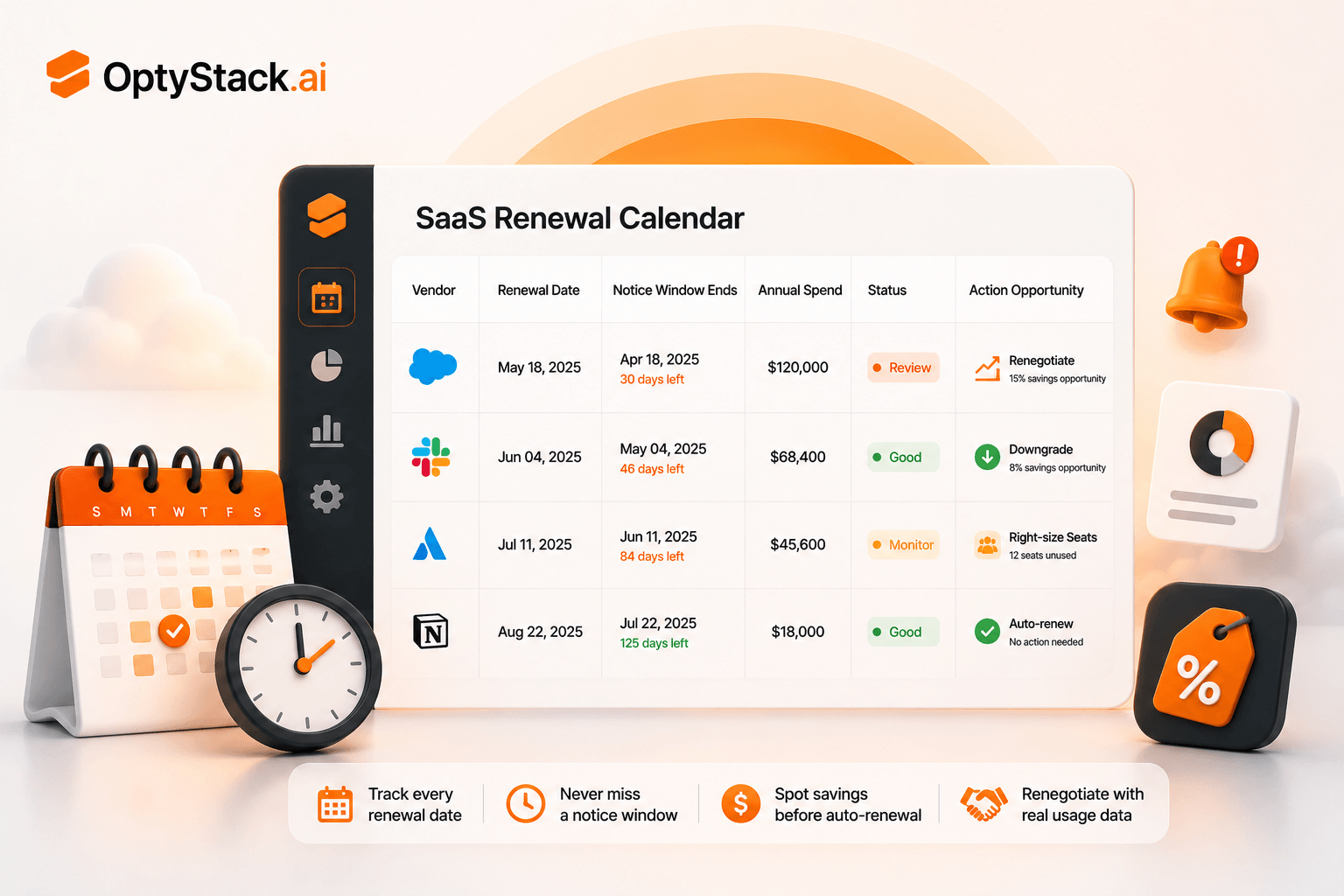
The antidote to the auto-renewal trap is a renewal calendar — but a useful one does far more than list dates. A bare list of renewal dates tells you when but not what to do, which means you still scramble when each one arrives.
A renewal calendar that earns its place records, for every contract:
· Renewal date — when it auto-renews.
· Notice window deadline — the date by which you must act. This is the one that actually drives behavior.
· Annualized spend and contract scope — how much is at stake.
· Business owner and admin owner — who's accountable and who manages it.
· Usage quality — seat utilization and adoption trend, pulled from real data.
· Recommended action — renew, renegotiate, downgrade, or replace.
With that in front of you, each renewal stops being a fire drill and becomes a decision you've already prepared for. You can instantly separate the contracts that just need a quick approval from the ones that deserve a deeper look or a competitive evaluation. The big contracts everyone remembers get attention anyway; it's the quiet mid-sized renewals — which add up to real money, especially when several overlap — that a proper calendar catches.
Usage data is your negotiating leverage
Here's the part most teams under-use: the same usage data that helps you spot waste is also your single best negotiating tool.
Vendors expect you to renew blind — to accept the quoted price because you don't have the evidence to push back. Walk into a renewal with actual usage curves and the dynamic flips. "We're paying for 50 seats and 32 are active" is a fact that moves pricing. "Our usage has been flat for six months while you're proposing a 15% increase" is leverage. "We have an overlapping tool that does 80% of this" is a credible alternative that changes the conversation.
The best alternative to a weak contract is rarely just a tougher negotiation, though. Sometimes it's a downgrade to a smaller plan. Sometimes it's a seat reset to match the current team. Sometimes it's consolidating into another tool you already own. Usage data tells you which of these is the real play — and gives you the evidence to back it up.
The pre-renewal review: a 90-day checklist
The most effective renewal review starts well before the contract date — ideally 90 days out, which gives you room to actually act on what you find. Here's the checklist:
1. Review actual usage and license allocation for the current term. How many seats are active versus paid for?
2. Check for overlapping vendors or duplicate functionality. Is there another tool that could absorb this one?
3. Estimate the cost of renewing as-is versus changing scope. What does status quo cost versus a right-sized plan?
4. Account for organizational change. Has a team restructured, a project ended, or a new core platform been adopted that makes this tool less essential than when you signed?
5. Confirm the business-critical users and required features. Who genuinely needs this, and which features justify the tier?
6. Enter the renewal with a clear target outcome — a specific decision (renew at X seats, downgrade to tier Y, renegotiate to price Z, or replace) rather than a vague intention to "look into it."
Run this 90 days out and you arrive at the renewal already knowing whether utilization is healthy, whether overlaps exist, and whether there's a savings opportunity worth pursuing. The vendor conversation becomes yours to drive.
The four outcomes of any renewal
Every renewal decision ends in one of four places. Knowing them in advance turns a vague "should we keep this?" into a clear choice with evidence behind it.
Renew as-is. The right call when usage is healthy, the price is fair, and the tool is genuinely earning its place. Don't reflexively fight every renewal — some tools deserve to continue, and renewing a well-utilized tool quickly frees your energy for the ones that need scrutiny.
Downgrade. The most under-used option. You're on a tier or seat count larger than you need. Drop to the plan that matches reality — fewer seats, a lower tier, or both. Usage data makes this an easy, evidence-backed conversation rather than a guess.
Renegotiate. When the tool is needed but the terms aren't right — a price increase you want to push back on, or leverage from flat usage and competitive alternatives. Walk in with data and a target, and a surprising amount of pricing and terms turn out to be negotiable.
Replace or cancel. When the tool is underused, duplicated by something else you own, or simply no longer worth it. This is where consolidation lives — folding a weak tool into a stronger one you already pay for.
The point of the 90-day review is to know which of these four you're heading toward before you're in the conversation, so you arrive prepared instead of reacting.
Negotiation tactics that actually move the price
Renewals aren't fixed — vendors expect negotiation, and a few evidence-backed tactics consistently shift outcomes. None of these require being adversarial; they require data.
Lead with utilization. "We're paying for 50 seats, 32 are active" is a fact a vendor can't argue with, and it reframes the whole conversation around right-sizing rather than list price.
Bring a credible alternative. Knowing that an overlapping tool you already own could absorb 80% of this one's job changes your leverage entirely. You don't have to threaten to switch — just demonstrating you could shifts the dynamic.
Use timing. Vendors often have quarter-end or year-end targets. A renewal conversation that aligns with their sales cycle can unlock flexibility that doesn't exist mid-quarter.
Trade term for price. Sometimes a longer commitment buys a better rate — but only commit to length on tools you're confident about, backed by strong usage data. For uncertain tools, keep flexibility.
Ask what's actually included. Tiers, add-ons, and bundled features get murky, especially with AI features now folded into plans. Understanding exactly what you're paying for sometimes reveals you're on a higher tier than you need.
The common thread: every one of these tactics runs on data you already have if you've been managing spend continuously. Negotiation isn't a separate skill bolted on at renewal — it's the payoff of the visibility you built all year.
The reason renewals get missed isn't incompetence — it's fragmentation. Renewal data lives in inboxes and calendar reminders. Contract terms sit in legal's files. Usage data sits in each tool's admin console. Spend data sits in finance's systems. No single person sees the whole picture, so notice windows slip through the cracks between teams.
Synchronizing all of that — contract timing, spend, usage, and ownership — into one timeline is what makes renewal management defensible instead of dependent on someone remembering. When legal, procurement, and finance all work from the same renewal timeline, the surprises stop.
Where OptyStack fits
OptyStack tracks every SaaS contract renewal date, auto-escalates upcoming deadlines, and surfaces renegotiation opportunities before spend locks in. Crucially, it pairs renewal awareness with the usage and spend data you need to act — so when a renewal approaches, you already know whether utilization is healthy, whether overlapping tools exist, and whether there's a downgrade or consolidation opportunity worth pursuing.
Instead of a renewal calendar you have to maintain by hand across inboxes and spreadsheets, you get a single live timeline showing owner, vendor, spend, plan type, usage quality, and the recommended next step for every contract. The notice windows stop being invisible, and the auto-renewal trap stops catching you.
It's free to start, and you can see your upcoming renewals — and the usage behind them — in under ten minutes.
Frequently asked questions
What is SaaS renewal management?
SaaS renewal management is the practice of tracking every contract's renewal date and notice window, reviewing actual usage before each renewal, and deciding deliberately whether to renew, downgrade, consolidate, or cancel — before the auto-renewal commits the spend for another term.
What is a notice window in a SaaS contract?
The notice window (or notice period) is the timeframe — typically 30 to 60 days before the renewal date — during which you can cancel, downgrade, or renegotiate a contract. Once it closes, the contract auto-renews at full price with little room to change anything. It's the deadline that actually matters, and it sits weeks before the renewal date itself.
How far in advance should I review a SaaS renewal?
Ideally 90 days out. That gives you enough time to review usage, check for overlapping tools, estimate the cost of different options, and enter the renewal with a clear target — rather than scrambling inside the notice window or, worse, finding out when the invoice lands.
How does usage data help with renewals?
Usage data is negotiating leverage. Knowing exactly how many seats are active versus paid for, and how adoption has trended, lets you push back on price increases, justify downsizing, or make the case for consolidation. It turns a blind renewal into an evidence-backed decision.
Why do companies miss SaaS renewals?
Because renewal data is fragmented — dates live in inboxes and calendars, contract terms in legal's files, usage in app consoles, and spend in finance systems. No single person sees the whole picture, so notice windows slip through the cracks. A unified renewal timeline fixes this.
Never get surprised by a renewal again. Start free with OptyStack and see all your upcoming renewals — with usage data attached — in under 10 minutes.
Related reading: [The Complete Guide to SaaS Spend Management in 2026](https://optystack.ai/blogs/complete-guide-saas-spend-management-2026) · [How to Find & Eliminate Unused SaaS Licenses](https://optystack.ai/blogs/find-eliminate-unused-saas-licenses)