The Complete Guide to SaaS Spend Management in 2026
Hemant Wadhwani · June 26, 2026
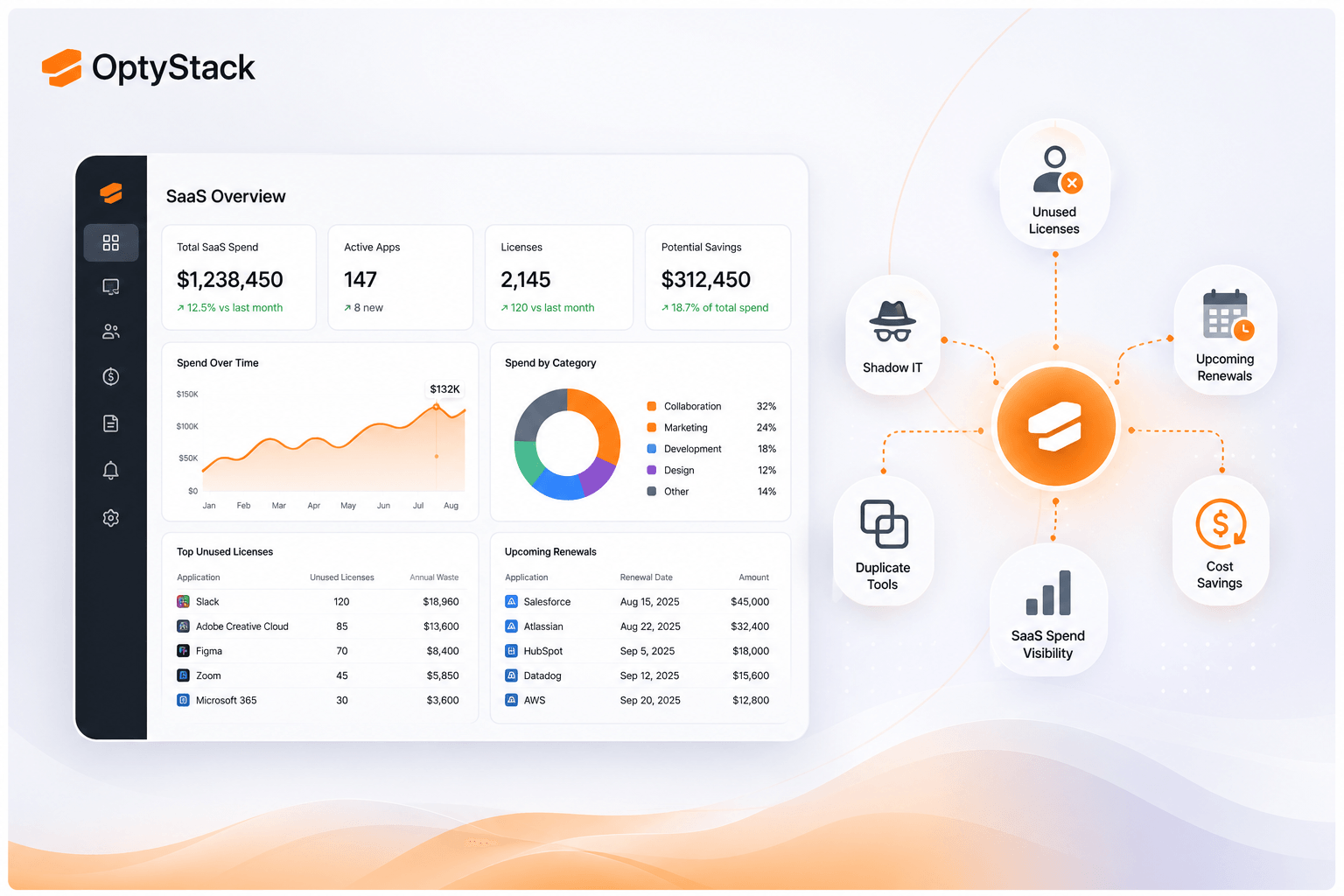
SaaS spend now eats up to 70% of software budgets, yet half of every license bought goes unused. This is the complete 2026 guide to SaaS spend management — what it is, why it breaks, and the exact operating model finance and IT teams use to take back control.
The Complete Guide to SaaS Spend Management in 2026
Quick answer: SaaS spend management is the ongoing practice of seeing every software subscription your company pays for, matching what you pay against what people actually use, and acting on the gap before it locks in for another year. Done well, it cuts 20–30% of software waste without removing a single tool anyone needs. Done badly — or not at all — it quietly hands a vendor another year of money for seats nobody logs into.
That is the whole idea in three sentences. The rest of this guide is about how to actually do it, because the gap between knowing the definition and running the discipline is where most companies lose the money.
Here is the uncomfortable backdrop for 2026. Software is now the fastest-growing line in the IT budget, and SaaS makes up roughly 70% of total software spend, up from about 55% at the start of the decade. The average company runs somewhere north of 100 applications. And depending on whose research you trust, somewhere between a third and half of all the licenses bought sit unused. Half. You are, statistically, paying full price for a stack where a coin flip decides whether any given seat is doing anything at all.
This guide is written for the people who have to answer for that number — heads of IT, finance leaders, FinOps practitioners, and the founders and operators who sign the renewals. It is long because the topic is genuinely layered, but it is built so you can jump to the part you need. We will cover what SaaS spend management really is (and how it differs from procurement), why spend leaks in the first place, the four pillars that actually matter, a step-by-step operating model you can start this quarter, the mistakes that quietly undo the work, and how the whole thing is changing now that AI is both the biggest new cost driver and the best new tool for controlling it.
What SaaS spend management actually means
It helps to start by clearing up what SaaS spend management is not, because the term gets used loosely.
It is not the same as procurement. Procurement is the mome
nt of purchase — the negotiation, the contract, the signature. SaaS spend management is everything that happens after that, on a loop, for as long as you keep paying. A tool can be procured beautifully and still bleed money for two years because nobody revisited it.
It is not the same as a once-a-year audit, either. An audit is a snapshot. SaaS spend management is a video. The difference matters more than it sounds, because SaaS waste does not appear all at once on audit day. It accumulates continuously — a seat goes idle here, a team downsizes there, a department buys a second tool that overlaps with one you already own. By the time the annual audit catches it, you have often already paid for another full term.
And it is broader than cost-cutting. The goal is not to spend as little as possible. The goal is to spend deliberately — to know that every rupee or dollar of software cost maps to something a real person is genuinely using to do real work. Sometimes that means cutting. Sometimes it means consolidating two weak tools into one good one. Occasionally it even means spending more on the tool everyone lives in, because the data finally proves it deserves the investment.
So a working definition: SaaS spend management is the continuous practice of discovering every piece of software your organization pays for, measuring real usage against what you are billed, and turning the gap between the two into decisions — reclaim, downgrade, consolidate, renegotiate, or keep — before the next renewal locks the spend in.
The continuous part is the part people skip. It is also the part that makes it work.
Why SaaS spend leaks in the first place
Before fixing anything, it is worth understanding why the money leaks, because the causes are structural, not a sign that your team is careless. Even sharp, disciplined organizations bleed SaaS spend. Here is the anatomy of it.
Buying got democratized, tracking did not. A decade ago, software came through IT. One door, one gatekeeper. Then product-led growth changed the game: any team can now swipe a card, sign up in ninety seconds, and be using a tool before lunch. Marketing buys a design platform. Sales grabs a prospecting tool. An engineer expenses an API. None of it is wrong — speed is a feature, not a bug. But the buying spread out across the whole company while the tracking of it stayed stuck in a finance spreadsheet that nobody updates. That mismatch is the root of almost everything that follows.
Nobody owns the full picture. When buying is decentralized, ownership fragments too. Finance sees a charge on a statement but does not know what it is for. IT knows the sanctioned tools but not the rogue ones. The person who championed a tool moves teams, and the subscription becomes an orphan that renews on autopilot. Ask most growing companies "who owns total SaaS spend?" and the honest answer is nobody — and unowned spend is unmanaged spend.
Provisioning is fast, deprovisioning is forgotten. Adding a seat takes a click. Removing one when someone leaves or changes roles takes a process that usually does not exist. The result is what the industry calls zombie accounts — paid licenses tied to people who are gone, demoted out of the tool, or simply never logged in. They do not look like a problem on a statement. They look like a normal line item nobody questions.
Renewals arrive before reviews do. Most SaaS contracts auto-renew, and most carry a cancellation notice window — often 30 to 60 days before the renewal date — after which you are locked in for another full year. Miss that window and the decision is made for you, at full price, with zero negotiating leverage. Teams that review 90 days out hold the leverage; teams that find out when the invoice lands have already lost it.
Pricing got murky, and AI made it murkier. Vendors bundle AI features into existing tiers, introduce usage-based pricing that can spike 10x in a month, and adjust plans in ways that do not always show up in a changelog. What you paid last year may look nothing like next quarter's bill, even with no change in headcount. This is the newest and fastest-growing source of unpredictable spend, and it deserves its own section later.
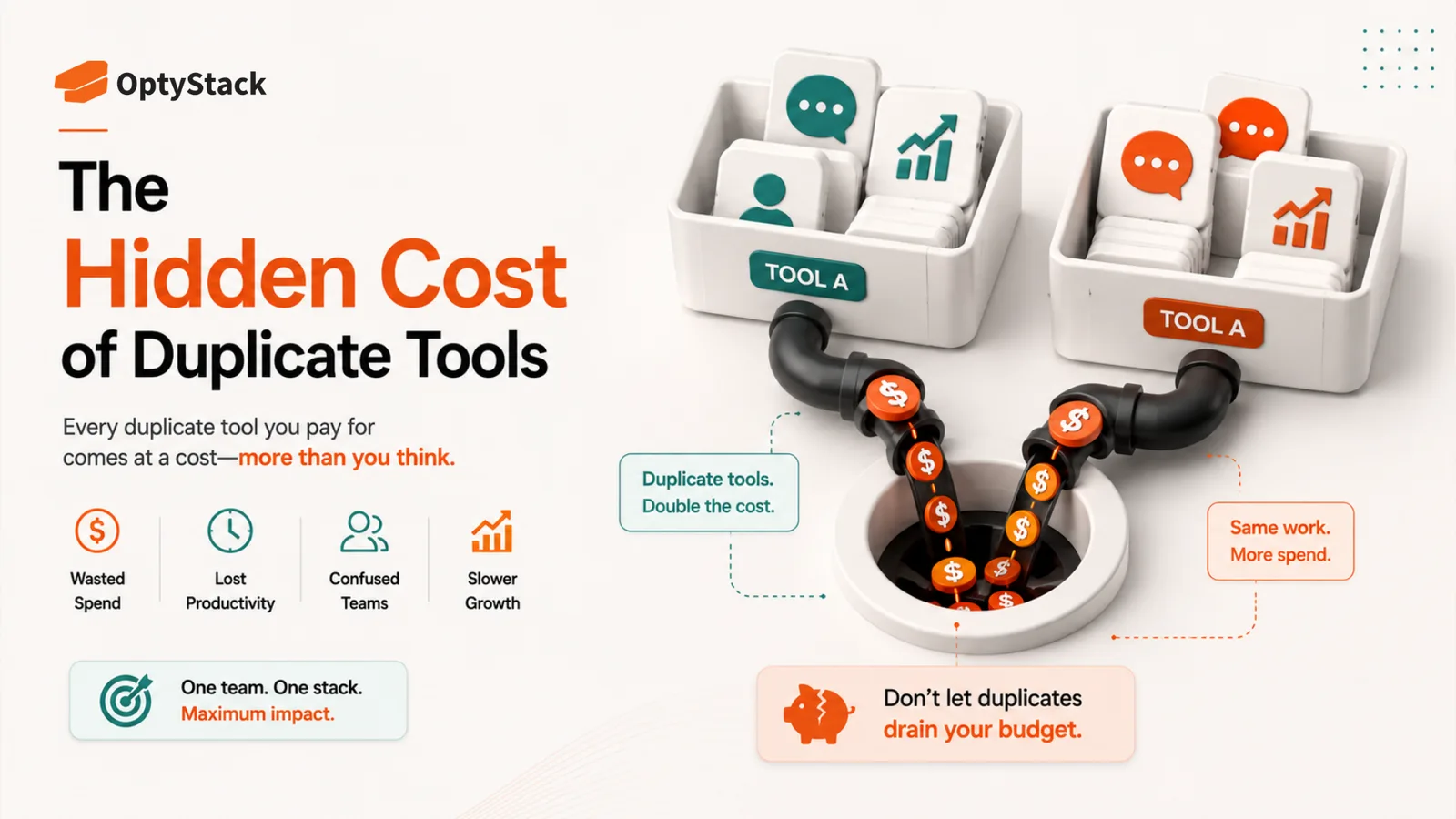
Overlap creeps in invisibly. Companies routinely run several tools that do roughly the same job — multiple project trackers, two video tools, three note-taking apps — because each was bought by a different team at a different time for a slightly different reason. Each purchase was rational in isolation. Collectively they are redundant spend and fragmented data.
None of these is a moral failing. They are the predictable physics of buying software in a fast-moving company. Which is exactly why the answer is a system, not a one-off cleanup or a stern email about expense discipline.
The four pillars of SaaS spend management
Everything in SaaS spend management rolls up into four pillars. Get all four working together and the waste has nowhere to hide. Neglect any one and the leaks reopen.
Pillar 1 — Discovery (you cannot fix what you cannot see)
Discovery is the foundation, and it is non-negotiable. Before you can optimize anything, you need a complete, living inventory of every application the company pays for — including the ones bought outside official channels.
Good discovery pulls from multiple signals and cross-references them, because no single source sees everything:
Finance and expense data — credit card statements, bank feeds, and expense reports catch tools bought on personal or department cards.
Identity and single sign-on (SSO) — your identity provider shows which apps people actually log into, and how often.
Browser and endpoint signals — these surface tools and AI plug-ins that never touch a central system at all.
Direct integrations — connecting to major vendors' admin consoles gives exact seat counts and last-login data.
The output of discovery is a single source of truth: one place where every tool, owner, cost, renewal date, and usage signal lives together. That single source is what every other pillar depends on.
Pillar 2 — License optimization (right-sizing what you already own)
Once you can see the stack, license optimization is where the fastest savings come from. This is the work of matching seats to actual humans using them:
Find unused licenses — seats with no logins in 30, 60, or 90 days.
Kill zombie accounts — seats assigned to people who left or moved on.
Spot over-provisioning — premium tiers bought for features nobody uses, or seat counts that outgrew the team.
Identify duplicate tools — overlapping apps you can consolidate into one.
The beauty of license optimization is that it almost never disrupts anyone. You are reclaiming seats that, by definition, nobody is using. The savings are real and the risk is close to zero.
Pillar 3 — Renewal and contract management (timing is leverage)
This pillar is about never being surprised by a renewal again. Every contract should have, on record and visible well in advance: the renewal date, the notice window, the annual cost, the owner, the current usage quality, and a recommended action. With that timeline in front of you, renewals stop being fire drills and become planned decisions. You walk into each one knowing whether to renew, downgrade, consolidate, or renegotiate — and you walk in with usage data that gives you genuine leverage instead of negotiating blind.
Pillar 4 — Shadow IT and shadow AI governance (seeing the invisible layer)
The final pillar deals with everything that bypassed the front door. Shadow IT — software adopted without IT's knowledge — is not a fringe problem; in many organizations it accounts for a third or more of total software spend. And in 2026 it has a fast-growing new sibling: shadow AI, the sprawl of LLM subscriptions, AI copilots, and browser plug-ins quietly touching company data outside any governance review. Governing this layer is not about blocking everything (that just pushes usage further underground). It is about seeing it, scoring the risk, and bringing the genuinely useful tools into the light.
What SaaS waste looks like in the real world
Abstract percentages are easy to nod along to and hard to act on. So here are the patterns the way they actually show up inside companies — the specific, recognizable shapes that waste takes. If you've worked anywhere with more than fifty employees, you'll recognize at least three of these.
The project that ended but the tools didn't. A team spins up for a six-month initiative. They buy a project tracker, a design tool, a specialized analytics platform. The project wraps. The team disperses. Nobody cancels the tools, because cancelling wasn't anyone's job — it wasn't even on anyone's radar. Eighteen months later, those subscriptions are still renewing, still billing, still doing absolutely nothing. This is one of the most common waste patterns in existence, and it's invisible precisely because the people who'd notice have moved on.
The freemium-to-enterprise trap. A team adopts a tool on its free tier. It's useful, adoption grows, and eventually they hit a wall that requires upgrading. But the vendor's paid plan has a minimum seat count — say 50 — when the team only needs 15. To get the features, you buy the floor. You've just created a 35-seat deficit on day one, baked into the contract. The vendor gets their revenue; your utilization report shows a third of the seats empty from the start.
The duplicate nobody compared. Marketing buys a design tool. A year later, the product team — not knowing marketing's tool exists — buys a different design tool. Now you're paying for two platforms that do 80% of the same job, neither team aware of the other, and your data and brand assets are split across both. Multiply this across categories (two video tools, three note apps, overlapping CRMs) and the redundant spend adds up fast.
The promotion that left a seat behind. Someone gets promoted out of a hands-on role into management. They no longer use the specialized tool their old job required — but their license was never reclaimed. They're not gone from the company, so they don't show up in an offboarding sweep. The seat just sits there, assigned to someone who'll never log in again.
The AI bill that 10x'd overnight. An engineer wires an LLM API into a workflow. It works beautifully at low volume, costing a few dollars a month. Then the workflow scales — more calls, more usage, more cost — and because it's consumption-priced, the bill balloons before anyone's watching the meter. The first sign of trouble is a finance person asking "what is this five-figure charge?"
The thread connecting all five: each was a perfectly reasonable decision in the moment, and each became waste only because nobody was watching continuously. That's the entire case for SaaS spend management in a nutshell — not smarter buying, but continuous seeing.
Does waste vary by company size? (Benchmarks)
A fair question when you're trying to figure out how worried to be: is this an everyone problem, or a big-company problem? The data says everyone, but the shape changes with size.
Small and early-stage companies tend to have fewer tools but less process — buying is informal, often on personal or founder cards, and nobody owns tracking. The waste percentage can actually be high here even though the absolute dollars are smaller, because there's essentially no governance. The fix is also easiest at this stage: get a system in place before the sprawl compounds.
Mid-market companies (roughly 100–1,000 employees) are where the problem usually bites hardest. The stack has grown past what a spreadsheet can hold, buying is fully decentralized across departments, but dedicated SaaS management headcount usually doesn't exist yet. This is the classic danger zone — enough complexity to generate serious waste, not enough structure to catch it. Companies this size frequently discover six-figure annual waste on a first proper audit.
Large enterprises run the most tools — some run several hundred — and the absolute waste is enormous, often into the millions or tens of millions annually. They usually have some governance, but the sheer scale and the pace of decentralized buying outrun it. Here the challenge is less "do we have a process" and more "can our process keep up with the volume," which is why automation becomes essential rather than optional.
The honest summary: no size is immune. The smallest companies waste a high percentage of a small number; the largest waste a meaningful percentage of a very large number. Everyone in between gets some combination. What changes isn't whether you have waste — it's how much structure you need to control it.
A step-by-step operating model you can start this quarter
Theory is comforting; a plan is useful. Here is a concrete operating model you can begin running this quarter. It moves in three phases — discover, decide, operate — and you do not need a perfect inventory to start. You need enough visibility to make better decisions in the next 30 to 90 days, then you mature the loop over time.
Phase 1 — Discover (weeks 1–3)
Pull every software charge from the last 12 months. Go through card statements, bank feeds, and expense reports. Do not trust memory; trust the money trail.
Layer in usage signals. Connect your SSO and, where possible, the admin consoles of your biggest tools. The aim is to see logins, not just costs.
Build the single source of truth. For every tool, record: name, owner, business purpose, department, annual cost, seat count, renewal date, notice window, and a usage signal. Start with your top 20 vendors by spend if a full sweep feels daunting — that is usually where most of the money sits.
Phase 2 — Decide (weeks 3–6)
Tag every tool. For each line, answer three questions: Does it have an owner? Is it actually being used? Does it duplicate something else?
Flag the obvious waste. Anything with no owner, no recent logins, or a clear duplicate goes on the action list immediately.
Map the next 90 days of renewals. List every contract renewing in the next quarter and the date its notice window closes. These are your time-sensitive decisions — handle them first, before the windows shut.
Assign each flagged item an action: reclaim, downgrade, consolidate, renegotiate, or keep.
Phase 3 — Operate (ongoing)
Run a monthly tactical review. Thirty minutes is enough. Look at new tools that appeared, licenses that went idle, and anomalies. This is where continuous beats annual — you catch waste in the month it happens, not the year after.
Run a quarterly strategic review. Zoom out to contract strategy, big renewals, and consolidation opportunities. This is where the structural savings live.
Track the trend, not just the snapshot. Watch whether total spend, waste percentage, and utilization are moving in the right direction month over month. Progress you can see is progress you can defend in a budget meeting.
That is the engine. Discover continuously, decide deliberately, operate on a rhythm. Everything else is detail.
The mistakes that quietly undo the work
Plenty of companies start a SaaS spend management effort. Far fewer sustain one. The difference usually comes down to a handful of avoidable mistakes — the kind that don't announce themselves but quietly let the waste creep back. Knowing them in advance is half the battle.
Treating it as a one-time cleanup. This is the big one. A company gets a scare — a surprise renewal, a budget crunch — runs a big audit, reclaims a pile of licenses, and declares victory. Six months later the waste is back, because the conditions that created it never changed. SaaS waste regenerates continuously; a one-time fix is like mopping a floor while the tap is still running. The win isn't the cleanup. It's the ongoing rhythm.
Optimizing for the lowest cost instead of the right cost. Cutting too aggressively is its own failure mode. Kill a tool people genuinely rely on and you don't save money — you create a productivity hole, shadow workarounds, and a team that now distrusts the whole initiative. The goal is deliberate spend, not minimal spend. Sometimes the right answer is to keep, or even expand, a tool the data proves is earning its place.
Relying on memory and spreadsheets. A manual spreadsheet captures only what someone remembers to enter, and it goes stale the moment updates lapse — which they always do. The tools most worth catching, shadow IT and shadow AI, are precisely the ones a manual process never sees, because nobody told the spreadsheet about them. Manual tracking doesn't scale past a couple dozen tools, and most companies are well past that.
Leaving spend unowned. If no single person is accountable for SaaS spend, it drifts. "Someone should look at this" becomes nobody looking at it. Whether it's a FinOps lead, an IT asset manager, or a finance operator wearing the hat, the program needs an owner — the same way every individual tool does.
Ignoring renewals until the invoice lands. By the time the bill arrives, the notice window has closed and every decision has been made for you. Reviewing renewals reactively forfeits all your leverage. The discipline is to review 90 days out, while you can still act.
Forgetting the AI layer. A spend program built around traditional subscriptions but blind to AI tools is increasingly missing the fastest-growing, most volatile part of the stack. Shadow AI has to be in scope from the start, not bolted on later after a surprise bill.
Avoid these six and you're already ahead of most companies — not because the work is hard, but because consistency is rare.
How AI changed the game (in both directions)
You cannot write an honest guide to SaaS spend management in 2026 without talking about AI, because it has become the single biggest variable in the equation — and it cuts both ways.
On the cost side, AI is the new shadow IT, and it is worse. Spending on AI-native software jumped roughly 108% year over year. Every team is quietly adopting AI tools — a marketer on an AI writing assistant, an engineer expensing an LLM API, an analyst on a paid research copilot, and browser plug-ins that read every page someone opens, including internal dashboards. Two things make this scarier than the old shadow IT. First, much of it is usage-based, so a tool that cost a little last month can 10x overnight when usage spikes. Second, these tools touch sensitive company data, often with no governance review at all. AI sprawl is the fastest-growing layer of waste and risk in the modern stack.
On the control side, AI is also the best tool you have ever had to fight back. The same wave that is inflating spend is what finally makes continuous management feasible without an army of analysts. AI is genuinely useful in SaaS management when it turns noisy operational data into prioritized actions — categorizing unknown apps automatically, spotting that two tools overlap, flagging an anomaly the moment it appears, and ranking findings by where the real money and risk are. The work that used to take hours of manual reconciliation collapses into a prioritized list of things to actually do.
The takeaway: AI raised the stakes and supplied the answer at the same time. Companies that govern AI spend deliberately will pull ahead. Those that pretend it is still a small line item will be the ones opening a surprise five-figure invoice with no idea where it came from.
The metrics that prove it is working
"We're spending too much on software" is a feeling. To manage it, you need to turn it into numbers you can track. A handful of metrics do most of the work:
Total SaaS spend — the headline number, tracked monthly. If you cannot state it to the rupee or dollar, that is your first problem.
Utilization rate — what percentage of purchased licenses are actually active. This is the single most revealing number in SaaS management.
Waste percentage — the share of spend going to unused, duplicate, or zombie licenses. The number you are trying to drive down.
Cost per active user — what you really pay per person actually using a tool, which is very different from the list price.
Renewals reviewed before the notice window — the discipline metric. The closer to 100%, the more leverage you hold.
Verified savings captured — the proof. What you actually reclaimed, not what you theoretically could.
Track these over time and SaaS spend management stops being a vague intention and becomes a visible, defensible operating discipline — the kind a CFO can put in a board deck.
Building the rhythm (and who owns it)
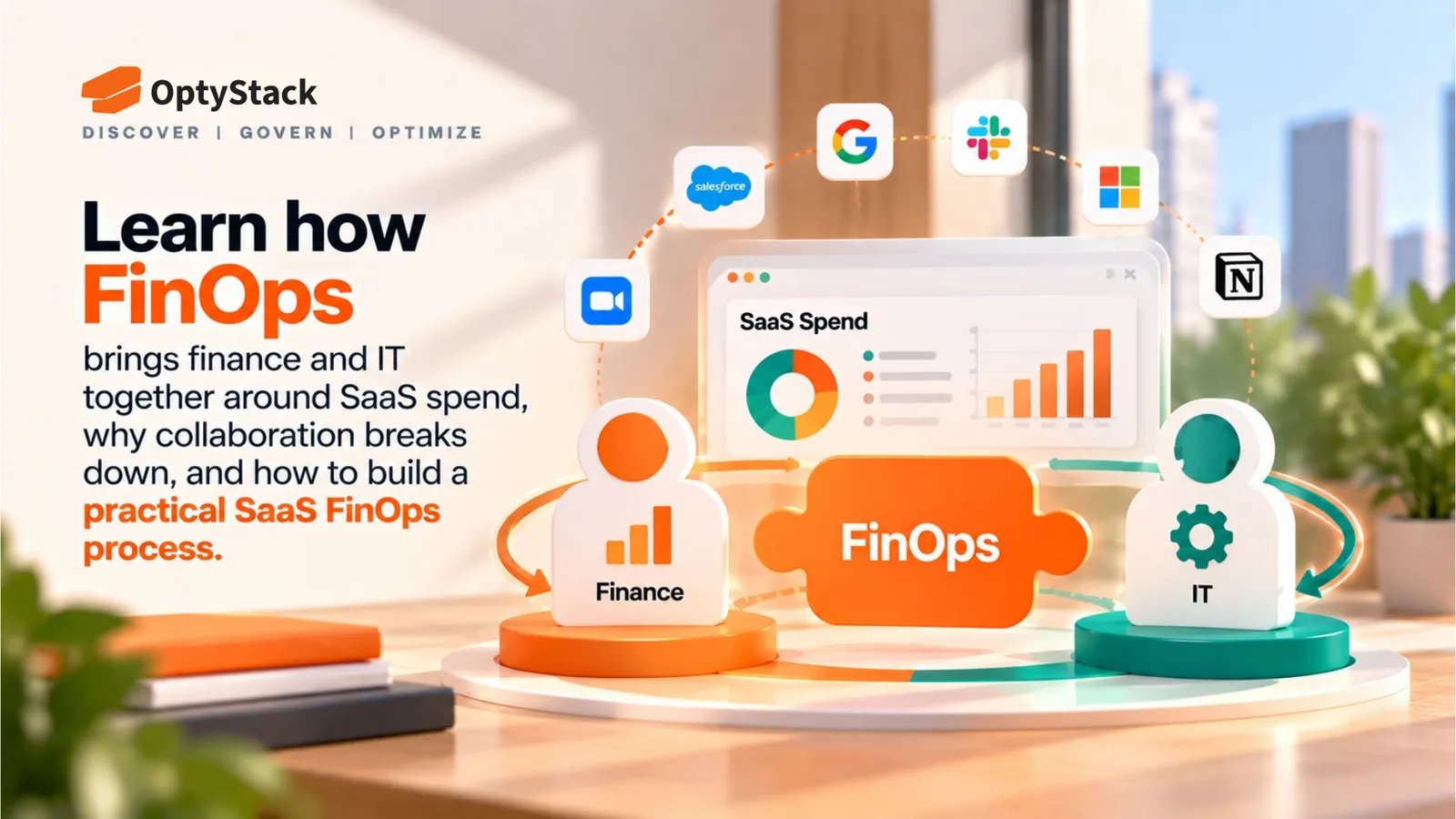
The best SaaS savings programs are not heroic one-time cleanups. They are a light, shared rhythm between finance, IT, and the business — each looking at the same source of truth from a different angle. Finance cares about budget and ROI. IT cares about governance and risk. Department leaders care about whether their teams have the tools to do the work. A single source of truth lets all three collaborate instead of arguing from separate spreadsheets.
And the ownership question — who actually runs this — has a clear answer: someone has to. Whether it is a FinOps function, an IT asset manager, or a finance operator wearing the hat, SaaS spend needs a single accountable owner the same way every individual tool does. Unowned programs drift. Owned ones compound.
Where OptyStack fits
Everything in this guide is doable manually. It is also exhausting to maintain manually across a hundred-plus tools that change every week — which is precisely why most manual efforts start strong and quietly fade by month three.
OptyStack exists to make the four pillars continuous instead of heroic. It connects your stack to build the single source of truth automatically, discovers shadow IT and shadow AI as they appear, surfaces unused and duplicate licenses with the usage data to back them up, tracks every renewal before its window closes, and uses AI to rank findings by where the real savings and risk sit. The first savings show up in under ten minutes, and it is free to start — no credit card — so you can see your own number before committing to anything.
If you take one idea from this guide, make it this: you cannot fix what you cannot see. Visibility is the whole game. Get everything into one place where the waste cannot hide, and the savings follow almost on their own.
Frequently asked questions
What is SaaS spend management?
SaaS spend management is the continuous practice of tracking every software subscription a company pays for, comparing what you pay against actual usage, and acting on the gap — reclaiming, downgrading, consolidating, or renegotiating — before renewals lock the spend in. It differs from a one-time audit because it runs on a loop rather than as an annual snapshot.
How much SaaS spend is typically wasted?
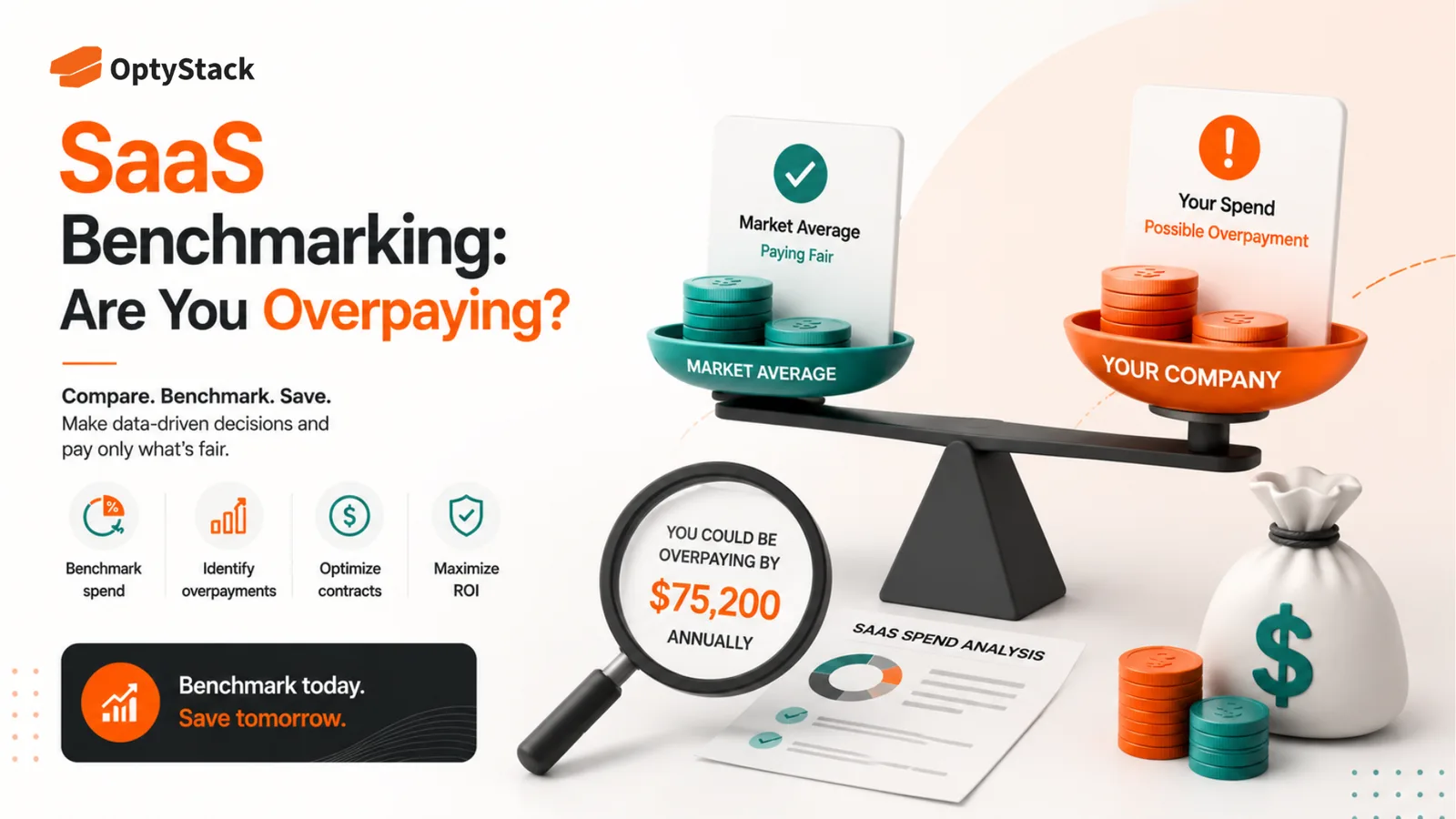
Research across 2025–2026 consistently finds that somewhere between a third and half of all SaaS licenses go unused, and that the average enterprise wastes roughly 25–30% of its software budget on unused, duplicate, or zombie licenses. For many mid-to-large companies that translates to millions in annual waste.
What is the difference between SaaS spend management and procurement?
Procurement is the point of purchase — negotiating and signing the contract. SaaS spend management is everything that happens afterward, on an ongoing basis: tracking usage, managing renewals, reclaiming waste, and governing shadow IT for as long as you keep paying for the tool.
How do I start managing SaaS spend?
Start with discovery. Pull every software charge from the last 12 months of statements, layer in usage data from your SSO, and build a single source of truth listing each tool's owner, cost, usage, and renewal date. Then flag the obvious waste and map the next 90 days of renewals. You can complete a useful first pass in a few weeks.
Can AI help control SaaS spend?
Yes — and increasingly it is essential. AI categorizes unknown apps, detects overlapping tools, flags spending anomalies in real time, and ranks findings by financial and security impact, turning hours of manual reconciliation into a prioritized action list. It is also, ironically, the biggest new source of spend, which is why governing AI tools is now a core part of the discipline.
Ready to see your own number? Start free with OptyStack and discover your SaaS waste in under 10 minutes — no credit card required.
Related reading: [What Is Shadow IT?](https://optystack.ai/blogs/what-is-shadow-it-2026-guide) · [How to Find & Eliminate Unused SaaS Licenses](https://optystack.ai/blogs/find-eliminate-unused-saas-licenses) · [SaaS Renewal Management](https://optystack.ai/blogs/saas-renewal-management-stop-auto-renewals)