Is Your SaaS Bill Rising Faster Than Inflation? A Simple Benchmark for Finance
Raunak Verma · November 23, 2026
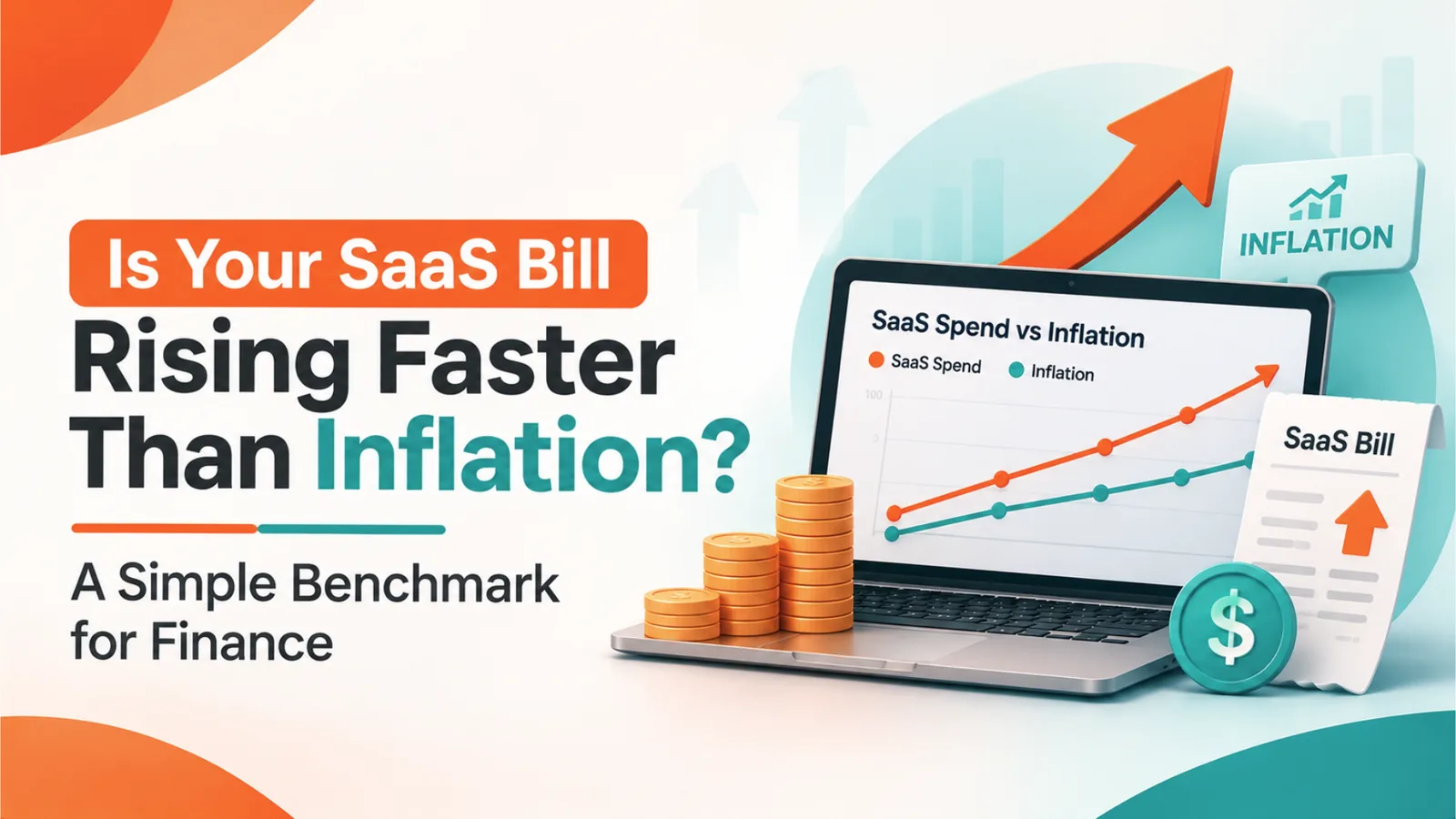
SaaS vendors raised prices at a record pace in mid-2026, and the increase a company receives at renewal depends on when it negotiates. This guide gives finance teams a four-step benchmark to compare each contract's increase with a market index and India CPI, and to decide where to push back.
Is Your SaaS Bill Rising Faster Than Inflation? A Simple Benchmark for Finance
SaaS prices have been rising faster than general inflation for some time. In June 2026, the software price index tracked by procurement platform Vertice reached 16.4%, its highest monthly reading on record. The rate eased to 12.9% in July and 12.7% in August, then rose to 14.3% in early September, according to Vertice's SaaS inflation rate page. Vertice's own description adds a useful point for finance teams: a renewal quoted in June faced a market rate nearly four points higher than one quoted in August.
India's general inflation tells a different story. The MoSPI September 2026 CPI release put retail inflation at 5.54%. A software contract rising at 14% is not moving in line with the economy, and that gap is what this benchmark measures.
A renewal quote does not move with the market. It moves with the month it is quoted, the vendor's pricing strategy, and how hard the buyer negotiates. Without a benchmark, a finance team cannot tell whether a quote is high, low, or in line.
This article gives a simple benchmark. It compares each contract's increase with the market index and India CPI over the same period, and shows how to use the result in a renewal conversation.
Why Renewal Increases Outpace Your Budget
Most SaaS contracts renew once a year, and the increase arrives as one line on the quote. Finance sees the total and asks whether it is reasonable. The honest answer depends on three things the quote does not show.
Timing. Vertice's data shows rates moving month to month, with a sharp rise in the second quarter and a dip in July and August. Two renewals for the same product, quoted in different months, can carry very different increases.
Packaging. Vendors may raise list prices, move features into higher tiers, or reduce what a tier includes. Vertice calls this shrinkflation: the price stays or rises while the value at the same tier falls. A quote that looks like a modest increase may cost more in practice.
Scope. A renewal can change the seat count, the usage allowance, or the add-ons. A rise in the total bill is not always a rise in unit price.
A benchmark has to separate these effects. Otherwise, a finance team negotiates against a number it cannot explain.
A Four-Step SaaS Inflation Benchmark
Use this method for each contract that renews in the next 12 months.
Step 1: Calculate the unit increase. Divide the new price per unit by the old price per unit, then subtract one. Use the same unit on both sides: per user, per license, or per credit. If seat counts changed, adjust for them first, so the result reflects price rather than volume.
For example, a contract at ₹1,000 per user per month that renews at ₹1,180 per user per month has a unit increase of 18%. The total bill may rise more or less depending on headcount, but the unit increase isolates the price change.
Step 2: Match the market index for the same period. Find the Vertice reading for the month the renewal was quoted, or the closest month available. Compare the contract's increase with that single reading, not a yearly average, because the index moves sharply within the year.
Step 3: Compare with India CPI. Take the India CPI change over the same twelve months from MoSPI, the official source, and use the series published on the new 2024 base. Do not use a US figure for an Indian budget. Compare the contract increase with the CPI rate to see how far vendor pricing has moved from the broader economy.
Step 4: Calculate the excess increase. Subtract the market index reading from the contract's unit increase. A positive result means the contract rose faster than the market, and a negative result means it rose more slowly. Multiply the excess by the annual contract value to estimate the extra cost against the market.
Record the results in one table:
Contract | Unit increase | Vertice index (same month) | Excess increase | Annual value | Extra cost vs. market |
|---|---|---|---|---|---|
Example project tool | 18% | 14.3% | +3.7 points | ₹12 lakh | About ₹44,000 |
The example is illustrative. Replace it with your own contract data before using the result for a decision.
Reading the Results
A contract with a large positive excess is the first candidate for negotiation. Start with the largest extra cost, not the largest total bill, because a small contract with a large excess can still be worth challenging.
A contract with a small or negative excess is not automatically a good deal. It may rise in line with the market and still cost more than it delivers. The benchmark shows whether the price moved faster than the market. It does not show whether the product is worth buying.
Watch for contracts where the unit increase is small but the total rose because seats were added. Those increases are growth, not price. Track them separately, so growth is not mistaken for inflation.
Using the Benchmark in a Renewal Conversation
Bring the table to the vendor and ask three questions:
What is the reason for the unit increase, and how much is list-price change versus packaging change?
Which features are in the new tier that were not in the old one, and which were removed?
Is a price cap available for a multi-year term, and what would the rate be if the renewal closed at the end of the next quarter?
Vendors often respond more readily when the buyer shows an index comparison. The goal is not to demand the market rate. It is to show that the increase needs a documented reason.
Before the conversation, check two things. First, confirm the notice period. A renewal that requires notice 60 to 90 days ahead may close before negotiation begins. Second, confirm what the contract lets you change, including seats, tiers, and price-change clauses.
Where OptyStack Fits
The benchmark depends on an accurate list of contracts, renewal dates, and seat counts. That list is usually scattered across finance, IT, and business teams. OptyStack is a SaaS and AI access governance platform that brings it together. Its Essentials plan includes a renewal calendar with notice-window alerts, license reclamation for unused, underused, and zombie seats, and a spend dashboard. Its Growth plan adds user lifecycle management, AI agent discovery, and remediation workflows.
The billing model suits Indian mid-market teams. OptyStack bills per employee, counting active accounts in Google Workspace, Microsoft 365, or Okta. Pricing is listed in rupees: Essentials is ₹270 per employee per month and Growth is ₹540, both billed annually, with minimums of ₹22,410 and ₹53,910 per month. For a 100-employee company, that is about ₹27,000 per month on Essentials or ₹54,000 on Growth, before taxes. Confirm the GST treatment on your invoice.
OptyStack does not calculate market price indexes or benchmark vendor pricing. The index in this article comes from Vertice, and the inflation figure comes from MoSPI. OptyStack supplies the contract and seat inventory that makes the comparison possible.
To build the contract table for your organization, you can run a free scan with no credit card required. Read more about contract renewal tracking, or compare plans on the OptyStack pricing page.