Zluri Alternatives After the Infotech Acquisition: Zluri vs OptyStack
Aryan Malik · October 15, 2026
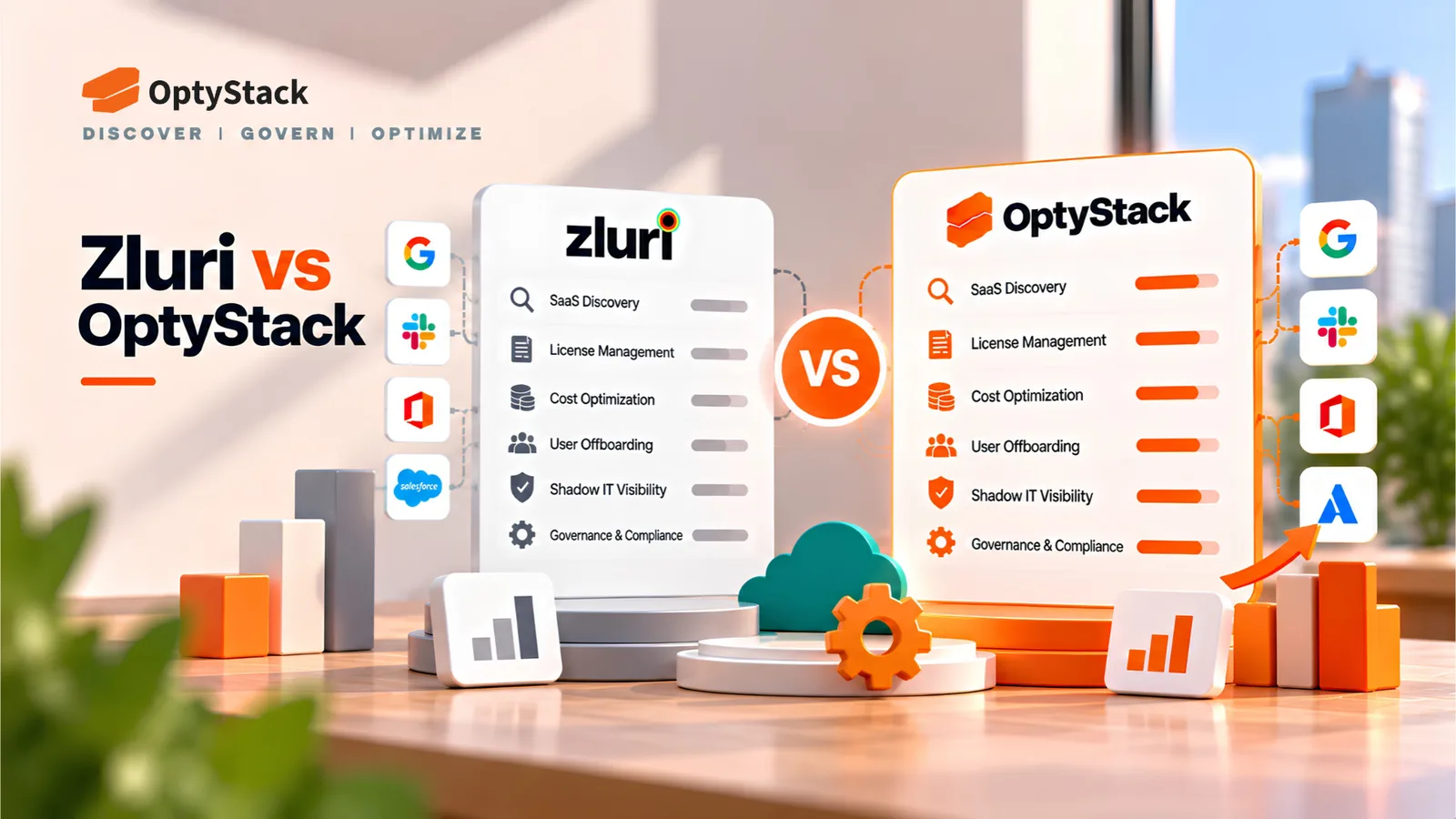
Infotech's acquisition of Zluri adds a new consideration for SaaS buyers. Compare Zluri and OptyStack on application discovery, identity governance, SaaS spend, Shadow AI and suitability for mid-market teams in India.
Looking for Zluri alternatives? Start with what your business needs
Zluri helps organizations discover SaaS applications, manage software spending, optimize licenses and govern application access. Its product also covers Shadow IT and Shadow AI discovery, making it relevant to IT, security, procurement and finance teams.
On October 14, 2026, Infotech announced that it had completed its acquisition of Zluri. The announcement also introduced CIO Analytics, Infotech's API-driven advisory platform, with Application Discovery and Identity Governance and Administration (IGA) among its initial modules. Infotech said Zluri would continue serving customers while contributing capabilities to CIO Analytics. The financial terms were not disclosed. Source: Infotech's acquisition announcement.
The acquisition is a reason to review your software vendor strategy, but it does not automatically mean Zluri customers need to switch. Existing customers should verify any changes to product packaging, support arrangements, pricing, integrations and roadmap directly with Zluri.
For organizations evaluating their options, the more useful question is: Which platform fits your SaaS management priorities, operating model and budget?
This guide compares Zluri and OptyStack across five areas: application discovery, identity governance, SaaS spend optimization, Shadow AI visibility and suitability for mid-market businesses in India.
Zluri vs OptyStack: Quick comparison
Evaluation area | Zluri | OptyStack |
|---|---|---|
Application discovery | Discovery across sources such as SSO, integrations, transactions, browser agents and MDM, depending on configuration | SaaS and Shadow IT discovery using spend, SSO and browser signals |
Identity governance (IGA) | Dedicated IGA capabilities, including access reviews, provisioning, deprovisioning and access governance | Identity mapping, user lifecycle management and license-related actions; validate whether your required IGA controls are covered |
SaaS spend optimization | Spend and usage visibility, license optimization, contract and renewal management | Spend dashboards, unused-license reclamation, optimization recommendations and renewal tracking |
Shadow AI | Gen AI application discovery and governance features | Shadow AI discovery, including visibility into unmanaged AI apps |
India mid-market fit | Evaluate the required modules, implementation, support and commercial terms with the vendor | Published INR pricing and a free tier make initial evaluation straightforward; confirm total cost and required integrations |
Comparison based on publicly available product information as of October 15, 2026. Features, plan availability and functionality can depend on configuration and subscription. This is not a substitute for a product demonstration or written vendor confirmation.
Sources: Zluri SaaS Management, Zluri application discovery documentation, OptyStack product, and OptyStack pricing.
1. Application discovery: Can you see the software people actually use?
An application inventory built only from procurement records or an SSO dashboard can miss software employees obtain independently. Teams may pay for tools on corporate cards, use applications without connecting them to company SSO, or adopt AI tools without formal approval.
Zluri documents discovery through multiple sources, including SSO providers, direct integrations, transactions, browser agents, desktop agents and mobile device management systems. The actual inventory depends on which sources are connected and what data they expose.
OptyStack combines spend, SSO and browser signals to help organizations identify SaaS applications outside their centrally managed inventory. Its focus includes duplicate tools, unauthorized applications and unmanaged subscriptions.
For a fair comparison, do not rely on a vendor's total integration count alone. Test discovery against applications you already know are being used.
Questions to ask both vendors:
Which discovery sources are available in our proposed plan?
Can the platform identify applications used without SSO?
How does it distinguish a genuinely active application from a one-time visit?
Can it connect an application to its owner, department, usage and spend?
What happens when an application cannot be matched automatically?
A useful proof of concept should include known SaaS applications, a few independently purchased subscriptions and AI tools used by employees. Compare what each platform finds against a manually verified inventory.
2. Identity governance: Do you need full IGA or focused lifecycle management?
Identity governance and administration is an important distinction between SaaS management products. Application discovery tells you what software exists; identity governance helps determine who should have access, whether that access is appropriate and what must happen when a person's role changes or employment ends.
Zluri offers dedicated IGA capabilities. Its documentation describes identity discovery, access management, access reviews and risk management, including identifying orphaned accounts and over-privileged users.
OptyStack offers cross-platform identity mapping and user lifecycle management, alongside license optimization. These capabilities can help teams connect users to applications and manage license-related changes. However, buyers should not assume that these features are equivalent to a full IGA program.
If your organization needs formal access certification, complex approval workflows, policy enforcement, segregation-of-duties controls or extensive audit evidence, ask OptyStack to demonstrate each required control. If those requirements are central to your security program, compare Zluri's IGA capabilities against specialist IGA platforms as well.
The decision comes down to control depth. A team primarily looking to identify inactive users and reclaim unused licenses may have different needs from an enterprise managing regulated access reviews across hundreds of applications.
3. SaaS spend: Can the platform turn visibility into savings?
A SaaS dashboard is useful only when it helps a team make better purchasing and renewal decisions.
Zluri provides spend and usage insights, license optimization, contract tracking and renewal alerts. These capabilities help teams identify unused seats, overlapping applications and opportunities to adjust subscriptions.
OptyStack focuses on SaaS spend visibility and optimization through application-level spend dashboards, usage analytics, unused-license reclamation, renewal tracking and recommendations. Its product is designed to connect software usage and ownership with spending decisions.
When comparing the two platforms, ask for evidence of how recommendations translate into action. A list of potentially unused licenses is not the same as a verified saving.
Evaluate whether each platform can:
Identify inactive or underused licenses.
Show the users and departments associated with the cost.
Flag overlapping applications or redundant subscriptions.
Track upcoming renewal dates and relevant contract details.
Record whether a recommendation was accepted and whether the saving was realized.
Use the same sample data for both demonstrations. Include actual seat counts, invoices, contract dates and usage information. Ask each vendor to explain which savings are measured, which are estimated and what work remains with your team.
4. Shadow AI: Can you identify unmanaged AI applications?
Shadow AI has made application discovery more complicated. Employees may adopt AI assistants, writing tools, meeting transcription services, browser extensions and other AI-enabled applications without a formal purchasing process.
Zluri publicly describes Gen AI application discovery and governance, including visibility into AI tools and controls for managing unauthorized applications.
OptyStack also provides Shadow AI discovery, with its Pro plan listing unlimited Shadow AI application discovery. The exact visibility available in a customer's environment will still depend on connected sources, technical configuration and the type of activity being monitored.
For this category, separate application discovery from security enforcement. Finding an AI tool does not automatically mean a platform can inspect every prompt, prevent sensitive-data transfers or control an AI agent's actions.
Ask both vendors to demonstrate:
How they detect AI applications and browser-based tools.
Which usage and identity signals are available.
How they identify application owners and business purpose.
How they classify and prioritize potential risks.
Which remediation actions are automated and which require another security product.
If your main concern is discovering unapproved AI tools and connecting them to SaaS governance, evaluate discovery coverage and remediation workflows. If you need prompt-level data-loss prevention or runtime controls for autonomous agents, assess the relevant security tools separately.
5. India mid-market fit: Compare the total cost, not just the starting price
For a mid-market company in India, the right SaaS management platform must fit both the technical environment and the budget. Pricing is only one part of the decision; implementation effort, integration requirements, support and ongoing administration also affect the total cost.
OptyStack publishes a free plan with unlimited application discovery and up to three app integrations. Its pricing page lists Pro at ₹100 per user per month, with a ₹10,000 monthly minimum, and Enterprise at custom pricing. Confirm the current commercial terms directly before budgeting.
Zluri's publicly described capabilities cover a broad combination of SaaS management and IGA. To compare its cost fairly with OptyStack, request a written quote that specifies the included modules, integration limits, user or application thresholds, implementation services and any additional fees.
For an Indian mid-market team, assess:
Budget fit: What is the full annual cost at your expected user count?
Implementation: How much internal IT time is required to connect systems and validate data?
Regional requirements: Can the vendor meet your data residency, privacy, security and support requirements?
Integration coverage: Are your identity provider, HR system, finance tools and core SaaS applications supported?
Operational ownership: Can your existing team manage the platform without adding significant administrative overhead?
Room to grow: Will the platform still fit if the company adds more applications, employees or governance requirements?
A lower starting price does not guarantee lower total cost. Conversely, a more comprehensive product may be unnecessary if your immediate goal is to discover applications, reclaim licenses and manage renewals.
The best choice is the one that covers your actual requirements without forcing you to pay for capabilities you do not need—or leaving important controls unaddressed.
What should Zluri customers do after the Infotech acquisition?
Zluri customers do not need to assume that the acquisition requires an immediate migration. Infotech's announcement says Zluri will continue serving customers while contributing capabilities to CIO Analytics.
However, the acquisition makes it sensible to review your vendor relationship. Ask your account team for written clarification on:
Whether your existing contract, pricing and renewal terms remain unchanged.
Whether your product roadmap or support contacts will change.
How Zluri's standalone product relates to CIO Analytics.
Whether any planned changes affect integrations, data access or product packaging.
How customer data is handled across products and services.
What export, termination and transition assistance your agreement provides.
The public announcement does not establish that all customers will experience a pricing change, product migration or service disruption. Treat these as due-diligence questions, not assumed outcomes.
If the answers satisfy your business requirements, continuing with Zluri may be the most practical option. If your requirements have changed, use the renewal window to compare alternatives against the same evaluation criteria.
Why consider OptyStack as a Zluri alternative?
OptyStack is worth evaluating if your immediate priorities are SaaS discovery, spend visibility, unused-license optimization, renewal tracking and Shadow IT or Shadow AI visibility.
Its published pricing also gives teams a straightforward starting point for evaluating the product before committing to a larger deployment. The free plan includes unlimited application discovery and up to three integrations, while Pro adds capabilities such as unlimited integrations, renewal tracking, unused-license reclamation, user lifecycle management and unlimited Shadow AI application discovery.
That does not mean OptyStack is the right replacement for every Zluri customer. Organizations with extensive IGA requirements should validate those controls directly and compare the necessary functionality against their existing configuration.
A sensible evaluation process is to choose five to ten representative applications, connect the required data sources, verify the discovered users and licenses, and test a real renewal or optimization workflow. Score both platforms on discovery accuracy, control coverage, implementation effort and total cost.
You can explore OptyStack's product and pricing plans to determine whether it matches your requirements.
For a structured starting point, use the SaaS Audit Toolkit to organize your inventory, review licenses and upcoming renewals, and identify areas that need further investigation.
Frequently asked questions
What changes for Zluri customers after the Infotech acquisition?
Infotech announced the completed acquisition on October 14, 2026, and said Zluri would continue serving customers while contributing Application Discovery and IGA capabilities to CIO Analytics. The announcement does not confirm universal changes to customer pricing, contracts or product access. Customers should obtain written clarification from their account team.
Is Zluri being discontinued?
The acquisition announcement says Zluri will continue serving customers. It does not announce a discontinuation of the standalone product. Customers should monitor official communications for future product or packaging updates.
What are the best Zluri alternatives?
The right alternative depends on whether your priority is SaaS discovery, spend optimization, access governance, procurement or security. OptyStack is one option to evaluate for discovery, license optimization, spend visibility, renewals and Shadow AI. Teams requiring comprehensive IGA should compare the specific controls offered by each vendor before deciding.
Is OptyStack a direct replacement for Zluri?
Not necessarily for every use case. Both products address SaaS management, discovery and optimization, but the depth of their identity governance capabilities and individual workflows may differ. Evaluate the required features against your current Zluri configuration before migrating.
How much does OptyStack cost in India?
OptyStack's published pricing lists a free plan, Pro at ₹100 per user per month with a ₹10,000 monthly minimum, and custom Enterprise pricing. The free plan includes unlimited application discovery and up to three app integrations. Check the official pricing page for current terms and plan details.
Does OptyStack support Shadow AI discovery?
Yes. OptyStack lists Shadow AI discovery among its capabilities, including unlimited Shadow AI application discovery on Pro. The specific applications and activity signals visible depend on the environment and configured discovery sources.
Should we switch away from Zluri before renewal?
Not solely because of the acquisition. Review the contract, product roadmap, support arrangements, data portability and future costs first. If Zluri continues to meet your requirements, staying may be the least disruptive option. If it no longer fits, compare alternatives through a structured proof of concept before committing to a migration.
Final takeaway
The Infotech acquisition gives SaaS buyers a reason to review vendor strategy, but it is not proof that Zluri customers must change platforms. The decision should be based on the capabilities your organization needs, the commercial terms available to you and the level of governance your environment requires.
Compare Zluri and OptyStack using the same applications, users, spending records and renewal scenarios. Verify product claims in a live demonstration, document any gaps, and calculate the full cost of ownership before choosing an alternative.
Start with your own SaaS inventory. It will make the comparison more useful than choosing a platform based on acquisition headlines alone.