Multi-Year SaaS Contracts: When They Make Sense
Aryan Malik · October 14, 2026
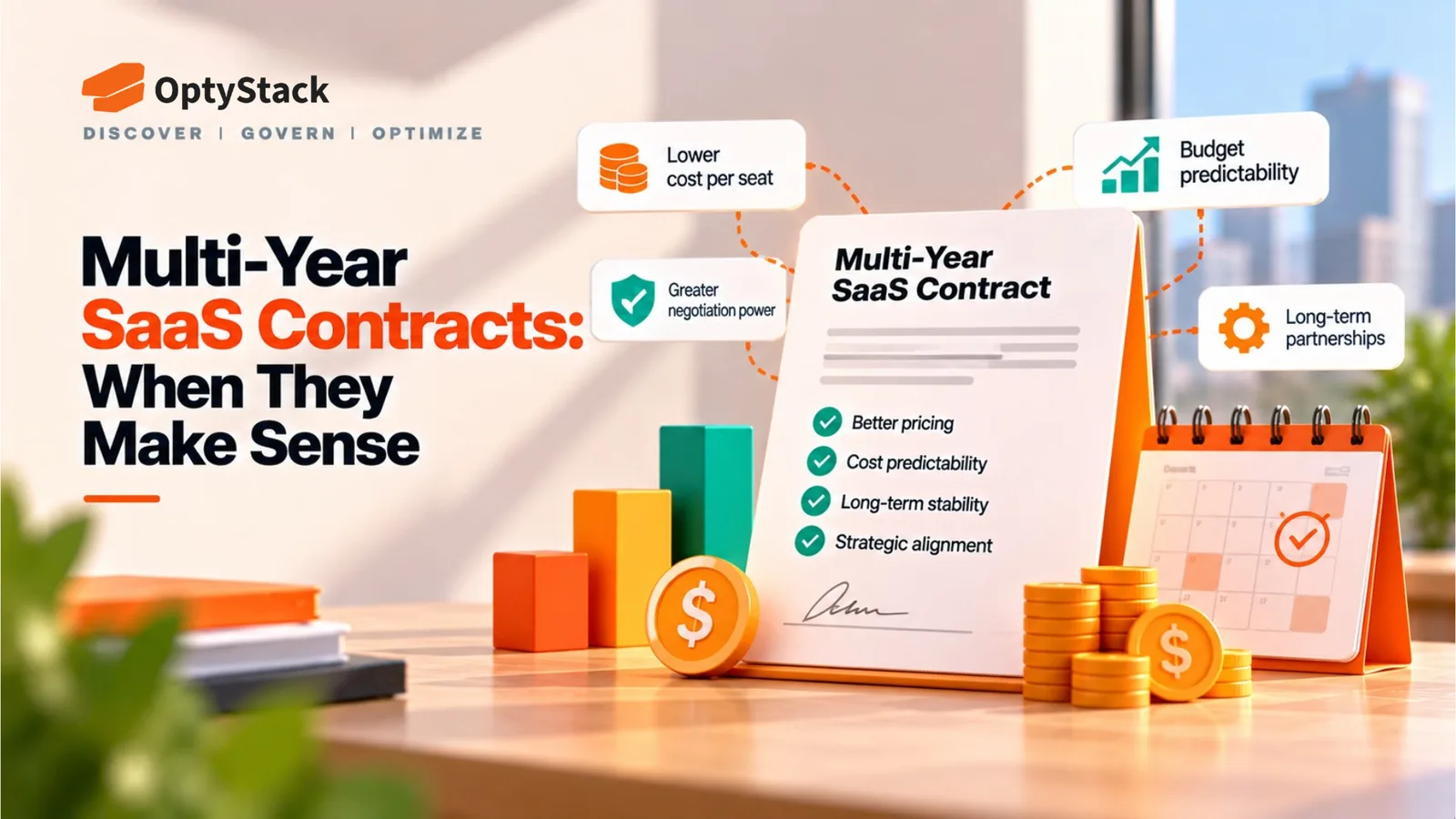
Multi-year SaaS contracts can reduce subscription costs, but rigid commitments can make unused licenses expensive. Learn how to compare annual and multi-year deals, model changing demand and negotiate terms that protect your budget.
A vendor offers your company a 12.5% discount if you commit to three years instead of renewing annually. Finance likes the savings. Procurement wants to close the deal. IT expects to keep using the platform.
Then, halfway through year two, the company restructures and needs 25 fewer licenses. The vendor still expects payment for all 100 seats.
This is where an attractive SaaS deal can become expensive. A multi-year contract can reduce subscription rates and improve budget predictability, but it can also lock a company into spending that no longer matches its needs.
The right decision depends on the savings you can secure, how confidently you can forecast demand, and how much flexibility the contract preserves.
What Is a Multi-Year SaaS Contract?
A multi-year SaaS contract commits a customer to a software subscription for longer than one year, commonly two or three years. Depending on the agreement, the customer may pay annually, pay upfront or commit to minimum spending throughout the term.
Vendors may offer discounted rates, price protection or additional services in exchange for that commitment. However, a longer contract does not automatically guarantee fixed pricing or permission to reduce licenses.
The FinOps Foundation's Licensing & SaaS guidance explains that software agreements can permit increases in license quantities while restricting reductions. These terms can leave businesses paying for unused entitlements. The Foundation recommends coordinating procurement, finance and software asset management to evaluate contracts, usage and optimization opportunities.
That makes contract flexibility a financial consideration, not merely a legal detail.
When Multi-Year SaaS Contracts Make Sense
1. The software is essential to operations
A longer commitment is easier to justify when a platform supports important business processes and replacing it would involve significant migration, integration or training costs.
An established CRM or financial management system may be a reasonable candidate if it meets current requirements, performs reliably and fits the company's technology roadmap.
By contrast, a recently adopted AI tool or a platform being evaluated against alternatives may warrant a shorter commitment. A discount has limited value if the company later needs to replace the product.
2. The discount creates measurable savings
Compare the full cost of annual renewal with the multi-year proposal. Include license fees, implementation, support, add-ons, minimum commitments and permitted price increases.
Consider this hypothetical offer for 100 users:
Contract option | Annual cost | Three-year total |
|---|---|---|
Annual contract at $120 per seat | $12,000 | $36,000 |
Three-year contract at $105 per seat | $10,500 | $31,500 |
The multi-year option saves $4,500 over three years, a 12.5% reduction against the assumed annual-contract price.
These are nominal totals: they add payments without discounting future cash flows. A formal financial comparison may also calculate present value using the company's discount rate, payment timing and any upfront payment requirements.
The discount is only one part of the calculation. Buyers also need to establish whether they can reduce quantities if demand changes.
3. Demand is predictable enough to support the commitment
A company with stable headcount, consistent usage and a clear long-term need can forecast its license requirements more confidently.
A business planning an acquisition, restructuring or major technology change faces greater uncertainty. It may need to reduce seats, move to another product or change subscription tiers before the contract ends.
The FinOps Foundation's guidance on applying FinOps to SaaS recommends using timely usage data and forecasting to inform purchasing and negotiation. It also notes that reducing license quantities during a contract may be prohibited or incur financial penalties.
Before committing, estimate demand across the entire term and negotiate adjustments where uncertainty is material.
When a Multi-Year Contract Becomes Expensive
Return to the 100-seat example. Suppose the company needs only 75 seats from year two onward.
The comparison below assumes the annual agreement allows seat reductions at each renewal, while the rigid multi-year agreement requires payment for all 100 seats. Actual results depend on the contract terms.
Three-year scenario | Total cost |
|---|---|
Annual contract: 100 seats in year one, 75 in years two and three | $30,000 |
Multi-year contract: 100 seats locked for all three years | $31,500 |
Multi-year contract with 75 seats allowed from year two | $26,250 |
Despite its lower per-seat price, the rigid multi-year contract costs $1,500 more than the flexible annual option. If the vendor permits the company to reduce its commitment to 75 seats, the discounted multi-year option instead costs $26,250.
These are illustrative nominal totals, not discounted present values. They assume constant prices and exclude implementation costs, taxes and other fees. The example also assumes the discounted rate remains available after the seat reduction.
The result demonstrates why seat-reduction rights can matter more than an additional percentage point of discount. A company should understand its contractual minimum before comparing headline prices.
Annual vs. Multi-Year SaaS Contracts
Consideration | Annual contract | Multi-year contract |
|---|---|---|
Initial commitment | Lower | Higher |
Discount potential | May be smaller | May be greater |
Price predictability | Depends on renewal terms | Stronger if prices are protected |
Opportunity to reassess | Usually at annual renewal | Depends on adjustment and exit clauses |
Unused-seat exposure | Potentially lower | Potentially higher |
Best fit | Changing needs or uncertain demand | Stable needs and favorable terms |
Neither option is automatically better. An annual contract can include steep renewal increases, while a multi-year deal may offer stable prices and valuable flexibility. Compare the actual contractual terms rather than relying on contract length alone.
A Practical Rule for Evaluating the Deal
Use a commitment-adjusted cost estimate to compare the options:
Commitment-adjusted cost = contracted spend + expected cost of unused capacity + expected exit or switching costs.
Treat each component as an estimate, not a guaranteed future expense. Compare equivalent products over the same period, and include transition costs in both alternatives where applicable. Avoid counting costs twice if they are already included in the contracted spend.
Before signing, ask:
How many licenses will we realistically need each year?
What happens financially if demand falls by 10%, 20% or 25%?
Can we reduce seats, change tiers or reallocate committed spending?
Are price increases and usage charges clearly defined?
What would it cost to exit or replace the product?
Unused capacity should be assessed in context. Some applications are used infrequently but remain essential for audits, reporting or specialist projects. The relevant cost is the capacity the company pays for but cannot reasonably justify—not simply every license with low recent activity.
What to Negotiate Before Signing
Gartner's report, 4 Vendor Management Actions for SaaS Engagements, identifies contract management, performance, relationships and risk as important parts of effective SaaS vendor management. Applying that approach means evaluating the full agreement rather than focusing exclusively on the initial discount.
Price protection: Specify prices by year and cap permitted increases. Clarify how add-ons, additional seats and usage-based charges are treated.
Seat flexibility: Negotiate scheduled opportunities to reduce quantities, change tiers or adjust commitments. Confirm minimums, true-up charges and whether reductions are permitted at all.
Renewal terms: Record the end date, auto-renewal conditions and notice deadline. Start the review early enough to compare alternatives before the cancellation window closes.
Termination and transition: Define appropriate rights if the vendor materially breaches the agreement or discontinues a critical service. Confirm data-export formats, access after termination and migration support.
Service commitments: Document uptime, support obligations and remedies for material failures. Ensure agreed protections apply throughout the term.
Have legal counsel review significant commitments, particularly where termination restrictions, sensitive data or substantial financial exposure are involved. Ensure negotiated concessions appear in the signed agreement rather than relying on informal sales assurances.
Manage SaaS Contracts Before Renewal
A multi-year decision starts with a clear view of what the company owns, what it uses and when its commitments can be changed. That information is difficult to assemble when contracts are scattered across departments or renewal dates are tracked manually.
The free OptyStack SaaS Audit Toolkit includes a SaaS inventory, a 25-point checklist, a renewal calendar and an audit summary. Use it to identify contracts, assign owners, organize renewal dates, review spending and prioritize commitments that deserve closer examination.
For ongoing contract oversight, OptyStack's SaaS contract renewal tracking helps teams organize renewal dates, notice windows and uplift clauses alongside usage information. This can support better-informed renewal decisions, although the actual ability to reduce seats or exit a contract still depends on the vendor agreement.
A multi-year contract is worth accepting when the discounted price, expected demand and contractual protections work together. Before signing, test what happens if your business changes. The strongest deal is the one that remains financially sensible when your original forecast no longer holds.
Frequently Asked Questions
Are multi-year SaaS contracts always cheaper?
No. Discounts can reduce subscription rates, but unused licenses, minimum commitments, additional charges and exit restrictions can offset the savings. Compare total costs across equivalent scenarios.
What is the biggest risk of a multi-year SaaS contract?
Being committed to spending that no longer matches business requirements. Seat-reduction restrictions and limited termination rights can make that problem more expensive.
When should a company negotiate a multi-year contract?
Before signing, while there is still an opportunity to compare alternatives and negotiate terms. Review actual usage, forecast demand and renewal conditions before accepting the proposal.