SaaS Pricing in the AI Agent Era: Per-Seat vs. Usage-Based vs. Outcome-Based Models
Raunak Verma · October 27, 2026
AI agents are changing how software vendors charge customers. Compare per-seat, usage-based, and outcome-based pricing models, and learn how IT and finance teams can evaluate contracts, forecast costs, and avoid unexpected charges.
AI agents are changing how businesses use software. Instead of simply providing tools for employees, applications can now perform tasks, process information, interact with other systems, and execute workflows with varying levels of autonomy.
This shift also changes how software should be priced. Traditional per-seat subscriptions may not reflect how much work an AI agent performs, while usage-based pricing can introduce unpredictable costs.
According to G2's 2026 AI Agents Insight Report, 46% of surveyed AI agent buyers reported higher-than-expected operating costs. For IT, procurement, and finance teams, understanding the pricing model is becoming essential before purchasing or renewing an AI-powered SaaS product.
Why Traditional Per-Seat Pricing May Not Work for AI Agents
Per-seat pricing charges businesses according to the number of users who can access a product. It is familiar, relatively easy to budget for, and works well when software value grows with employee adoption.
AI agents complicate this model because the amount of work performed is not necessarily tied to the number of human users. One agent might process hundreds of requests, while another handles only a few tasks.
As a result, a fixed per-seat fee may not reflect actual consumption or business value. Vendors may introduce usage limits, additional credits, or premium tiers to account for heavier workloads.
The challenge for buyers is finding a pricing model that makes costs transparent without paying for unnecessary capacity or exposing the business to unpredictable bills.
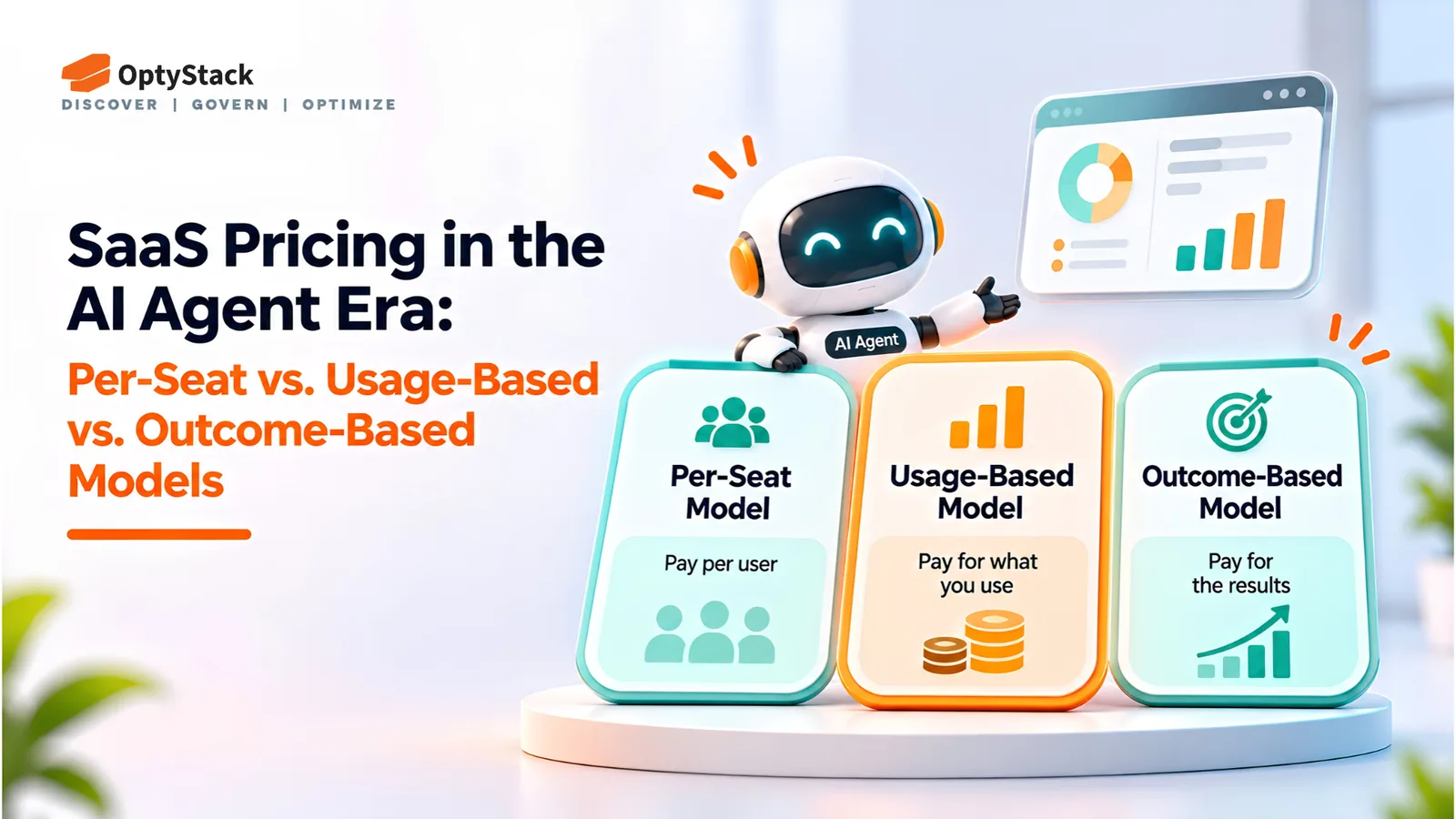
Three AI Agent SaaS Pricing Models Compared
The main pricing models differ in what triggers a charge and how easily businesses can forecast expenditure.
Pricing model | What triggers the cost? | Main advantage | Main risk |
|---|---|---|---|
Per-seat | Number of licensed users | Predictable subscription costs | Poor fit for variable workloads |
Usage-based | Consumption, tasks, or API calls | Cost follows usage | Unexpected charges |
Outcome-based | Defined results or completed outcomes | Links payment to value | Disputes over results and measurement |
1. Per-Seat Pricing
Under per-seat pricing, a company pays for each licensed user, usually monthly or annually. AI capabilities may be included in the subscription or sold through higher-priced tiers.
This model suits applications where employees regularly interact with the software and adoption is a reasonable measure of value. It also simplifies budgeting because costs can be estimated from the number of licenses.
However, businesses should check whether agent functionality is included, whether automated activity consumes additional credits, and whether new licensing rules apply as usage grows.
2. Usage-Based Pricing
Usage-based pricing charges customers according to consumption. Depending on the product, billing units might include AI tokens, API calls, processed documents, completed tasks, or usage credits.
This approach can work well when workloads vary significantly. Businesses pay according to measured consumption rather than solely according to the number of licensed users.
The trade-off is budget uncertainty. Complex tasks may consume more resources than expected, and growing adoption can increase costs quickly. Usage dashboards, alerts, spending limits, and clearly defined overage rates help reduce this risk.
3. Outcome-Based Pricing
Outcome-based pricing ties charges to an agreed result, such as resolving a support ticket, processing a transaction, or qualifying a sales lead.
Its appeal is straightforward: businesses pay for a defined result rather than simply for access or activity. However, the model works only when outcomes can be measured consistently and attributed fairly to the agent.
Contracts should define what counts as a successful outcome, how failed attempts are handled, and what happens when human intervention is required. Without these definitions, disagreements over billing can undermine the model's benefits.
Hidden Costs Businesses Should Watch For
The advertised subscription price does not always represent the full cost of operating an AI agent. Before committing to a vendor, examine these potential expenses:
Token and credit consumption: Complex prompts, repeated attempts, and lengthy workflows may increase usage.
API and integration charges: Connecting the agent to other systems may introduce additional fees.
Overage charges: Exceeding included usage limits can trigger unexpected billing.
Premium features: Advanced models, higher processing limits, or additional security controls may require upgrades.
Human oversight: Employees may need to review outputs, resolve exceptions, and correct errors.
The last point matters because the cost of an AI agent includes more than its subscription. G2's 2026 research highlights oversight and rework as factors that can reduce the productivity gains businesses expect.
How to Evaluate an AI Agent Vendor's Pricing
Before signing or renewing a contract, IT, procurement, and finance teams should ask:
What exactly triggers a charge: a user, token, task, action, or successful outcome?
What usage is included in the base subscription?
What are the overage rates, spending limits, and billing thresholds?
Can the vendor provide historical usage data and cost forecasts?
Can pricing or billing units change during the contract term?
How are failed tasks, retries, and human escalations billed?
Can usage and billing data be exported for financial reporting?
Ask the vendor to model costs under low-, expected-, and high-usage scenarios. This helps reveal whether a seemingly affordable plan remains economical as adoption increases.
A Practical Framework for Choosing the Right Model
There is no universally best pricing structure. The right choice depends on workload patterns, business value, and budget requirements.
Start by estimating usage. Identify the workflows the agent will handle, expected task volumes, and likely growth.
Compare total costs. Include subscription fees, consumption charges, integrations, implementation, and human oversight.
Test different scenarios. Estimate expenditure if usage doubles or tasks become more complex. Confirm that spending controls are available.
Review the contract. Check renewal dates, price-change clauses, minimum commitments, and termination terms.
Monitor actual performance. Compare real costs with expected savings, time reductions, or completed outcomes. Reassess the pricing model at renewal.
AI Agent Pricing Checklist for IT and Finance Teams
Before approving a purchase, confirm that you can:
Identify the exact billing unit.
Verify included usage and overage rates.
Forecast costs at different adoption levels.
Set usage alerts or spending limits where available.
Review renewal terms and price-change clauses.
Measure actual costs against business value.
Conclusion: Make AI Agent Costs Predictable
AI agents are creating new ways to price software, but flexibility alone does not guarantee savings. Per-seat pricing offers predictability, usage-based pricing links costs to consumption, and outcome-based pricing ties payment to defined results.
The right decision depends on how accurately each model reflects the work performed, the value delivered, and the costs incurred.
For businesses managing multiple SaaS applications, understanding AI agent pricing is only the first step. Teams also need visibility into software usage, licensing, and upcoming renewals to identify unnecessary spending and make informed purchasing decisions. OptyStack helps businesses improve SaaS visibility, optimize software licenses, and manage renewals more effectively, giving IT and finance teams greater control over their software investments as AI adoption grows. Explore OptyStack's SaaS management solutions to bring greater visibility and control to your SaaS environment.