How to Negotiate SaaS Contracts Like a Pro
Aryan Malik · September 1, 2026
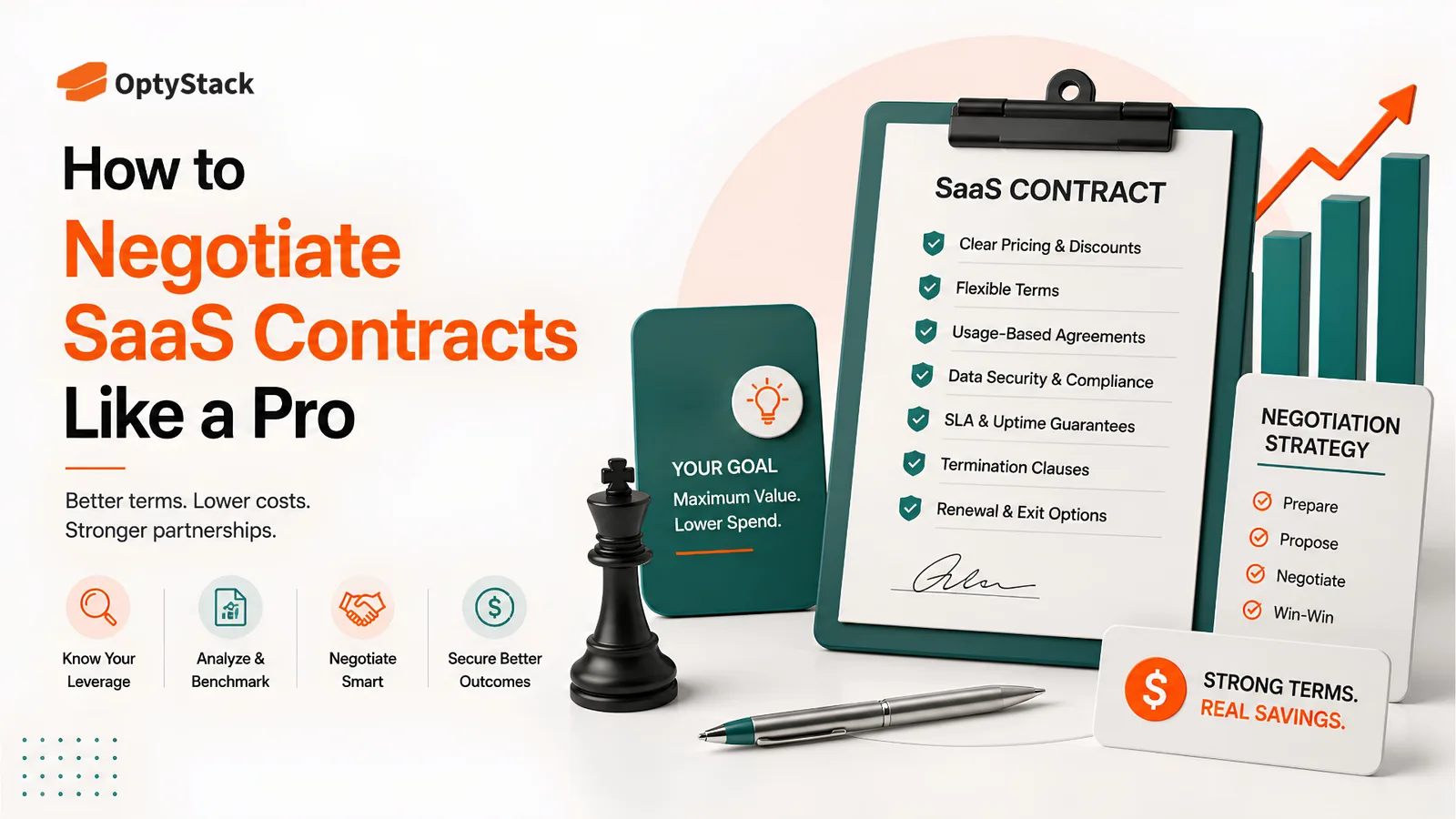
Most companies accept a SaaS vendor's first quote, while the ones who push back with real preparation often pay meaningfully less for the same product. Here's how to negotiate SaaS contracts with real leverage, from timing your approach to negotiating terms beyond just the price.
Most companies pay whatever a SaaS vendor first quotes, and most vendors build in room to negotiate precisely because they expect that. List prices function as a starting point, not a fixed number, and the gap between what's quoted and what a company that actually pushes back ends up paying can be substantial.
The problem isn't that negotiation doesn't work. It's that most teams walk into it without the preparation, timing, or leverage that actually moves a vendor. Here's what separates a routine renewal from a negotiation that gets real results.
Start earlier than feels necessary
Begin the process 90 to 120 days before renewal, not the week before. A vendor negotiating with a customer who has no runway left knows exactly how little leverage that customer has. A vendor negotiating with a customer who started early, has usage data in hand, and has genuinely evaluated alternatives is negotiating with someone who could actually walk.
Mark every contract's notice deadline months in advance, not just the renewal date. Most enterprise agreements require formal notice before a cancellation or renegotiation takes effect, often 30 to 90 days out. Missing that window typically means the contract renews automatically at whatever terms the vendor sets, regardless of how the conversation might have gone otherwise.
Time the final conversation near the vendor's fiscal quarter-end where possible. Sales representatives typically have the most discretion to approve discounts in the final days of a sales quarter, when hitting quota matters more than holding the line on price. This is one of the more reliable, low-effort timing levers available, and it costs nothing to simply ask when a vendor's fiscal quarter ends.
Build real leverage before the conversation starts
Know your own usage data before you negotiate anything. A team asking for a discount without knowing whether it's actually using its purchased seats is negotiating blind. Utilization data, active users versus assigned licenses, feature usage, login frequency, is the foundation every other argument in the room gets built on.
Get a genuine competing quote, even for a tool you plan to keep. A credible alternative changes the entire conversation, even if you have no real intention of switching. Vendors respond very differently to a customer who's clearly done the homework than one who's simply asking for a favor.
Understand what similar companies typically pay for comparable tools, where that information is available. Pricing benchmarks, even rough ones, give a concrete reference point instead of negotiating against a number with no context behind it.
Negotiate more than just the price
Look past the sticker price to the terms that carry real financial weight. Payment terms, extended net terms or annual versus quarterly billing, contract length, renewal price caps that limit future increases, and termination rights can each be worth more over the life of a contract than a one-time discount.
Push for a capped annual escalation clause explicitly. A renewal that increases by an uncapped percentage every year compounds quietly over time. Negotiating a fixed cap, or tying any increase to a published index, protects against that compounding before it becomes a problem.
Ask for a multi-year price lock in exchange for a longer commitment, if the tool is one you're confident you'll keep. Vendors frequently offer meaningfully better pricing for a longer commitment, since it reduces their own churn risk. This only makes sense for tools with genuinely stable, ongoing value, not ones still being evaluated.
Consider offering something other than money in return for better terms. A willingness to serve as a reference customer, participate in a case study, or provide a public testimonial has real value to a vendor, particularly a smaller or growing one that needs social proof. It's a lever plenty of buyers overlook simply because they never think to offer it.
Approach the actual conversation the right way
Lead with the relationship and the value exchange, not a list of demands. A negotiation framed as "here's why this partnership is worth continuing on better terms" tends to land differently than one that opens with an ultimatum, even when the underlying ask is the same.
Bring every requested change to the table at once, not across multiple rounds. A single, consolidated set of asks, covering both commercial terms and any legal redlines, is easier for a vendor to evaluate and respond to than a drawn-out back-and-forth that stretches the timeline and erodes goodwill on both sides.
Get every agreed change written into the final contract, not left as a verbal understanding. A discount or term change discussed on a call means nothing if it doesn't appear in the signed agreement. Confirm every negotiated point is reflected in the actual paperwork before signing.
Don't negotiate every contract the same way
Not every renewal deserves the same level of effort. A low-cost tool with minimal risk exposure doesn't need the same multi-round negotiation as a five- or six-figure enterprise agreement. Reserve the heaviest preparation for the contracts where the dollar value or the risk actually justifies it.
Capture what worked after each negotiation, and reuse it. A team that treats every renewal as a one-off starts from zero every time. A team that keeps a record of successful tactics, timing, and outcomes gets faster and more effective at this with every contract it works through.
Where OptyStack fits
Knowing your usage data, tracking every notice deadline, and preparing a genuine negotiating position for dozens of contracts a year is realistic for a handful of tools. It gets significantly harder once a company's SaaS estate grows past a few dozen applications, which is where most companies actually sit.
OptyStack keeps usage data, contract terms, and renewal dates in one place, so the preparation this playbook depends on, knowing what's actually being used, what's coming up for renewal, and when the notice window closes, is available well before a negotiation needs to happen.
It's free to start and doesn't require a credit card.
Walk into your next renewal prepared. Start free with OptyStack.