How to Consolidate Overlapping SaaS Tools Without Hurting Productivity
OptyStack Team · March 24, 2026

Use OptyStack to identify overlapping tools, compare adoption, and plan consolidation work that reduces cost without disrupting teams.
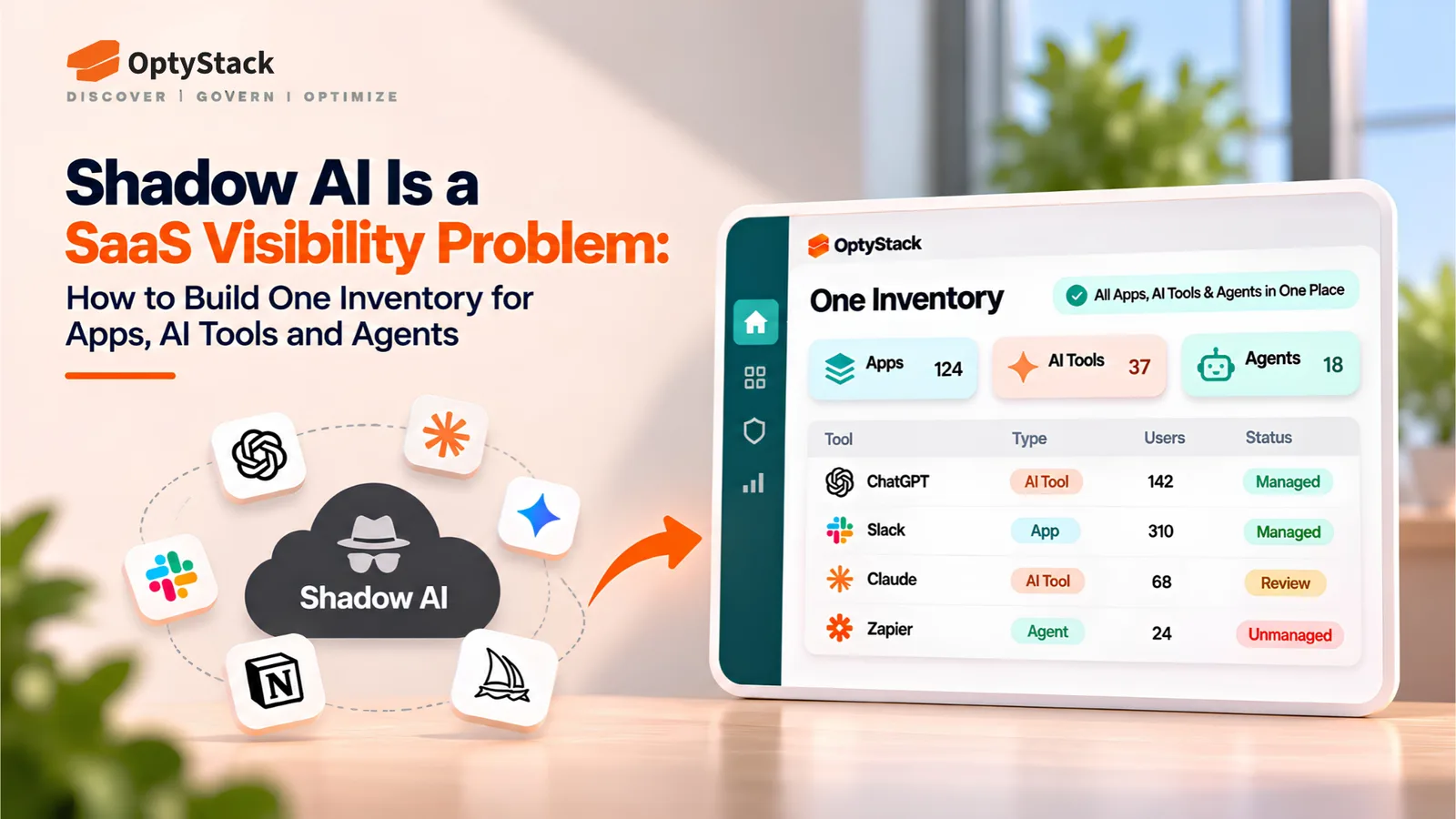
Software portfolios tend to expand faster than they simplify. New tools are added to solve local problems, but old tools rarely disappear at the same speed. Over time, organizations end up paying for several products that do similar work across messaging, project management, analytics, design, AI assistance, and customer collaboration.
OptyStack helps teams approach consolidation with evidence rather than guesswork. By combining discovery, spend visibility, usage insight, and category context, the platform makes it easier to see where overlap exists and which consolidation paths are most likely to reduce cost without damaging adoption or workflow quality.
Why overlapping tools are so common
Overlap is usually a side effect of growth. One team may buy a specialized solution before a company standard emerges, while another team adopts a broader platform later. In other cases, legacy tools remain active because no one owns the migration work required to fully retire them.
This creates more than just direct cost. It also fragments data, creates inconsistent user experiences, increases admin overhead, and weakens bargaining power with vendors. Each category with multiple competing tools adds complexity that compounds over time.
- Different teams optimize locally without a shared portfolio view.
- Legacy tools remain after new platforms are introduced.
- Retirement work is often harder to prioritize than purchase decisions.
What evidence should drive a consolidation decision
Consolidation should never be based on brand preference alone. Teams need to evaluate actual usage, feature fit, migration effort, cost, and organizational impact. OptyStack supports that analysis by showing which tools are active, how broadly they are used, how they contribute to spend, and where duplication is most likely.
The goal is to identify categories where a smaller number of platforms can meet the same business need with less cost and less operational complexity. Sometimes the answer is full replacement. Sometimes it is limiting one tool to a very specific niche use case while standardizing the rest of the company elsewhere.
- Breadth and depth of usage by team.
- Cost profile, including seat counts and plan mix.
- Functional overlap with approved or preferred platforms.
- Migration effort and stakeholder resistance.
How OptyStack helps find the best consolidation candidates
Because OptyStack organizes spend by app and category, teams can quickly spot areas where multiple tools are solving similar problems. Pairing that with usage-versus-license data gives a much better view of which platforms are genuinely important and which ones are underused or lightly adopted.
This reduces the risk of targeting the wrong vendor. Instead of treating the largest contract as the default consolidation target, leaders can compare actual portfolio efficiency and identify where the ratio of cost to value looks weakest.
- Highlights duplicate categories and overlapping spend.
- Shows where one platform has stronger adoption than another.
- Supports prioritization based on savings potential and migration practicality.
A low-friction consolidation workflow
Successful consolidation usually happens in phases. Start with the categories where usage is fragmented and where one tool already appears to be emerging as the primary standard. Then validate exceptions before making changes. This approach preserves trust because teams can see that decisions are grounded in evidence and business need, not just top-down cost pressure.
OptyStack helps structure those conversations by giving teams a common data set. Finance can discuss spend impact, IT can discuss supportability and governance, and department leaders can discuss workflow fit using the same baseline information.
- Identify categories with clear overlap and measurable cost impact.
- Compare adoption, feature requirements, and exception cases.
- Choose a preferred platform and define the scope of standardization.
- Plan migration and retirement steps around renewal windows where possible.
- Track realized savings and residual overlap after each consolidation wave.
Protecting productivity while reducing the stack
Consolidation fails when it ignores user reality. If a selected platform does not support a critical workflow, teams will recreate overlap through workarounds or shadow IT. The solution is to combine financial analysis with practical rollout planning, not to optimize for cost alone.
OptyStack makes this easier because it frames consolidation as a portfolio decision rather than a blunt budget cut. Leaders can act where redundancy is clear, retain exceptions where they are justified, and revisit edge cases later as usage patterns evolve.
- Validate key workflows before forcing platform changes.
- Use renewal timing to minimize contractual friction.
- Communicate the business rationale with clear data and ownership.
- Track whether the standard platform actually gains sustained adoption.
Final takeaway
Tool consolidation is one of the most powerful ways to improve SaaS efficiency because it reduces direct spend, administrative complexity, and portfolio fragmentation at the same time.
With OptyStack, organizations can identify the right consolidation candidates, build stakeholder alignment, and execute with less disruption to the teams that depend on the software every day.