SaaS Discount Benchmarks: How to Negotiate When Every Vendor Claims “Best Price”
Aisha Rahman · April 18, 2026

Benchmark reports and peer anecdotes help—but only if you understand list price games, multi-year trade-offs, and usage cliffs. Learn a structured approach to offers, counters, and walk-away criteria grounded in your own telemetry.
Renewal season arrives and your inbox fills with spreadsheets comparing your quoted discount to anonymous “market averages.” Vendors counter with claims of unprecedented flexibility while anchoring against inflated list prices nobody pays. Meanwhile, internal stakeholders fear downtime if negotiations slip. The result is often a modest percentage improvement that feels like victory but leaves material value on the table. Better outcomes come from combining external benchmarks with internal usage truth and a disciplined negotiation sequence that treats price, term, and risk as a bundle—not a single headline discount.
Decompose the offer
Separate platform fees, per-seat licenses, consumption tiers, premium support, and professional services. Vendors frequently discount one line while inflating another. Build a total cost of ownership model across three years including expected growth bands. A lower discount on seats may still win if overage rates and API pricing are fairer. Ask explicitly which components are commissionable; sales reps optimize what they are measured on.
Understand list-price mechanics. Some vendors publish list solely to make discounts appear deep. Request historical quotes from prior renewals and compare unit economics per active user, not percentage off an abstract list. Your own year-over-year trend is more informative than a generic benchmark report.
Bring internal telemetry to the table
Usage data changes leverage. If half your seats are inactive, your opening position is rightsizing, not incremental discount on the same count. If engineering relies on a narrow API surface, negotiate caps and burst policies instead of blanket enterprise tiers. When you can show credible alternatives—including doing nothing for a quarter—you signal that price concessions must be earned.
Document functional requirements from product and support teams before talks begin. Nothing weakens procurement faster than contradictory messages from internal champions who privately promise vendors expansions regardless of price.
Multi-year and commitment trade-offs
Longer terms can unlock meaningful discounts but reduce flexibility during technology shifts. Model break fees and partial termination rights. For fast-moving categories, prefer shorter terms with renewal price caps tied to objective indices instead of locking into five years of obsolete bundles.
- True-ups — Clarify measurement windows and dispute resolution before signing.
- Price protection — Ask for most-favored-customer clauses where realistic; verify audit rights.
- SLAs — Financial credits matter only if incidents are defined precisely; pair with exit triggers.
Psychology and process
Timebox negotiations and escalate on schedule. Silence is sometimes leverage; panic is never. Keep a written decision log so leadership understands trade-offs when deadlines approach. Involve legal early on liability caps and data processing terms to avoid collapsing commercial discussions over late redlines.
Competitive alternatives and bake-offs
Even when you prefer incumbent renewal, structured evaluations keep vendors honest. Run lightweight proofs of concept on export portability, API rate limits, and support responsiveness. Document gaps that would block migration if pricing diverges. Incumbents discount more when they believe switching costs are finite—not infinite loyalty.
Involve practitioners who live in the tool daily; executive relationships matter, but floor truth prevents buying features nobody uses. Capture qualitative feedback alongside quantitative scorecards so decisions remain defensible if leadership changes mid-cycle.
Renewal operations discipline
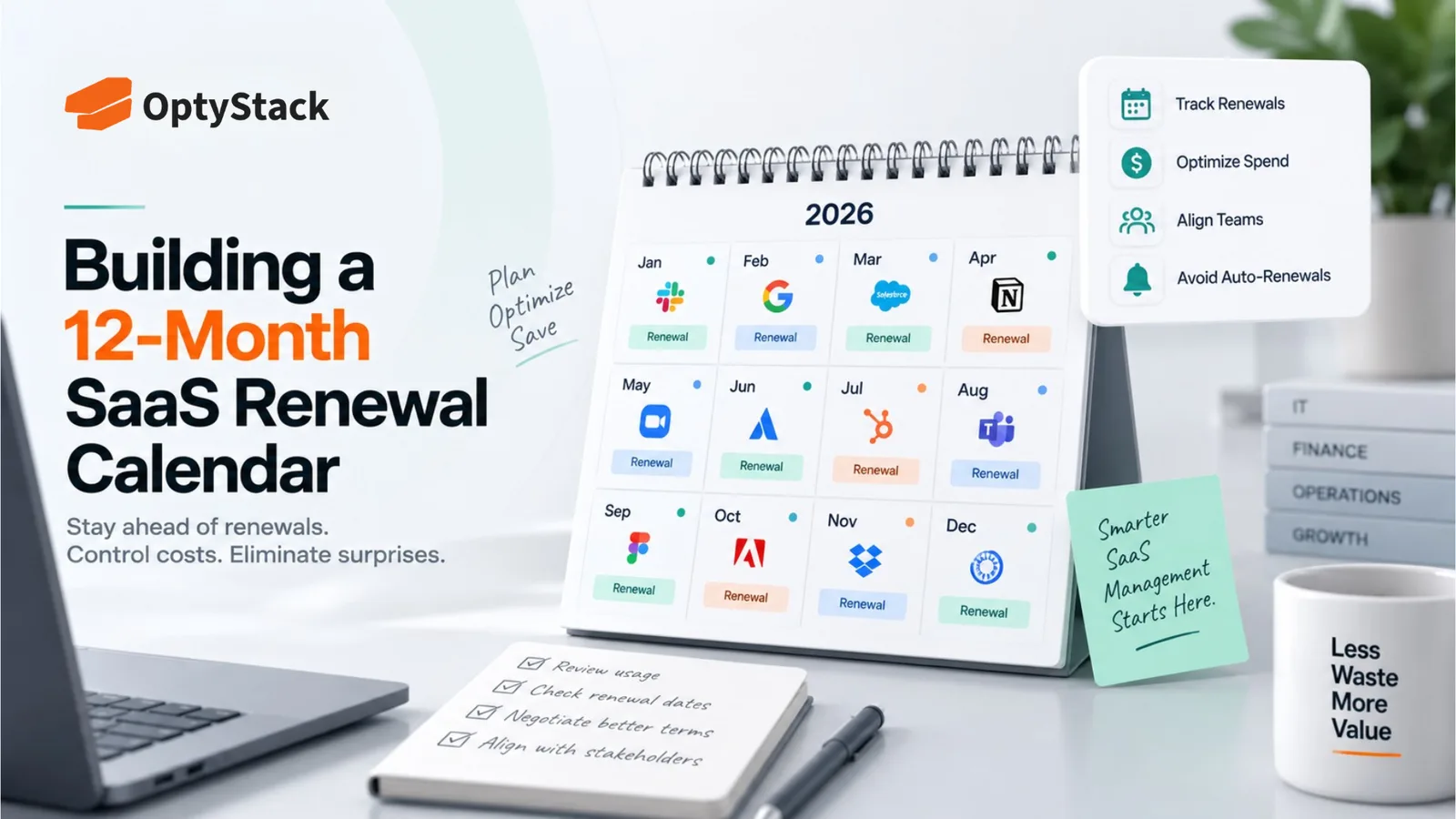
Create a renewal calendar with owners ninety days before option dates. Missing notice windows destroys leverage instantly. Pair calendar discipline with scenario models: flat headcount, aggressive growth, and contraction—each should have a pre-approved fallback position so negotiators are not inventing strategy on the final day.
OptyStack helps organizations ground negotiations in discovered adoption and integration breadth—facts that replace opinion when executives ask whether a vendor is truly strategic or merely sticky. Data will not replace relationships, but it keeps relationships honest.
After the signature
Capture lessons learned: which tactic moved price, which ask was pointless, and whether forecasted usage matched reality. Feed that back into playbooks for the next category renewal. Mature procurement teams improve every cycle; immature teams repeat the same theatrical discount dance.
Benchmarks are inputs, not oracles. The strongest position combines market knowledge with a clear view of how software is actually used inside your walls—then negotiates accordingly.
Category strategies beyond price
Some categories commoditize quickly—negotiate portability and exit terms as aggressively as unit price. Others consolidate into suites where switching costs rise; negotiate modular add-ons so you are not forced into bundles employees reject. Understanding category dynamics prevents copying last year’s playbook into a market that shifted.
Involve engineering architects when vendors promise roadmap features that drive renewals. Get written milestones or credits if delivery slips; goodwill fades when deadlines miss twice.
Ethics and long-term partnerships
Aggressive negotiation should not cross into misrepresentation. Accurate usage data and candid feedback build partnerships that survive rough renewals. Vendors remember customers who weaponize false churn threats; trust erodes and support quality suffers in ways spreadsheets never capture.
Institutionalizing negotiation excellence
Create a renewal war room template: roles, decision rights, communication protocols with vendors, and documentation standards. War rooms prevent duplicated emails that undermine leverage and ensure single sources of truth for offer versions.
Maintain a clause library for common protections—price caps, audit frequency limits, data portability SLAs—so legal reviews accelerate instead of restarting from blank pages each cycle. Update the library when courts or regulators shift interpretations.
Rotate junior procurement staff through technical shadowing with engineering architects; negotiators who understand architecture ask sharper questions about hidden fees and integration taxes. Cross-training pays dividends in categories like observability and data platforms where pricing is opaque.
Retrospectively score negotiations against outcomes twelve months later: did usage match projections, did support meet SLAs, did roadmap promises land? Feedback loops separate lucky deals from repeatable skill.
Navigating executive pressure and timelines
When leadership demands immediate signature to hit quarterly targets, document the risk acceptance explicitly: deferred security review, skipped benchmark validation, or accepted price uncertainty. Signed risk memos prevent retroactive blame and clarify when follow-up work must occur post-signature.
Prepare mini business cases for walking away: cost of migration, operational risk of staying, and opportunity cost of delaying. Executives choose more confidently when alternatives are quantified, not whispered.
Align procurement incentives with total value, not only discount percentage, to avoid perverse outcomes where bad deals look good on paper.
Final perspective
Negotiation is a portfolio skill: decompose offers, ground positions in telemetry, protect legal non-negotiables early, and institutionalize retrospectives so luck does not masquerade as competence. Benchmarks inform; they do not decide. Executive pressure is inevitable—document risk acceptance and quantify walk-away economics so choices are deliberate. Rotate talent through technical shadowing and maintain clause libraries to accelerate reviews. Above all, cultivate vendor trust with honest data; the steepest discounts matter little if support and roadmap partnership erode the quarter after signature.
Build a calendar of category reviews so no vendor surprises you in the same quarter as five peers; sequencing attention preserves quality. Capture institutional memory in a shared repository—past redlines, accepted fallbacks, and escalation paths—so departures do not erase leverage.
When macro conditions tighten, revisit payment terms and ramp schedules before headline price; cash flow flexibility sometimes beats another point of discount.
Involve customer success and support leaders in renewal prep; they hear product pain that procurement decks omit and can validate whether promised roadmap items matter to users.
Keep a “parking lot” list for non-critical asks—training credits, sandbox tenants, beta access—to trade when price stalls without conceding commercially.
Negotiate reference customer obligations carefully; over-promising case studies strains champions and weakens future leverage.