Why Wasted SaaS Licenses are Bankrupting Your IT Budget
Amit Dangi · March 5, 2026
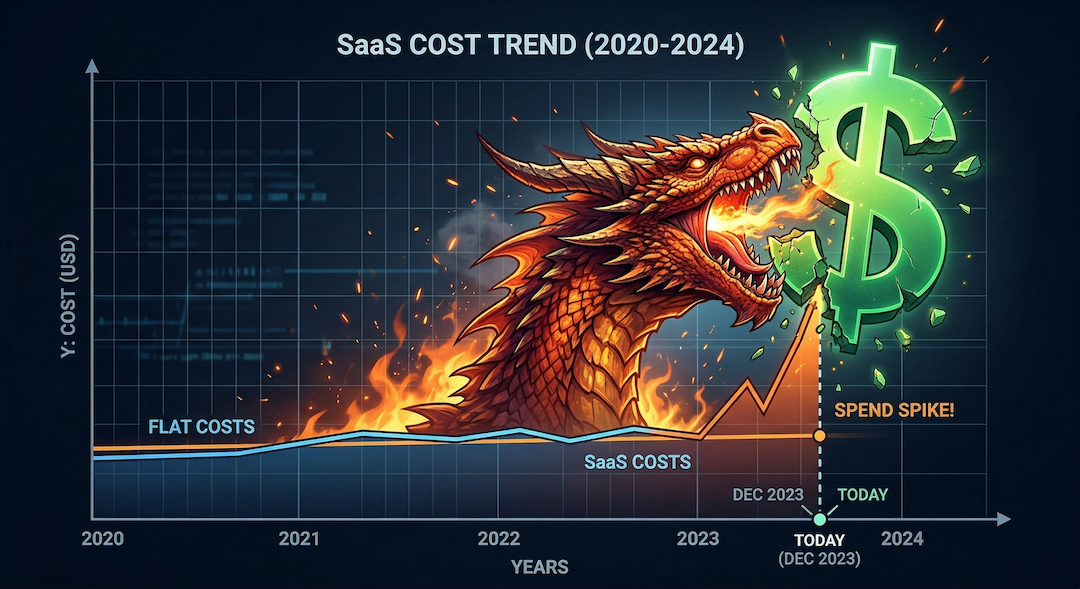
Gartner estimates that up to 30% of software spend is wasted on licenses that are unused, underutilized, or assigned to inactive accounts. If you are not actively managing SaaS license utilization, you are hemorrhaging your IT budget. Learn practical steps to reclaim that wasted spend today.
When IT and Finance leaders are asked to find ways to cut the corporate budget, the first place they often look is the software line item.
In the traditional software era the days of on-premise installations and perpetual licenses "wasted spend" was a relatively simple concept to grasp. You bought 1,000 licenses of a desktop application, but you only had 800 employees. You knew exactly where the waste was, and you adjusted your purchasing order for the next year.
In the modern SaaS era, the problem is far more dynamic, automated, and expensive. The ease of purchasing cloud software has created a sprawling, decentralized ecosystem where licenses are provisioned constantly, but rarely managed continuously.
If you are not actively monitoring the utilization of your SaaS stack, you are almost certainly overpaying. Industry analysts like Gartner estimate that up to 30% of enterprise software spend is wasted. For a mid-market company spending $2 million annually on SaaS, that is $600,000 leaking out of the budget every year.
Wasted SaaS license spend is perhaps the most significant "heavy weight" dragging down your IT budget, precisely because it is completely hidden from view.
Where the Money Goes: The Anatomy of Wasted Spend
To stop the bleeding, you first have to understand how SaaS waste occurs. It rarely happens through one massive, poorly negotiated contract. Instead, it happens through a thousand small, unmanaged cuts.
We categorize this waste into three primary drivers:
1. The Zombie Accounts (Paying for Ghosts) Zombie accounts are the most direct form of wasted spend. These are active, paid licenses assigned to users who are no longer with the company, or who have transferred to a new role where the software is no longer required.
This happens when offboarding processes are manual and decentralized. If HR terminates an employee but forgets to notify the marketing department head who manages the local Hubspot instance, that $150/month license will continue to bill indefinitely. We routinely audit organizations and find they are still paying for dozens of premium licenses for people who left the company years ago.
2. Inactive and Under-utilized Users (The "Just in Case" License) This is the most common form of waste. An employee insists they must have a premium license to a project management tool. IT provisions it. The employee logs in once, views a single project board for 15 minutes, and then never opens the application again.
Alternatively, you are paying for the top-tier "Enterprise" seat for a user who only utilizes the basic, free-tier features. If a user hasn't logged into a platform in 90 days, or is only using 5% of its functionality, you are subsidizing shelfware.
3. Functional Redundancy (The Duplicate Tool Dilemma) When procurement is decentralized and employees can buy what they want, duplication is rampant.
The Marketing team buys Trello.
The Engineering team insists on Jira.
The Sales team prefers Asana.
HR decides they need Monday.com.
You are now paying four different vendors for the exact same capability (project management). Not only are you missing out on the massive volume discounts that come from consolidating onto a single enterprise agreement, but you are also multiplying your training, integration, and security compliance costs by four.
The Solution: Moving from Guesswork to Data-Driven FinOps
You cannot manage this level of dynamic waste with a static spreadsheet or an annual true-up survey. Asking department heads "Do you still need these licenses?" usually results in a blanket "Yes," because no one wants to lose a resource.
You need a data-driven approach. You must move from IT Procurement to IT FinOps.
The solution is implementing a SaaS Management Platform (SMP) that integrates directly with application APIs to pull real-time, granular utilization data.
To reclaim your budget, your system needs to tell you:
Not just who is licensed, but when they last logged in.
Not just how many seats you have, but what specific features those users are engaging with.
Not just what applications you are paying for, but which applications perform the exact same function.
Stop Tipping the Scale. Start Reclaiming.
When you move from guesswork to granular data, IT transforms from a cost center trying to defend its budget into a strategic partner that ensures maximum ROI for every dollar spent.
You can confidently terminate the zombies, downgrade the under-utilizers, and consolidate the redundant tools. You stop paying for shelfware and start funding innovation.